6. Modulation Synthesis#
In this chapter we explore modulation synthesis, a family of techniques for synthesizing richer and more dynamic musical sounds than the methods we have studied so far.
The word modulation here means affecting a property of one signal with another signal. We have already seen this idea twice without naming it: multiplying a tone by an envelope (Chapter 4) modulates its amplitude, and multiplying a signal by a complex sinusoid inside the Fourier transform (Chapter 5) modulates it to measure frequency content. Here in this chapter, “modulation” will refer more specifically to scenarios where both of the signals involved will themselves be oscillating sinusoids.
When we studied additive synthesis (Chapter 3), we saw that richer frequency-domain spectra (Chapter 5) give rise to more interesting musical material. Wavetable synthesis lets us synthesize rich static spectra efficiently. But real musical sounds are not static. Their character changes dynamically over time, and often in a periodic fashion. The examples below each show richer time-varying behaviors, along with a visualization called a “spectrogram” that we’ll learn more about in Chapter 10, which displays how frequency content changes over time.
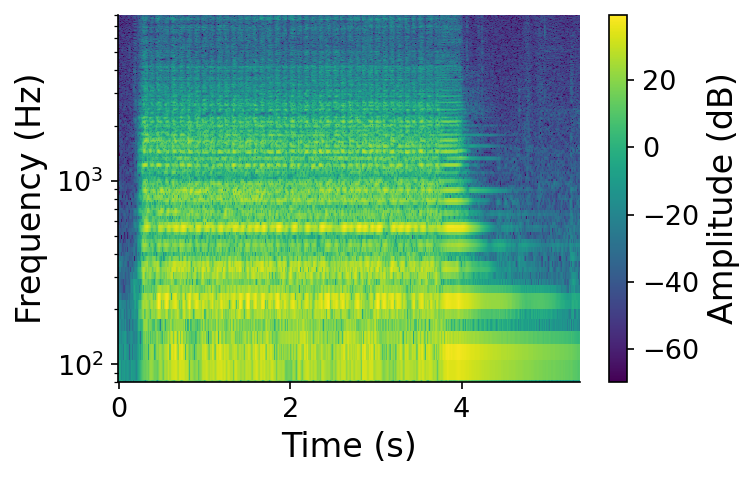
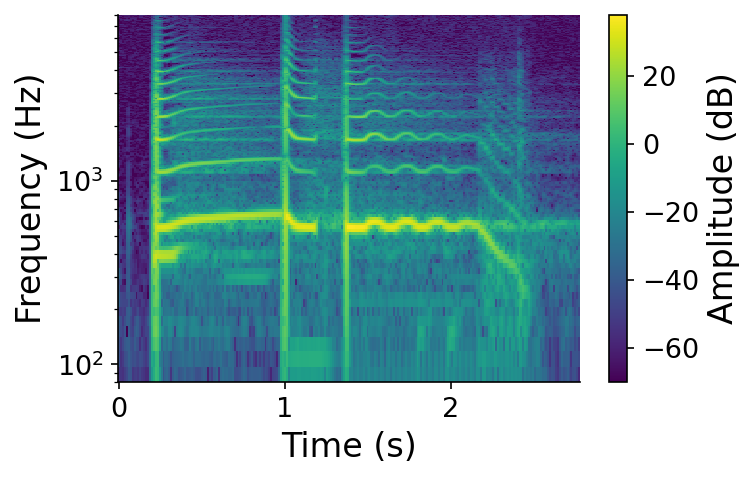
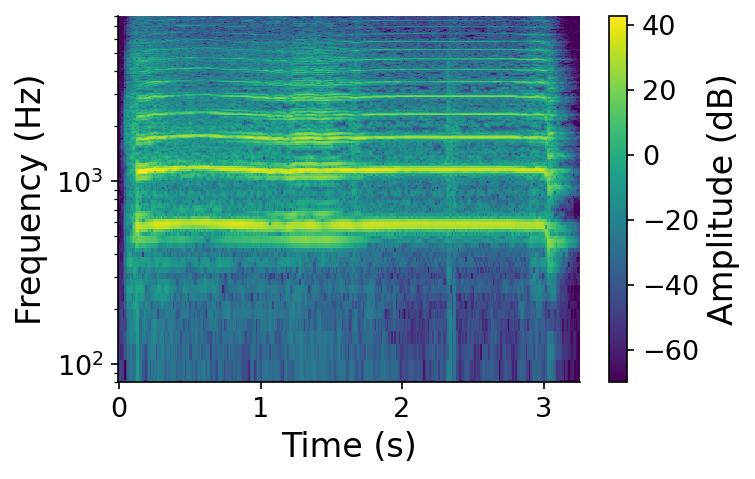
Three real instruments, each changing over time. The cello’s amplitude pulses (tremolo, seen as vertical ripples across the harmonics), the guitar’s pitch wavers (vibrato, seen as wavy harmonic lines), and the trumpet’s harmonic balance shifts continuously. Play each clip and watch its spectrogram. Sources from Freesound: 358372 by MTG (CC BY 3.0), 52080 by guitarguy1985 (CC0), and 636487 by KhalDrogo12 (CC0).
How would we synthesize these kinds of effects? When we studied the frequency domain, we learned that every sound has a unique recipe of frequency information. In principle, then, we could recreate any of these sounds by adding together a large number of sinusoids, each with its own time-varying amplitude. But this would be extraordinarily inefficient, potentially requiring hundreds or thousands of oscillators for a single note. Modulation synthesis allows us to implement these complex dynamics with just a small number of oscillators. We will build up from a simpler case (modulating amplitude) to a more powerful one (modulating frequency).