6.0 Ring modulation#
Let us start by examining tremolo, a musical performance technique that periodically varies the amplitude of a note over time.
The cello tremolo again. Repeated bow motion is used to rapidly modulate the amplitude of the sound while keeping the pitch constant.
How might we synthesize this effect? In Chapter 4 we studied amplitude envelopes, where we multiplied a sustained tone by a piecewise-linear function to shape its loudness. Tremolo is similar, except that the amplitude change is periodic over time rather than a one-shot attack and decay. This suggests an idea: to emulate tremolo, we can “envelope” a periodic sound with a second sinusoid that oscillates much more slowly. Multiplying two sinusoids in this way is called ring modulation.
Definition 17 (Ring modulation)
Given a carrier frequency \(\omega_c\) and a modulating frequency \(\omega_m\), ring modulation is the product of two sinusoids at those frequencies:
When the modulating frequency is low (below roughly 10 Hz), we perceive the result exactly as tremolo: a tone at the carrier frequency whose loudness pulses at the modulating rate. The following figure shows why. The fast carrier is shaped by the slow modulator, so the modulator traces out an amplitude envelope around the carrier:
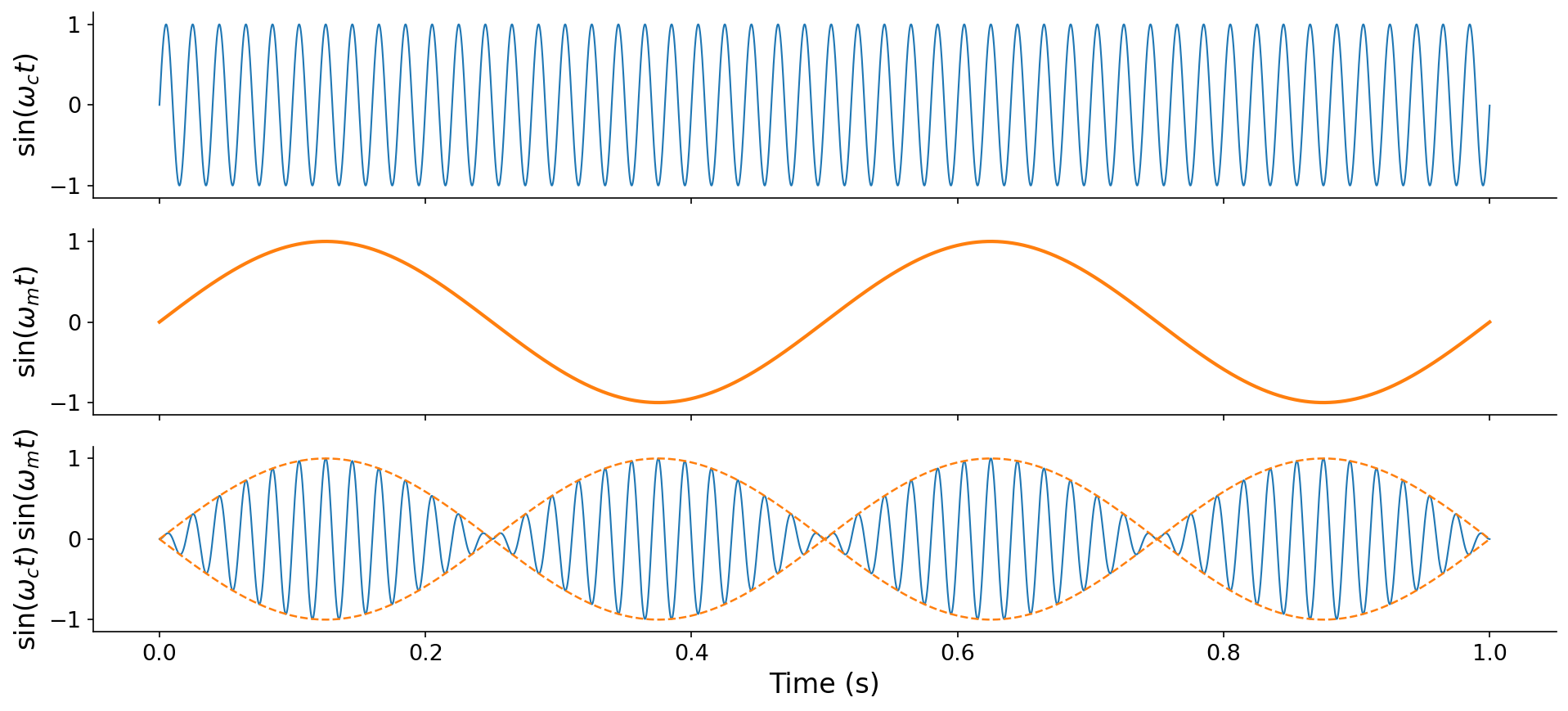
Fig. 22 Ring modulation in the time domain. The fast carrier \(\sin(\omega_c t)\) (top) is multiplied by the slow modulator \(\sin(\omega_m t)\) (middle). In the product (bottom), the modulator acts as an envelope (dashed), pinching the amplitude to zero and swelling it back four times per second (twice per modulator cycle).#
Listen to ring modulation at a few carrier and modulating frequencies. Each is a pure carrier tone with a slow tremolo:
Carrier 220 Hz, modulator 1 Hz
Carrier 220 Hz, modulator 2 Hz
Carrier 330 Hz, modulator 1 Hz
Carrier 330 Hz, modulator 2 Hz
Ring modulation with slow modulators. The carrier sets the pitch, and the modulator sets the tremolo rate.
You may notice that the loudness pulses at twice the modulating frequency. A 1 Hz modulator gives two pulses per second, not one. This is because the envelope is the absolute value \(|\sin(\omega_m t)|\). The amplitude swells to a peak whenever \(\sin(\omega_m t)\) reaches either its positive or its negative extreme, and it dips to silence at each of the modulator’s zero crossings. Since a sinusoid has two extremes per cycle, we hear two swells per modulator cycle.
By replacing the pure carrier sinusoid with a more complex sound, ring modulation becomes a general-purpose audio effect that adds tremolo to any input. The modulator simply multiplies whatever signal we feed in. Here it is applied to a glockenspiel recording with a 1 Hz modulator:
Ring modulation applied to a recorded sound rather than a pure tone. The 1 Hz modulator adds a slow tremolo. 19460 by Tristan, License: CC0 1.0.
Ring modulation is an intuitive way to add tremolo, and its time-domain mechanics are clear. But something more subtle is happening in the frequency domain. To see it, let us listen to what happens next as we steadily increase the modulating frequency.