3.0 Periodicity, period, and frequency#
Periodicity is the foundation of musical sound. Sounds that we recognize as having a definite “pitch” — a plucked guitar string, a sustained vowel, a flute tone — are periodic in nature. Their waveforms repeat, more or less, at a regular rate. Consider what happens when you pluck a guitar string: the string oscillates back and forth, and the resulting air pressure variations create a waveform whose shape recurs over and over:
Classical guitar, F3, plucked without vibrato. 154030 by Carlos_Vaquero, License: Attribution NonCommercial 4.0.

Fig. 2 A plucked guitar string (F3). Top: the pluck and decay over roughly 1.7 seconds. Bottom: zoomed in to about 23 milliseconds, where the quasi-periodic repetition of the waveform shape is clearly visible.#
The waveform in the zoomed view above is not perfectly repetitive. Instead, it’s what acousticians call quasi-periodic, meaning the shape changes slowly over time as the note decays. But over short time scales, the repetition is strikingly regular.
Periodicity#
Here we formalize the notion of periodicity, following notational conventions from [McF23]. A continuous signal \(x(t)\) is periodic with period \(T\) if
The fundamental period \(t_0\) is the smallest strictly positive \(T\) satisfying this condition.
Definition 3 (Periodicity)
A signal \(x(t) : \mathbb{R} \to \mathbb{R}\) is periodic if there exists a finite \(T > 0\) such that \(x(t + T) = x(t)\) for all \(t \in \mathbb{R}\). The fundamental period \(t_0\) is the smallest such \(T\).
If \(t_0\) is the fundamental period, then all integer multiples of \(t_0\) must also be periods:
More generally, \(x(t) = x(t + k \cdot t_0)\) for any \(k \in \mathbb{Z}\).
Frequency#
One full repetition of a periodic waveform is referred to as a cycle. The fundamental period \(t_0\) tells us how long one cycle takes, in units of \(\frac{\text{seconds}}{\text{cycle}}\). Its reciprocal is frequency — how many cycles fit in one second, in units of \(\frac{\text{cycles}}{\text{second}}\):
This relationship follows directly from the units: if \(t_0\) has units \(\frac{\text{seconds}}{\text{cycle}}\), then \(1/t_0\) has units \(\frac{\text{cycles}}{\text{second}}\).
Definition 4 (Fundamental frequency)
The fundamental frequency of a signal \(x(t)\) with fundamental period \(t_0\) is \(f_0 = 1 / t_0\).
Frequency is measured in Hertz (Hz), where 1 Hz = 1 \(\frac{\text{cycle}}{\text{second}}\).
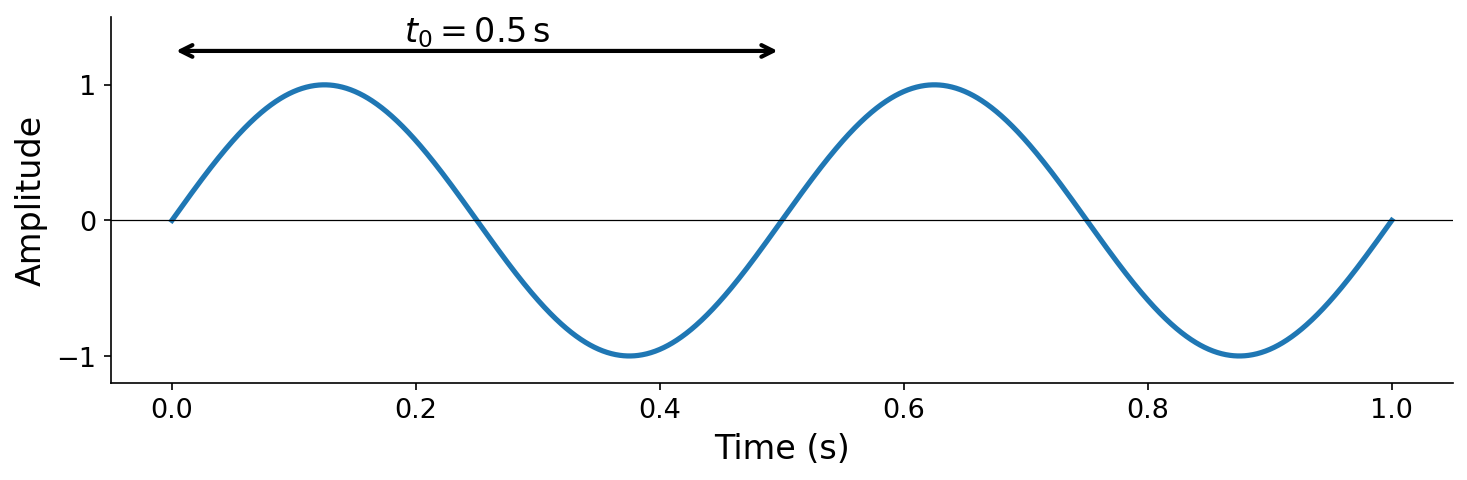
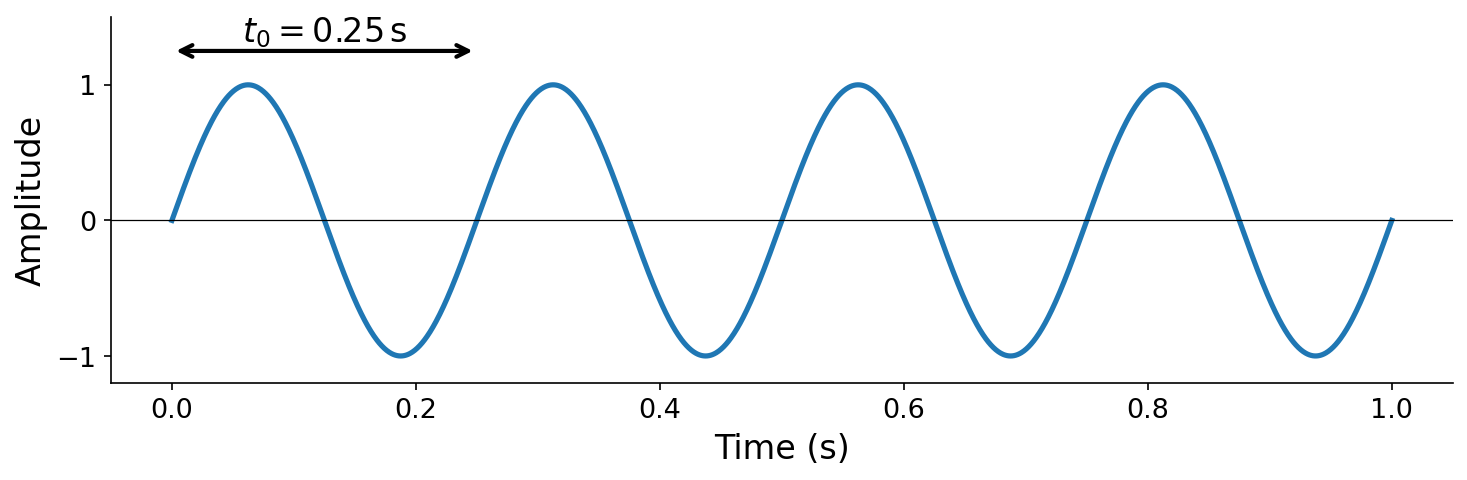
A waveform with \(t_0 = 0.5\,\mathrm{s}\) has \(f_0 = 2\,\mathrm{Hz}\) (top). Compressing the same shape into a quarter of a second gives \(t_0 = 0.25\,\mathrm{s}\) and \(f_0 = 4\,\mathrm{Hz}\) (bottom).
Frequency is the property most strongly associated with our perception of musical pitch: higher frequencies sound higher in pitch, lower frequencies sound lower. Accordingly, periods follow the opposite rule: the shorter the period, the higher the perceived pitch. If you’ve studied music, each line on a musical staff corresponds to a specific fundamental frequency. We will have more to say about pitch perception in later chapters.