6.2 Negative frequencies#
The sideband picture raises a subtle puzzle. Ring modulation is a product of two sinusoids, and multiplication is commutative, so \(\sin(\omega_c t)\,\sin(\omega_m t)\) and \(\sin(\omega_m t)\,\sin(\omega_c t)\) must be the exact same signal.
Yet if we apply our product-to-sum identity to each, the first gives sidebands at \(\omega_c \pm \omega_m\), while the second gives sidebands at \(\omega_m \pm \omega_c\). The sum frequencies agree (\(\omega_c + \omega_m = \omega_m + \omega_c\)), but the difference frequencies do not: in general, \(\omega_c - \omega_m \neq \omega_m - \omega_c\). How can the same signal have two different spectra?
To make sense of this, we need to consider an issue that we have so far avoided: that a frequency can be negative. Our examples until now quietly assumed \(\omega_m < \omega_c\), so that the lower sideband \(\omega_c - \omega_m\) came out positive. But nothing stops us from choosing \(\omega_m > \omega_c\), and then the lower sideband \(\omega_c - \omega_m\) is a negative frequency.
This is the first time we have explicitly confronted a negative frequency, but the idea is less exotic than it sounds. Back in our discussion of initial phase, we saw that shifting a sinusoid’s phase slides it in time without changing its pitch, and that our ears are largely insensitive to such shifts. As we are about to see, a negative frequency is nothing more than a phase-shifted positive frequency, a fact that follows directly from the same kind of trigonometric reasoning we used above.
What does a negative frequency sound like to us? Exactly like its positive counterpart. This follows from the symmetry of the sinusoids. Cosine is an even function (\(f(-x) = f(x)\)) and sine is an odd function (\(f(-x) = -f(x)\)):
A negative-frequency cosine is identical to its positive twin. A negative-frequency sine equals its positive twin flipped in sign, which is just a phase shift of \(\pi\). Either way, the difference is at most a phase shift, and our ears are insensitive to absolute phase. We can confirm this by ear with cosines and sines at \(\pm 220\) Hz:
Positive and negative frequencies compared. For the cosine, \(\cos(-\omega t) = \cos(\omega t)\) holds exactly, so those two clips are not merely audibly but mathematically identical. For the sine, \(\sin(-\omega t) = -\sin(\omega t) = \sin(\omega t + \pi)\), so the two clips differ by a \(\pi\) phase shift, yet sound identical. Either way, negative frequencies are an audible, physical reality of sound, not just an analytical device like the imaginary unit \(j\) in the phasor of Chapter 5.
We can package this symmetry in terms of the amplitude and phase spectra from Chapter 5. As a general property of the Fourier transform, the amplitude spectrum of any real signal is even (symmetric about zero), and its phase spectrum is odd (antisymmetric):
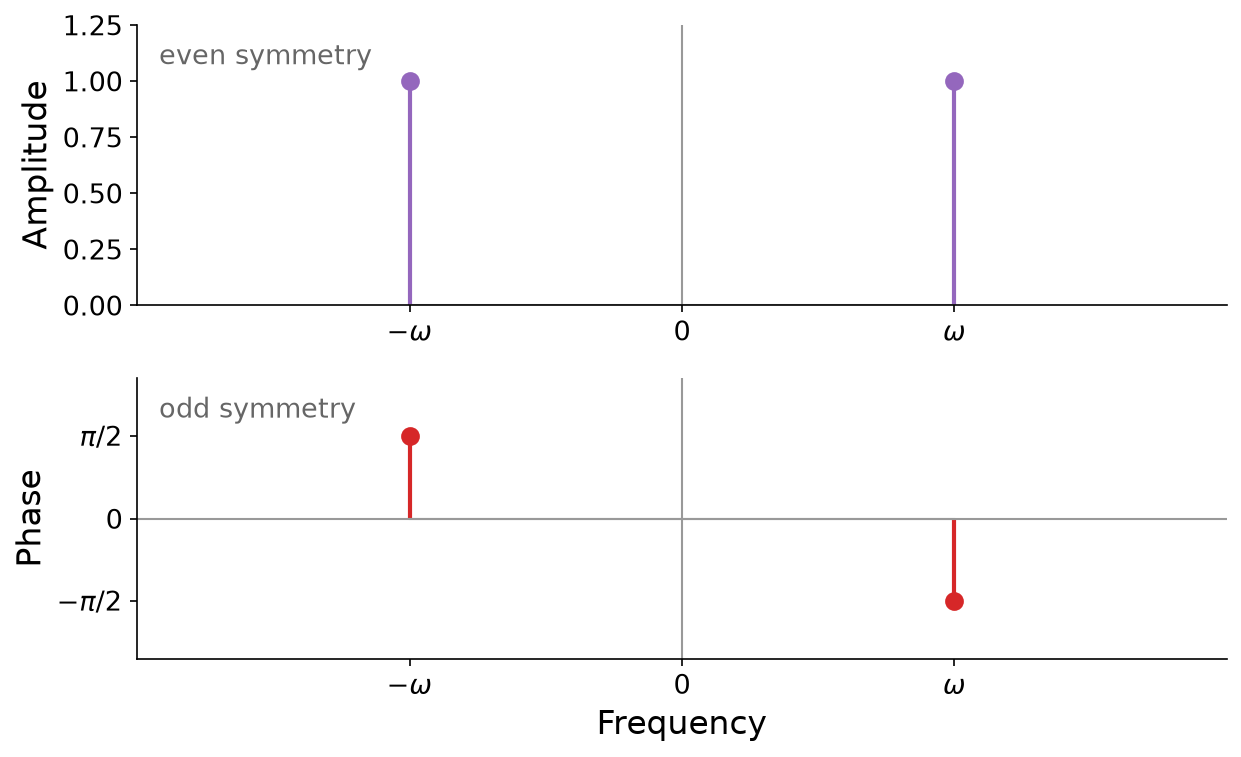
Fig. 24 The spectra of a real sinusoid are symmetric about zero frequency. The amplitude spectrum (top) is even, and the phase spectrum (bottom) is odd. This is why every positive frequency is mirrored by a negative one.#
The high-level insight here: any negative frequency can be interpreted as a phase-shifted positive frequency. Phase shifts and negative frequencies are two sides of the same coin. This is not just an analytical concept like the imaginary unit \(j\). It is a real, audible and mathematical phenomenon, and it will have important consequences when we study sampling theory in the next chapter.
Now we can resolve the puzzle. When \(\omega_m > \omega_c\), the difference sideband \(\omega_c - \omega_m\) is negative, but by even symmetry it shows up in the amplitude spectrum at \(|\omega_c - \omega_m| = \omega_m - \omega_c\), which is exactly the sideband the commuted expression predicted. The two derivations agree after all. Accounting for the negative frequencies that are always present, ring modulation really produces four sidebands, symmetric about zero:
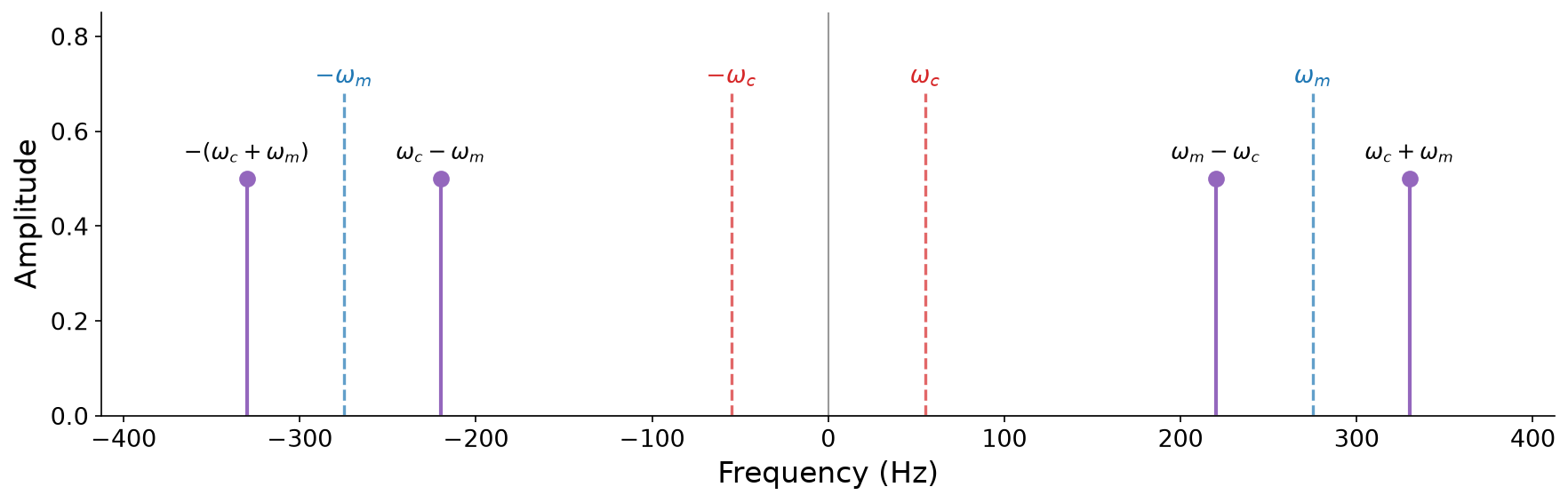
Fig. 25 The full spectrum of ring modulation, including negative frequencies, for a case where \(\omega_m > \omega_c\). The four sidebands are symmetric about zero. The two positive-frequency sidebands are what we hear.#
The animation below shows the fold in motion. The modulating frequency climbs past the carrier, the lower sideband slides through zero into negative frequency, and its mirror rises to take its place on the side we hear.
Because the amplitude spectrum is symmetric, we can freely swap \(\omega_c\) and \(\omega_m\) with mathematical equivalence, which finally makes the commutativity of multiplication consistent with the frequency-domain picture.