
Adaptive traffic signal control
 My current research focuses on real-time adaptive traffic signal control for urban road networks.
We have completed a pilot test of SURTRAC (Scalable Urban Traffic Control), our adaptive signal system on nine intersections in the East Liberty commercial district of Pittsburgh, Pennsylvania.
Traffic signals controlled by SURTRAC respond in real-time to shifts in traffic conditions, reducing congestion and vehicle emissions.
We are currently expanding the pilot site to nine additional intersections around Bakery Square, we'll be expanding to 29 more intersections in Pittsburgh by next fall, and we're currently planning a deployment outside of Pittsburgh.
My current research focuses on real-time adaptive traffic signal control for urban road networks.
We have completed a pilot test of SURTRAC (Scalable Urban Traffic Control), our adaptive signal system on nine intersections in the East Liberty commercial district of Pittsburgh, Pennsylvania.
Traffic signals controlled by SURTRAC respond in real-time to shifts in traffic conditions, reducing congestion and vehicle emissions.
We are currently expanding the pilot site to nine additional intersections around Bakery Square, we'll be expanding to 29 more intersections in Pittsburgh by next fall, and we're currently planning a deployment outside of Pittsburgh.
Selected references
- Stephen F. Smith, Gregory J. Barlow, Xiao-Feng Xie, and Zachary B. Rubinstein. "SURTRAC: Scalable Urban Traffic Control." Transportation Research Board Annual Meeting. Washington, DC. January 2013. (bib)
- Xiao-Feng Xie, Stephen F. Smith, Liang Lu, and Gregory J. Barlow. "Schedule-driven intersection control." Transportation Research Part C: Emerging Technologies. Volume 24, pages 168-189. October 2012. (abstract, bib, pdf)
- Xiao-Feng Xie, Stephen F. Smith, and Gregory J. Barlow. "Schedule-driven coordination for real-time traffic network control." International Conference on Automated Planning and Scheduling (ICAPS). Sao Paulo, Brazil. June 2012. (bib, pdf)
- Gregory J. Barlow. "Improving memory for optimization and learning in dynamic environments." Doctoral dissertation. Carnegie Mellon University. Pittsburgh, PA. July 2011. (abstract, bib, pdf)
Memory for optimization and learning in dynamic environments
 Many real-world problems are dynamic in some way and require adaptation over time.
While we can treat dynamic problems as a series of static problems, many problems change too fast for this to be possible.
Often, the dynamic nature of problems has some structure, which can be exploited to improve performance.
The use of memory in dynamic optimization is one way to exploit structure in dynamic problems.
My thesis research investigated ways to improve memory for dynamic problems.
I have developed two novel classes of memory: density-estimate memory and classifier-based memory.
Density-estimate memory builds probabilistic models of good solutions discovered during the search process, allowing the memory to create a rich, long-term model of the dynamic search space.
Classifier-based memory introduces an abstraction layer into explicit memories to allow memory to be used for problems like dynamic rescheduling, where a stored solution becomes obsolete as tasks are completed.
Many real-world problems are dynamic in some way and require adaptation over time.
While we can treat dynamic problems as a series of static problems, many problems change too fast for this to be possible.
Often, the dynamic nature of problems has some structure, which can be exploited to improve performance.
The use of memory in dynamic optimization is one way to exploit structure in dynamic problems.
My thesis research investigated ways to improve memory for dynamic problems.
I have developed two novel classes of memory: density-estimate memory and classifier-based memory.
Density-estimate memory builds probabilistic models of good solutions discovered during the search process, allowing the memory to create a rich, long-term model of the dynamic search space.
Classifier-based memory introduces an abstraction layer into explicit memories to allow memory to be used for problems like dynamic rescheduling, where a stored solution becomes obsolete as tasks are completed.
Selected references
- Gregory J. Barlow. "Improving memory for optimization and learning in dynamic environments." Doctoral dissertation. Carnegie Mellon University. Pittsburgh, PA. July 2011. (abstract, bib, pdf)
- Gregory J. Barlow and Stephen F. Smith. "Using Memory Models to Improve Adaptive Efficiency in Dynamic Problems." IEEE Symposium on Computational Intelligence in Scheduling. Nashville, Tennessee. March 2009. (abstract, bib, pdf)
- Gregory J. Barlow and Stephen F. Smith. "A Memory Enhanced Evolutionary Algorithm for Dynamic Scheduling Problems." Applications of Evolutionary Computing: EvoWorkshops 2008. Naples, Italy. March 2008. pp. 606-615. EvoSTOC Best Paper Award. (abstract, bib, ps, ps.gz, pdf)
Evolutionary robotics for unmanned aerial vehicles
 While most work in evolutionary robotics has been on wheeled mobile robots, unmanned aerial vehicles (UAVs) present a real opportunity for evolved control. In my master's thesis, I investigated the evolution of navigation controllers for UAVs. In subsequent work, I have done robustness testing for UAV controllers evolved in simulation in order to select a controller for transference to a real UAV. I have also evolved multi-UAV teams for distributed tasks.
Selected references
- Gregory J. Barlow and Choong K. Oh. "Evolved Navigation Control for Unmanned Aerial Vehicles." Frontiers in Evolutionary Robotics. Ed. Hitoshi Iba. Vienna: I-Tech Education and Publishing, 2008. pp. 353-378. (abstract, bib, pdf)
- Gregory J. Barlow, Choong K. Oh, and Stephen F. Smith. "Evolving Cooperative Control on Sparsely Distributed Tasks for UAV Teams Without Global Communication." Proceedings of the 2008 Genetic and Evolutionary Computation Conference. Atlanta, Georgia. July 2008. pp. 177-184. (abstract, bib, ps, ps.gz, pdf)
- Gregory J. Barlow and Choong K. Oh. "Robustness Analysis of Genetic Programming Controllers for Unmanned Aerial Vehicles." Proceedings of the 2006 Genetic and Evolutionary Computation Conference. Seattle, WA. July 2006. pp. 135-142. (abstract, bib, ps, ps.gz, pdf)
- Gregory J. Barlow, Choong K. Oh, and Edward Grant. "Incremental Evolution of Autonomous Controllers for Unmanned Aerial Vehicles using Multi-objective Genetic Programming." Proceedings of the 2004 IEEE Conference on Cybernetics and Intelligent Systems (CIS). Singapore. December 2004. pp. 688-693. (abstract, bib, ps, ps.gz, pdf)
- Gregory J. Barlow. "Design of Autonomous Navigation Controllers for Unmanned Aerial Vehicles Using Multi-objective Genetic Programming." Master's thesis. North Carolina State University. Raleigh, NC. March 2004. (abstract, bib, ps, ps.gz, pdf)
Evolutionary robotics
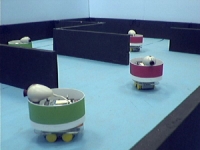 While I was at the Center for Robotics and Intelligent Machines at NC State, I also worked on evolutionary robotics for wheeled mobile robots. For this research, we used the EvBot and EvBot II platforms developed in-house. Much of this work was done with Andrew Nelson on his Ph.D research on evolved neural controllers for robot colonies.
I also evolved genetic programming controllers for a radar tracking task (originally intended for UAVs) and transferred the controllers to the EvBot II platform. A passive sonar system on the robot was used in place of the radar sensor, and a speaker emitting a tone was used as the target in place of a radar.
While I was at the Center for Robotics and Intelligent Machines at NC State, I also worked on evolutionary robotics for wheeled mobile robots. For this research, we used the EvBot and EvBot II platforms developed in-house. Much of this work was done with Andrew Nelson on his Ph.D research on evolved neural controllers for robot colonies.
I also evolved genetic programming controllers for a radar tracking task (originally intended for UAVs) and transferred the controllers to the EvBot II platform. A passive sonar system on the robot was used in place of the radar sensor, and a speaker emitting a tone was used as the target in place of a radar.
Selected references
- Andrew L. Nelson, Gregory J. Barlow, and Lefteris Doitsidis. "Fitness Functions in Evolutionary Robotics: A Survey and Analysis." Robotics and Autonomous Systems. Volume 57, Issue 4, pages 345-370. April 2009. (abstract, bib, pdf)
- Gregory J. Barlow, Leonardo S. Mattos, Edward Grant, and Choong K. Oh. "Transference of Evolved Unmanned Aerial Vehicle Controllers to a Wheeled Mobile Robot." Proceedings of the IEEE International Conference on Robotics and Automation. Barcelona, Spain. April 2005. pp. 2087-2092. (abstract, bib, ps, ps.gz, pdf)
- Andrew L. Nelson, Edward Grant, Gregory J. Barlow, and Thomas C. Henderson. "A colony of robots using vision sensing and evolved neural controllers." Proceedings of the IEEE Conference on Intelligent Robots and Systems. Las Vegas, NV. October 2003. pp. 2273-2278. (abstract, bib, pdf)
- Andrew L. Nelson, Edward Grant, Gregory Barlow, and Mark White. "Evolution of Complex Autonomous Robot Behaviors using Competitive Fitness." Proceedings of the IEEE International Conference on Integration of Knowledge Intensive Multi-Agent Systems. Boston, MA. September 2003. pp. 145-150. (abstract, bib, pdf)
EvBots
 The EvBot research platform was developed at the Center for Robotics and Intelligent Machines at NC State. John Galeotti developed both the hardware and software for the first EvBot, and Leonardo Mattos developed the hardware for the EvBot II.
While I was an undergraduate, I developed the upgraded software for the EvBot II, developed a communications protocol for the robot colony, and helped to automate many of the robot experiments we were doing at the time.
In addition to the evolutionary robotics work we did using the EvBot colony, we also used the colony for experiments on leadership protocols for distributed sensor networks.
The EvBot research platform was developed at the Center for Robotics and Intelligent Machines at NC State. John Galeotti developed both the hardware and software for the first EvBot, and Leonardo Mattos developed the hardware for the EvBot II.
While I was an undergraduate, I developed the upgraded software for the EvBot II, developed a communications protocol for the robot colony, and helped to automate many of the robot experiments we were doing at the time.
In addition to the evolutionary robotics work we did using the EvBot colony, we also used the colony for experiments on leadership protocols for distributed sensor networks.
Selected references
- Gregory J. Barlow, Thomas C. Henderson, Andrew L. Nelson, and Edward Grant. "Dynamic Leadership Protocol for S-nets." Proceedings of the IEEE International Conference on Robotics and Automation. New Orleans, LA. April 2004. pp. 1091-1096. (abstract, bib, ps, ps.gz, pdf)
- "Evolutionary Robotics Research Project." Industry/Research News. IEEE Robotics & Automation Magazine. March 2005. pg. 79. (pdf)