

Stepping Toward Better Mobility
By Marylee Williams
- Chief Marketing and Communications Officer, School of Computer Science
- aaupperlee@cmu.edu
- 412-268-9068
Mobility aids for people with trouble walking often miss the mark. Either the braces are too rigid or the exoskeletons are too bulky. A team in Carnegie Mellon University's School of Computer Science created an aid that combines functionality with wearability to support people with mobility issues, such as those who experienced strokes or age-related muscle loss.
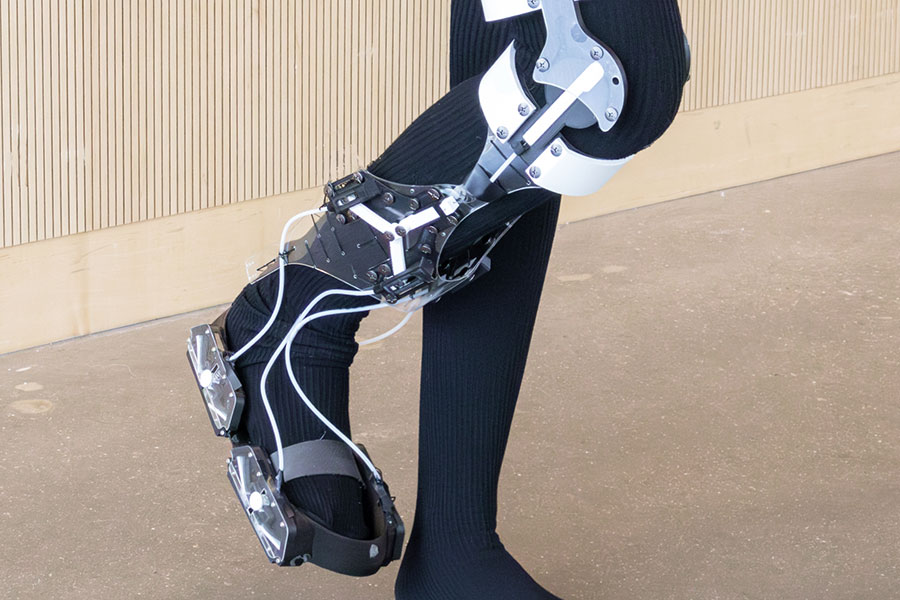
Researchers have designed an exoskeleton that stretches from the foot to above the knee and uses mechanical elements to allow wearers to adopt a more natural gait without the bulk of a robotic aid. This device, which is fully mechanical, weighs about the same as a pineapple and costs $38.
"There are two things that make our design unique and helpful to users. The first is the load-bearing function on the leg," said Yuyu Lin, a Ph.D. student in CMU's Human Computer Interaction Institute (HCII). "The second is the walking dynamics, which we've integrated into the design to allow for a more natural gait."
Before developing the design, the research team conducted one-on-one interviews with both the medical professionals who treat gait rehabilitation and the people who use mobility aids to walk. They learned that their design needed to factor in functionality, which means preventing the knee from buckling without hindering movement; accessibility, indicating it's easy to maintain, obtain and use; and wearability, meaning it's comfortable and acceptable to use in public.
Alexandra Ion, an assistant professor in the HCII, said one issue they discovered in these interviews is that the robotic exoskeletons on the market are often over-engineered. Their approach aimed to create a more accessible mechanical solution.
Ion's team developed an exoskeleton with a lockable joint on the knee activated by load-triggering plates on the foot that act like mechanical switches. The two switches, located on the heel and toe areas, are calibrated to the user's body weight. The locking mechanism only activates when a leg carries more than half the user's weight, ensuring it locks during a real step and not while the person is sitting with their foot fully on the ground. This design ensures people wearing the brace can maintain a natural gait.
The leg brace comes on the heels of Ion and Lin's work to create a customizable finger brace for people with joint injuries. The finger brace covered a smaller area and patients switched functionality a few times per day, while the knee brace handles much larger forces — the wearer's entire body weight — and switches automatically with each step.
"Additionally, there is an element of necessity," Ion said. "There are many conditions that can lead to needing support around the knee, including post-stroke muscle weakness and injuries, creating a need for more accessible support that can help a broader range of people."
Moving forward, the team is working on an improved version that will be easier to personalize and manufacture with less assembly. They're also digging deeper into its effectiveness with broader patient populations.
Along with Lin and Ion, the research team includes Yujia Liu, a doctoral student in the HCII; Emma Kim, a recent graduate from CMU's College of Engineering; and Olapeju Otusajo, a master's student in the HCII. This work was presented earlier this year at the Association for Computing Machinery Conference on Human Factors in Computing Systems (CHI 2026) in Barcelona.
Learn more about the device on the Interactive Structures Lab website.