

Researchers Channel AI To Solve Open Mathematical Problems
By Marylee Williams
- Chief Marketing and Communications Officer, School of Computer Science
- aaupperlee@cmu.edu
- 412-268-9068
Artificial intelligence can accelerate scientific discovery, but it isn't as simple as submitting a single query to an AI model. Research led by a collaboration between Carnegie Mellon University's School of Computer Science and Google is developing new methods to solve some of the hardest open mathematical problems with these models.
"My research describes different methods to interact with AI to accelerate research," said David Woodruff, a professor in the Computer Science Department. "We're witnessing a fundamental shift in scientific workflow. These AI tools are a force multiplier for human intellect, and many researchers, myself included, are asking, 'What's the best way of interacting with them to accelerate research?'"
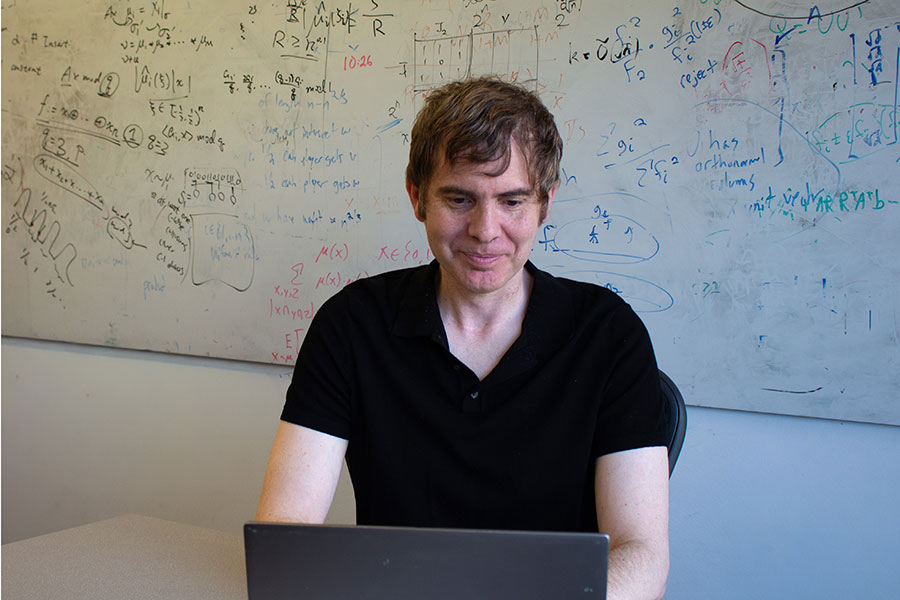
Woodruff recently collaborated with Michael Brenner, from Harvard University and Google Research, and Vincent Cohen-Addad, also from Google Research, on an open problem involving gravitational waves from cosmic strings. Previously, researchers would hit a mathematical brick wall, leaving the problem unsolved.
To break through this barrier, researchers looked to a Google Gemini Deep Think model not simply as a calculator, but as a genuine collaborator. The team developed what they call a "neuro-symbolic system," which uses an AI model's ability to generate ideas and predict patterns to theorize, develop and test possible solutions. The Gemini-based model developed the hypotheses and did the conceptual work. From there, it mapped out many possibilities and explored different avenues to a solution, potentially combining ideas or pulling from areas a human might not have considered. Finally, after the computer automatically verified the math, the results were sent to a human researcher to do a final check and iterate.
"In these AI models, there can be a lot of randomness in their exploration," Woodruff said. "So if you call one of these models once, but then you call it again with exactly the same prompt, it often gives you a very different answer. What that means is if I call it many times, then maybe one of those times it'll get it right.
"Then you can take all these answers and feed them back into a Gemini model to try to determine which ones are right, or combine some of this model's thoughts with another model's thoughts to maybe get the best of both of them, and eventually converge on a good solution," Woodruff continued. "This is known as recursive self-aggregation."
This approach is part of a larger study featuring Woodruff and 35 co-authors showing how they collaborated with Google's Gemini-based models to solve a diverse collection of open mathematical problems to advance scientific investigation and discovery.
Rather than simply identifying the best method or application of these AI tools, Woodruff and his peers point to the numerous ways the tools can help tackle complex problems as collaborators. The human researchers serve as the architects of these projects, working to structure the system so the models can explore the many possibilities that could lead to solutions.
"Just as the advent of calculators and computational algebra systems revolutionized applied mathematics in previous decades, the ability to rapidly iterate on abstract reasoning with a tireless, knowledgeable AI collaborator promises to dramatically reduce the friction of theoretical execution," the researchers wrote in their study.