Jonathan Laurent

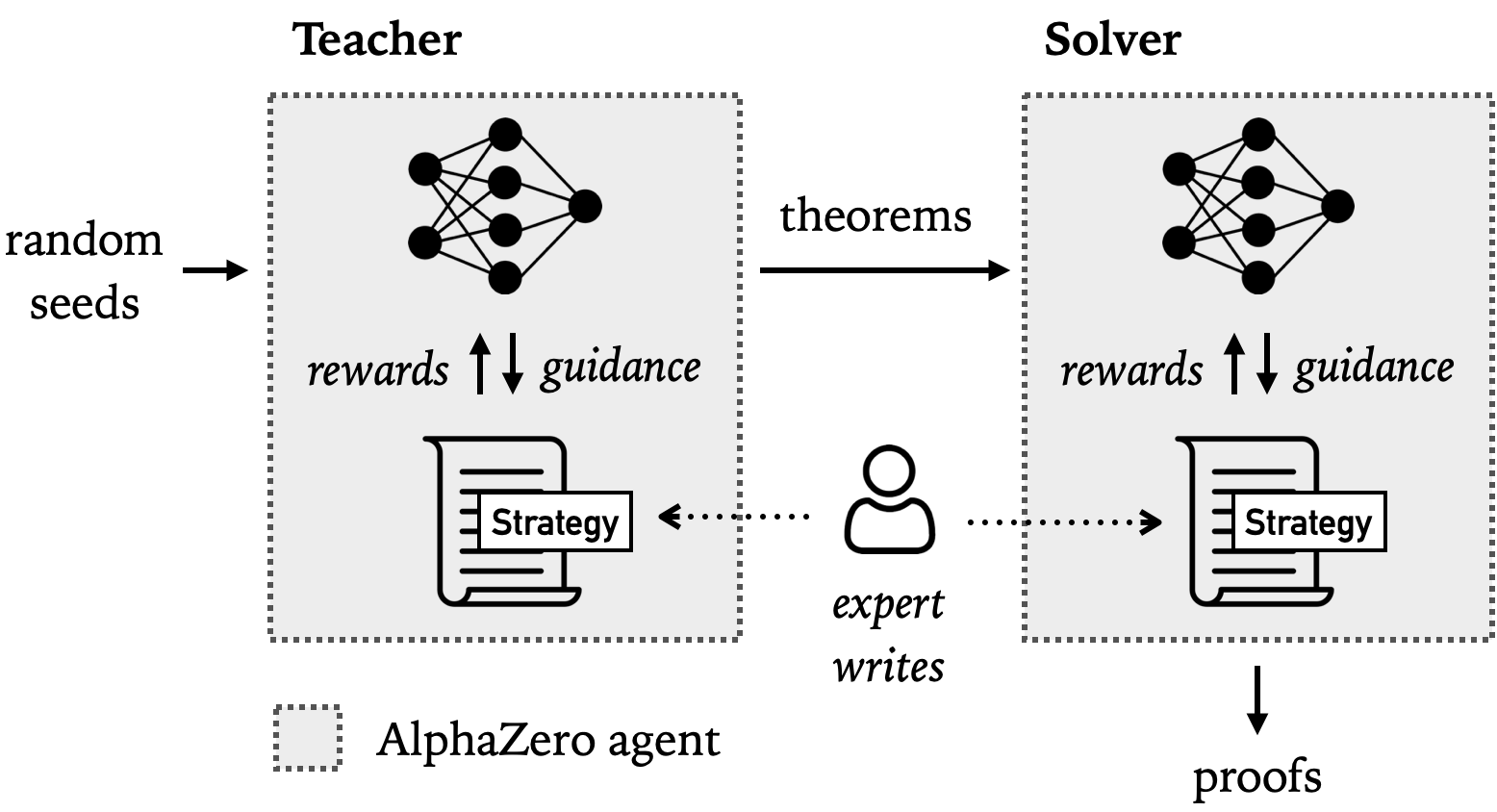
I am a PhD researcher at Carnegie Mellon University and at the Karlsruhe Institute of Technology. My current research interests lie at the intersection of language design, machine learning and automated theorem proving. My goal is to implement an AlphaZero-like agent capable of self-learning to prove and discover mathematical theorems without human supervision. I am also exploring new paradigms for integrating LLM prompting as a first-class programming primitive.

Previously, I developed techniques to uncover the causal structure of simulation trajectories generated from rule-based models of complex biochemical systems, in collaboration with Harvard Medical School. I am also passionate about teaching and programming in Julia or OCaml.

Jonathan Laurent

Education

Carnegie Mellon University, Pittsburgh

PhD in Computer Science.

Coursework

2017 -- Present

École Normale Supérieure de Cachan, Cachan

MSc in Machine Learning, awarded with highest honors (mention "très bien").

"Master Vision et Apprentissage", department of mathematics. Coursework

2016

École Normale Supérieure, Paris

BSc and MSc in Computer Science.

"Diplôme en Sciences de l'ENS, spécialité informatique". Coursework

2014 -- 2016

Lycée Louis-Le-Grand, Paris

Classes Préparatoires aux Grandes Écoles (MPSI-MP*)

Preparatory courses to nationwide competitive exams in mathematics (major), physics and computer science. Admitted to the École Normale Supérieure in computer science, ranked 11th.

2011 -- 2013

Research Experience

PhD in Computer Science at Carnegie Mellon University

I am currently a PhD researcher in Computer Science at Carnegie Mellon University. Until the end of 2018, I worked with Professor Jean Yang on causal analysis of complex biochemical systems, in collaboration with the team of Walter Fontana at Harvard Medical School. I then joined Professor André Platzer's lab, where I have been working at the intersection of language design, maching learning and theorem proving.

2017 -- Present
Research Internship at IRIF

In the "PPS" team of the "Research Institute on the Foundations of Computer Science", I developped a tactic for the Coq proof assistant that automatically suggests lemmas for proving the current goal. It relies on a statistical model of lemma relevance, which I fitted on a large corpora of formalized mathematics (the CoRN library). Report{.button} Code{.button}

March -- August 2016
Research Internship at Harvard Medical School

In the team of Professor Walter Fontana, I developed a formalism to capture the notion of a biological pathway, along with some techniques to uncover pathways in networks of protein-protein interactions modelled using the Kappa language. Report{.button}

March -- August 2015
Summer Internship at NASA Langley Research Center

I spent three months at the NASA Langley Research Center, under the supervision of Alwyn Goodloe. I developped the "Copilot Theorem" library, which enables fully-automated verification of safety properties of real-time embedded programs written in the Copilot language. Paper{.button} Talk{.button} Slides{.button} Code{.button}

June -- August 2014

Teaching Experience

Here is a copy of my teaching statement.
Teaching Assistant for "Logical Foundations of Cyberphysical Systems"

I was a Teaching Assistant for the the Logical Foundations of Cyberphysical Systems class taught by André Platzer at CMU. I created class material optimized for remote learning (due to the COVID pandemic) and taught weekly hybrid recitations. I was nominated to CMU's Alan Perlis Teaching Award (see my statement). Selected Student Feedback

Fall 2020
Teaching Assistant for a Software Verification Class

I was a Teaching Assistant for an introductory software verification class (15-414), taught by Matt Fredrikson and André Plazer. In particular, I designed a set of five labs relying on the Why3 verification platform, which led students to writing a fully verified implementation of a SAT solver with unit propagation. I was also responsible for teaching the two lectures introducing the Why3 platform. Selected Student Feedback

Fall 2017
Oral Examiner in Mathematics

I was an oral examiner in mathematics at Lycée Condorcet and then Lycée Louis-Le-Grand. Every week, I met with six freshmen during two one-hour sessions and trained them for the oral entrance examinations of the French Grandes Écoles. A selection of some of my favorite exercises can be found here (currated with Léonard Blier).

2015 -- 2016

Publications

Preprints

Oracular Programming: A Modular Foundation for Building LLM-Enabled Software
Jonathan Laurent, André Platzer Abstract Paper
ArXiv 2025
Hybrid Game Control Envelope Synthesis
Aditi Kabra, Jonathan Laurent, Stefan Mitsch, André Platzer Abstract Paper
ArXiv 2025

Conference Papers

Can Large Language Models Autoformalize Kinematics?
Aditi Kabra, Jonathan Laurent, Sagar Bharadwaj, Ruben Martins, Stefan Mitsch, André Platzer Abstract Paper
FMCAD 2025
Adaptive Shielding via Parametric Safety Proofs
Yao Feng, Jun Zhu, André Platzer, Jonathan Laurent Abstract Paper
OOPSLA 2025
CESAR: Control Envelope Synthesis via Angelic Refinements
Aditi Kabra, Jonathan Laurent, Stefan Mitsch, André Platzer Abstract Paper
TACAS 2024
Learning to Find Proofs and Theorems by Learning to Refine Search Strategies:
The Case of Loop Invariant Synthesis
Jonathan Laurent, André Platzer Abstract Paper Code Poster
NeurIPS 2022
A Trace Query Language for Kappa
Jonathan Laurent, Hector Medina Abarca, Pierre Boutillier, Jean Yang, Walter Fontana Abstract Paper
CMSB 2018
Counterfactual Resimulation for Causal Analysis of Rule-Based Models
Jonathan Laurent, Jean Yang, Walter Fontana Abstract Paper
IJCAI 2018
Assuring The Guardians
Jonathan Laurent, Alwyn Goodloe, Lee Pike Abstract Paper
RV 2015

Workshop Papers

Designing a Theorem Prover for Reinforcement Learning and Neural Guidance
Jonathan Laurent and André Platzer, Talk Proposal Abstract Paper
AITP 2021
Causal Analysis of Rule-Based Models by Counterfactual Reasoning
Jonathan Laurent, Jean Yang, Walter Fontana Abstract Paper
SASB 2017

Theses and Reports

Learning to Discover Proofs and Theorems Without Supervision
Jonathan Laurent, Thesis Proposal Abstract Paper
2022
Suggesting Relevant Lemmas by Learning From Succesful Proofs
Jonathan Laurent, Internship Report Paper Code
2016
Causal Analysis of Rule-Based Models of Signaling Pathways
Jonathan Laurent, Master Thesis Abstract Paper
2015

Selected Talks

Oracular Programming: A Modular Foundation For LLM-Enabled Software
Formath Seminar, IRIF, Invited Talk
February 2025
Learning to Find Proofs and Theorems by Learning to Refine Search Strategies
Google N2Formal Reading Group, Invited Talk
August 2022
Building on AlphaZero with Julia
JuliaCon 2021, Long Talk
August 2021
Julia User Group, Munich.
March 2023
Causal Analysis of Rule-Based Models through Counterfactual Reasoning
AI seminar, Carnegie Mellon University, Pittsburgh.
November 2018
Harvard PL Seminar, Boston.
December 2017
University of Alabama, Birmingham.
September 2017
PL Lunch, Carnegie Mellon University, Pittsburgh.
September 2017
SASB Workshop, New-York.
August 2017
Uncovering Pathways in Biomolecular Interaction Networks
PL Lunch, Carnegie Mellon University, Pittsburgh.
April 2017
Peut-on tout calculer ?
Lycée Louis-Le-Grand, Paris.
December 2014
SMT-based Model-Checking Techniques for the Verification of Synchronous Dataflow Programs
National Institute of Aerospace, Hampton.
August 2014

Honors and Awards

Nominated for Carnegie Mellon University's Allan Perlis Teaching Award.
2021
Programming Languages Mentoring Workshop (PLMW) Scholarship. Details
2017
Princeton University Graduate School's Dean Grant, declined. Details
2016
University of Washington's CSE Distinguished Graduate Student Award, declined. Details
2016
Ranked 4th at the Google HashCode programming contest, with team <$><*>.
2014
Admitted to the École Normale Supérieure in Computer Science, ranked 11th nationwide.
2013

Professional Service

External Reviewer for: LICS 2025, TACAS 2025, IJCAR 2024, ICCPS 2024, NFM 2023, LSFA 2023, LICS 2023, FM 2023, IJCAR 2022, ICCPS 2022, CADE 2021, ICCPS 2020, LICS 2020, FASE 2019, OOPSLA 2018.
Artifact Evaluation Committee Member for: SAS 2023.
Organizer of the weekly PL Lunch at Carnegie Mellon University.
Spring 2018

Skills

Programming

Languages