Overview
07-380 is the second in a two-course sequence covering the breadth and depth of AI/ML required by the AI major/minor. Building upon 07-280 AI & ML I, 07-380 is designed to both solidify the fundamental components of AI and ML as well as introduce students to the latest breakthroughs in the rapidly changing AI landscape.
Key topics include: AI ethics, ML theory, game theory, unsupervised learning, ensemble learning, recommender systems, convex and non-convex optimization, probabilistic graphical models, automated theorem proving, planning, distributed deep learning, reinforcement learning with human feedback, generative AI, diffusion models, and variational autoencoders.
Prerequisites
The prerequisites for this course are:
- 07-280: Artificial Intelligence & Machine Learning I
- 36-225 or 36-217 or 15-259 or 21-325 or 15-359 or 36-218 or 36-219 or 36-235: Probability
Learning Objectives
After completing the course, students should be able to:
- Given an AI task, formulate the problem and apply an appropriate combination of symbolic reasoning, search and planning, optimization, and data-driven learning methods to solve it, justifying the selected approach based on correctness, complexity, applicability, and tradeoffs between exact and approximate methods.
- Construct and learn probabilistic models for reasoning under uncertainty, and apply exact and approximate methods for estimation and inference.
- Explain and apply principles underlying modern generative AI and model adaptation techniques.
- Derive and interpret the mathematical foundations underlying core AI and machine learning methods, including concepts such as constrained and unconstrained optimization, probabilistic inference, and variational methods.
- Apply theoretical foundations of AI and machine learning to reason about generalization, strategic interactions, and the performance and limits of computational methods.
- Apply appropriate practices for developing and evaluating modern AI and machine learning systems, including addressing data quality and distribution shift, reasoning about scalability and computational resource tradeoffs, and identifying ethical, societal, and professional considerations.
Office Hours
The calendar of office hours (and recitations) is below.
OHQueue: Link
Instructor OH by Appointment
In addition to Pat's standing office hours on the calendar above, Pat often has "OH" (or "Open") appointment slots on his office hours appointment calendar. If there are no available OH or appointments that meet your needs, please contact Pat via a private post on Piazza with a list of times that work for you to meet.
Schedule
Subject to change
Reading sources:
(AIMA) Russell, Stuart and Peter Norvig. Artificial Intelligence: A Modern Approach, 4th Edition, available via CMU Library
Bishop, Christopher. Pattern Recognition and Machine Learning, available online
Boyd, Stephen and Lieven Vandenberghe. Convex Optimization, available online
(CIML) Daumé III, Hal. A Course in Machine Learning, available online
(MML) Marc Peter Deisenroth, A. Aldo Faisal, and Cheng Soon Ong. Mathematics for Machine Learning, available online
Murphy, Kevin P. Machine Learning: A Probabilistic Perspective, available online
| Dates | Module | Topic | Lecture Materials | Pre-Reading | Reading (optional) |
|---|---|---|---|---|---|
| 8/24 Mon | Introduction | 1. Introduction | pptx (inked) pdf (inked) | AIMA Ch. 1 | |
| 8/26 Wed | Reasoning Under Certainty | 2. Logical Agents SAT/DPLL; Forward chaining; Search + GenAI: Alpha Geometry |
pptx
(inked)
pdf
(inked) Example: Minesweeper Example: Wumpus World |
Prop Logic.pdf Checkpoint due 8/25 Tue, 11:59 pm |
AIMA Ch. 7.1-7 |
| 8/31 Mon | Reasoning Under Certainty | 3. Planning PDDL; Relaxations |
pptx
(inked)
pdf
(inked) |
Planning.pdf Checkpoint due 8/30 Sun, 11:59 pm |
AIMA Ch. 11.1-3 |
| 9/2 Wed | Reasoning Under Certainty | 4. Motion Planning RRT |
pptx
(inked)
pdf
(inked) Demo: Piano Mover Demo: Robot Cook Demo: Robot Cook N-link |
AIMA Ch. 26.5 | |
| 9/7 Mon | No class: Labor Day | ||||
| 9/9 Wed | Optimization | 5. Continuous Optimization: LP |
pptx
(inked)
pdf
(inked) Desmos demos: |
Linear Programming.pdf Checkpoint due 9/8 Tue, 11:59 pm |
Boyd and Vandenberghe Ch. 2.2.1, 2.2.4, 4.3-4.3.1 |
| 9/11 Fri | Quiz 1 During recitation/quiz section |
||||
| 9/14 Mon | Optimization | 6. Discrete Optimization: ILP |
pptx
(inked)
pdf
(inked) Desmos demo: IP |
||
| 9/16 Wed | Optimization | 7. Low Rank Optimization: PCA PCA (LoRA) |
pptx
(inked)
pdf
(inked) Desmos: Projection Desmos: Projection of points pca_2d_exercise.ipynb |
PCA.pdf Checkpoint due 9/15 Tue, 11:59 pm |
PCA: Bishop 12.1, Murphy 12.2 LoRA: Low-Rank Adaptation of Large Language Models. Hu et al. (2021) |
| 9/21 Mon | Reasoning Under Uncertainty | 8. MAP |
pptx
(inked)
pdf
(inked) Desmos: Bernoulli Likelihood and Posterior |
MAP.pdf Checkpoint due 9/20 Sun, 11:59 pm |
07-280 Notation Guide 07-280 Probability Background 07-280 MLE Pre-reading MML 9.2.3-4 Mitchell MLE and MAP |
| 9/23 Wed | Reasoning Under Uncertainty | 9. Generative Models Naive Bayes; Gaussian discriminant analysis |
pptx
(inked)
pdf
(inked) Notes_Generative_Models.pdf cat_dog_sampling.ipynb |
Mitchell Generative and Discriminative Classifiers Murphy 3.5, 4.2, 8.6 |
|
| 9/25 Fri | Quiz 2 During recitation/quiz section |
||||
| 9/28 Mon | Reasoning Under Uncertainty | 10. Graphical Models: Naive Bayes and Discriminant Analysis |
(see previous slides) discriminant_analysis.ipynb Naive Bayes SPAM worksheet.pdf |
Bayes Nets.pdf Checkpoint due 9/27 Sun, 11:59 pm |
|
| 9/30 Wed | Reasoning Under Uncertainty | 11. Graphical Models: Bayes Nets, Exact and Approximate Inference Likelihood weighted sampling; Gibbs |
pptx
(inked)
pdf
(inked) Sampling Worksheet.pdf Bayes Net Demo Likelihood Sampling Demo |
AIMA Ch. 12.1-5, 13.1-2 AIMA Ch. 13.4 |
|
| 10/5 Mon | Reasoning Under Uncertainty | 12. HMM / Particle Filtering Light on forward model |
Markov Chain Inference.pdf Checkpoint due 10/4 Sun, 11:59 pm |
AIMA Ch. 14.1-3, 14.5 | |
| 10/7 Wed | Reasoning Under Uncertainty | 13. Graphical Models: Latent Factors Clustering/GMM; EM |
Notes_Clustering.pdf |
K-means: Bishop 9.1 GMM: Bishop 9.2 |
|
| 10/9 Fri | Quiz 3 During recitation/quiz section |
||||
| 10/12 Mon | No class: Fall Break | ||||
| 10/14 Wed | No class: Fall Break | ||||
| 10/19 Mon | Acting Under Uncertainty | 14. RL: Policy Gradient Methods Policy Gradient Methods → RLHF |
Checkpoint due 10/18 Sun, 11:59 pm | Sutton and Barto Ch. 13 (Policy Gradient Methods) | |
| 10/21 Wed | Generative AI | 15. Deep Learning Optimization RMSProp, momentum; Numerical/gradient stabilization |
An overview of gradient descent optimization algorithms. Sebastian Ruder (2017) | ||
| 10/26 Mon | Generative AI | 16. Image Generation: VAE Vision transformers (quick); VAE |
autoencoder_csv.ipynb | Checkpoint due 10/25 Sun, 11:59 pm |
An Image is Worth 16x16 Words: Transformers for Image Recognition at Scale. Dosovitskiy et al. (2020) Auto-Encoding Variational Bayes. Kingma and Welling (2013) Tutorial on Variational Autoencoders. Doersch (2016) |
| 10/28 Wed | Generative AI | 17. Image Generation: Diffusion Diffusion Models; LDM |
Deep Unsupervised Learning using Nonequilibrium Thermodynamics. Sohl-Dickstein et al. (2015) Denoising Diffusion Probabilistic Models. Ho et al. (2020) Variational Inference: A Review for Statisticians. Blei, Kucukelbir, and McAuliffe (2018) |
||
| 10/30 Fri | Quiz 4 During recitation/quiz section |
||||
| 11/2 Mon | Generative AI | 18. Multimodal Learning VLM/VLA; JEPA |
Checkpoint due 11/1 Sun, 11:59 pm | ||
| 11/4 Wed | ML Systems | 19. Parallel Computing Data, model, pipeline, MoE |
|||
| 11/9 Mon | ML Systems | 20. Scaling Laws | Checkpoint due 11/8 Sun, 11:59 pm |
Scaling Laws for Neural Language Models. Kaplan et al. (2020) Training Compute-Optimal Large Language Models. Hoffmann et al. (2022) |
|
| 11/11 Wed | Additional Topics | 21. Recommender Systems | Matrix Factorization Techniques for Recommender Systems (pdf). Koren, Bell, and Volinsky (2009) | ||
| 11/13 Fri | Quiz 5 During recitation/quiz section |
||||
| 11/16 Mon | Additional Topics | 22. Ensemble Methods | Checkpoint due 11/15 Sun, 11:59 pm |
Ensemble Methods. Daumé CIML Ch. 13 A Brief Introduction to Boosting. Schapire (1999) |
|
| 11/18 Wed | Additional Topics | 23. ML Theory PAC (w/o derivation) and VC dims (with shattering explanation/examples); Double descent curves |
A Few Useful Things to Know about Machine Learning. Pedro Domingos (2012) Generalization Abilities: Sample Complexity Results. Nina Balcan (2015) |
||
| 11/23 Mon | Additional Topics | 24. Game Theory | Checkpoint due 11/22 Sun, 11:59 pm |
AIMA Ch. 18.1-2 15-281 Game Theory Notes |
|
| 11/25 Wed | No class: Thanksgiving Break | ||||
| 11/30 Mon | Practice and Impact | 25. ML in Practice Data (collection, cleaning, synthetic data, etc.); WandB, checkpointing, calibration etc |
|||
| 12/2 Wed | Practice and Impact | 26. AI Ethics Fairness conundrum; Future AI / AGI Quiz 6, during lecture |
AIMA Ch. 16.7, 27.1-3 | ||
| TBA | Final Project due During the final exam period: 12/7 Mon – 12/15 Tue; see Final Project |
Recitation
There is a single recitation section, which meets Friday, 11:00 am - 12:20 pm, in Wean Hall (WEH) 5403 (the same time and room as lecture). Recitation starts the first week of class, Friday, Aug. 28th. Recitation attendance is recommended to help solidify weekly course topics, and the recitation materials published below are required content.
Bi-weekly quizzes will take place during the Friday recitation/quiz sections; see Quizzes. Quiz dates will be posted here and on the Schedule.
| Dates | Recitation | Handout/Code |
|---|---|---|
| 8/28 Fri | Recitation 1: Logical Agents |
Recitation 1 Recitation 1 Solutions |
| 9/4 Fri | Recitation 2: Planning |
Recitation 2 Recitation 2 Solutions |
| 9/11 Fri | Recitation 3: LP Quiz 1 |
Recitation 3 Recitation 3 Solutions |
| 9/18 Fri | Recitation 4: ILP and PCA |
Recitation 4 Recitation 4 Solutions |
| 9/25 Fri | Recitation 5 + Quiz 2 |
Recitation 5 Recitation 5 Solutions |
| 10/2 Fri | Recitation 6 |
Recitation 6 Recitation 6 Solutions (slides) |
| 10/9 Fri | Recitation 7 + Quiz 3 |
Recitation 7 Recitation 7 Solutions |
| 10/16 Fri | No recitation: Fall Break | |
| 10/23 Fri | Recitation 8 | |
| 10/30 Fri | Recitation 9 + Quiz 4 | |
| 11/6 Fri | Recitation 10 | |
| 11/13 Fri | Recitation 11 + Quiz 5 | |
| 11/20 Fri | Recitation 12 | |
| 11/27 Fri | Recitation 13 No in-person recitation (worksheet only) Quiz 6 will be the following Wed 12/4 in lecture |
|
| 12/4 Fri | Recitation 14 |
Assignments
There will be approximately seven assignments with possible written and programming components (subject to change). Written assignments will involve working through algorithms presented in the class, deriving and proving mathematical results, and critically analyzing material presented in class. Programming assignments will involve writing code in Python to implement various algorithms.
There will also be weekly pre-reading assignments and associated checkpoints.
For any assignments that aren't released yet, the dates below are tentative and subject to change.
Homework due dates (Tentative)
Note: Links will be added to the table when assignments are released.| Homework | Link (if released) | Due Date |
|---|---|---|
| HW1 |
Online: Gradescope Programming: Logical Agents |
9/3 Thu, 11:59 pm |
| HW2 |
Online: Gradescope Written: hw2.pdf, hw2_tex.zip Programming: Classical and Motion Planning |
9/18 Fri, 11:59 pm |
| HW3 |
Online: Gradescope Written: hw3.pdf, hw3_tex.zip Programming: Linear and Integer Programming |
10/1 Thu, 11:59 pm |
| HW4 |
Online: Gradescope Written: hw4.pdf, hw4_tex.zip Programming: HMMs and Particle Filtering |
10/22 Thu, 11:59 pm |
| HW5 | 11/5 Thu, 11:59 pm | |
| HW6 | 11/19 Thu, 11:59 pm | |
| HW7 | 12/4 Fri, 11:59 pm |
Pre-reading due dates (Tentative)
| Pre-reading | Link (if released) | Due Date |
|---|---|---|
| PR1: Prop Logic.pdf | Checkpoint | 8/25 Tue, 11:59 pm |
| PR2: Planning.pdf | Checkpoint | 8/30 Sun, 11:59 pm |
| PR3: Linear Programming.pdf | Checkpoint | 9/8 Tue, 11:59 pm |
| PR4: PCA.pdf | Checkpoint | 9/15 Tue, 11:59 pm |
| PR5: MAP.pdf | Checkpoint | 9/20 Sun, 11:59 pm |
| PR6: Bayes Nets.pdf | Checkpoint | 9/27 Sun, 11:59 pm |
| PR7: Markov Chain Inference.pdf | Checkpoint | 10/4 Sun, 11:59 pm |
| PR8 | 10/18 Sun, 11:59 pm | |
| PR9 | 10/25 Sun, 11:59 pm | |
| PR10 | 11/1 Sun, 11:59 pm | |
| PR11 | 11/8 Sun, 11:59 pm | |
| PR12 | 11/15 Sun, 11:59 pm | |
| PR13 | 11/22 Sun, 11:59 pm | |
| No PR14 | --- | --- |
Course Notes
Course notes, including pre-reading notes, will be posted here as they are released.
Quizzes
The course includes six bi-weekly quizzes, administered during the Friday recitation/quiz sections (11:00 am - 12:20 pm, WEH 5403). The tentative quiz dates (subject to change) are Fri 9/11, 9/25, 10/9, 10/30, 11/13, and Wed 12/2, during lecture (Quiz 6 shifted due to Thanksgiving Break); they are also marked on the Schedule and Recitation tables. Your lowest quiz score will be dropped when computing your semester score. Plan any travel around quizzes, as quizzes cannot be rescheduled. There is no final exam; see the Final Project.
Final Project
A final project due during the final exam period. This will be an opportunity to work with a team and apply AI and machine learning concepts from class to a project that is more customized to your interests. More details about the project and deadlines will be announced later in the semester.
Project due dates (Tentative)
| Milestone | Link (if released) | Due Date |
|---|---|---|
| Project Group Selected | TBA | |
| Project Proposal with Data | TBA | |
| Final Project Submission | TBA (during final exam period, 12/7 – 12/15) |
Policies
Grading
Grades will be collected and reported in Canvas. Please let us know if you believe there to be an error in the grade reported in Canvas.
Grading breakdown:
- 55% Quizzes (lowest quiz score dropped)
- 25% Homework (online/written/programming)
- 5% Pre-reading checkpoints (lowest two checkpoints dropped)
- 5% Participation
- 10% Final project
Final grade
This class is not curved. However, we convert final course scores to letter grades based on grade boundaries that are determined at the end of the semester. What follows is a rough guide to how course grades will be established, not a precise formula — we will fine-tune cutoffs and other details as we see fit after the end of the course. This is meant to help you set expectations and take action if your trajectory in the class does not take you to the grade you are hoping for. So, here's a rough heuristics about the correlation between final grades and total scores:
- A: above 90%
- B: 80-90%
- C: 70-80%
- D: 60-70%
This heuristic assumes that the makeup of a student's grade is not wildly anomalous: exceptionally low overall scores on exams, programming assignments, or written assignments will be treated on a case-by-case basis and, while rare, could potentially drop a student's grade.
Precise grade cutoffs will not be discussed at any point during or after the semester.
Participation
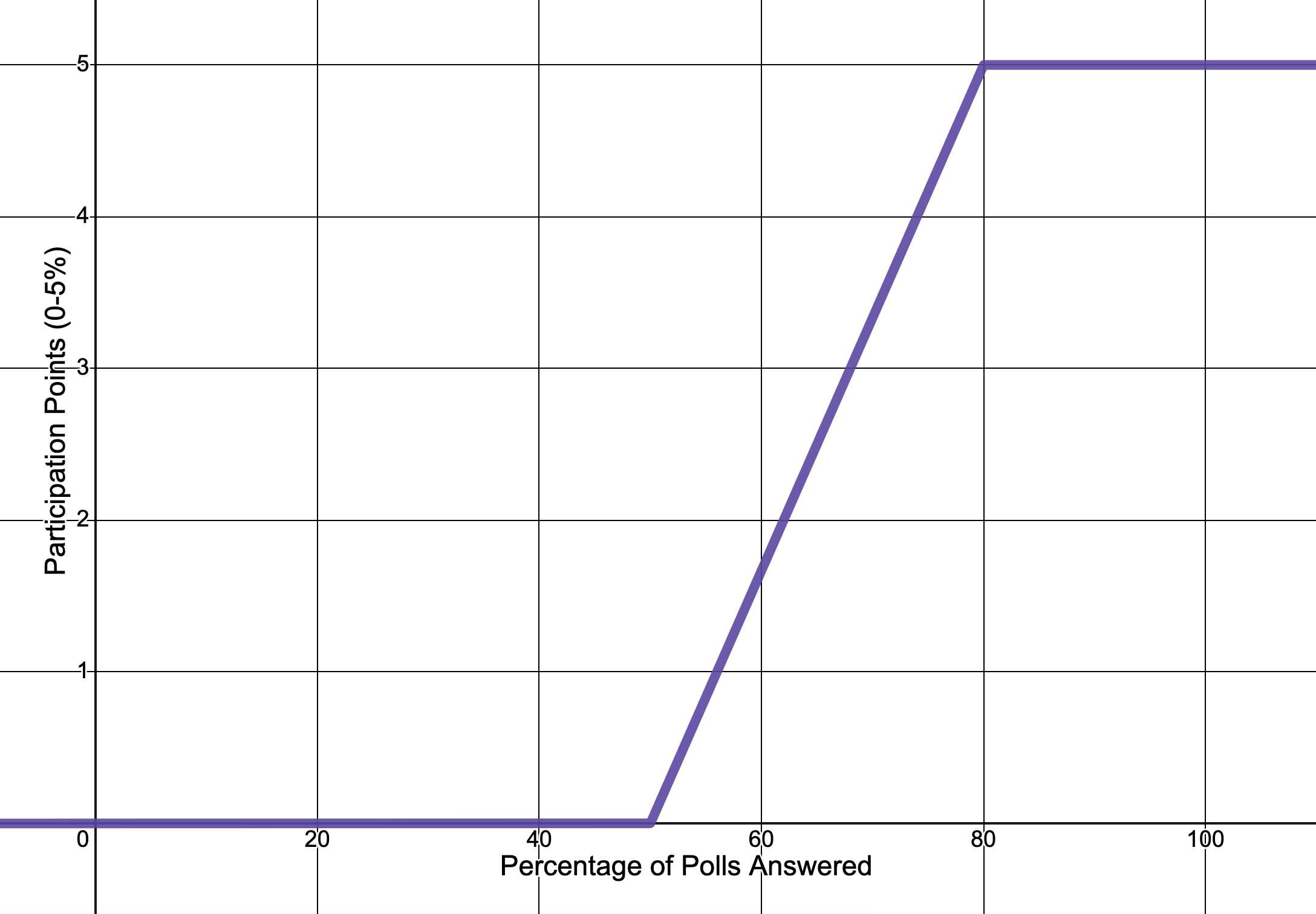
In class, we will use a series of polls as part of an active learning technique called Peer Instruction. Your participation grade will be based on the percentage of these in-class poll questions answered:
- 0% for 50% or less
- Full participation credit for 80% or greater poll participation
- Linear scale for values in between 50% and 80%
- Correctness of in-class polling responses will not be taken into account for participation grades.
- If a poll is duplicated with the same question (e.g. before and after discussing with your neighbor), you should answer all of the duplicated versions as well, as they will be counted as separate polls.
- If you have systemic/repeated technical issues, please let us know as soon as possible, so we can resolve the situation.
- Missing polls due to absences (e.g., brief illness) from lecture or due to technical difficulties is expected occasionally, and this is why you only need to answer >= 80% of the polls to get full credit.
It is against the course academic integrity policy to answer in-class polls when you are not present in lecture. Violations of this policy will be reported as an academic integrity violation. Information about academic integrity at CMU may be found at https://www.cmu.edu/academic-integrity.
Late Policies, and Extensions, and Exceptions
Participation
- Missing polls due to absences (e.g., brief illness) from lecture or due to technical difficulties is expected occasionally, and this is why you only need to answer >= 80% of the polls to get full credit.
- If you must miss many lectures due to circumstances outside of your control (e.g., if you have an extended illness) please make a private post on Piazza prior to lecture.
Quizzes
Quizzes cannot be rescheduled and don't have any extensions or late days. However, the lowest quiz score will be dropped when computing your semester score. See below for information on rare exceptions.
Pre-reading checkpoints
Pre-reading checkpoints don't have any extensions or late days. However, the lowest two checkpoints will be dropped when computing your semester score. Reasoning: We want to make sure that everyone is able to complete the pre-reading prior to lecture, so we can build on that knowledge in class; minor illness and other minor disruptive events outside of your control happen occasionally and thus dropping the lowest two scores. See below for information on rare exceptions.
Late days for written, programming, and online homework
You have a pool of 6 late days across all written, programming and online assignment types
- Use up to two per assignment number
- Components of an assignment with the same homework number are considered the same assignment; so e.g., if you turn in both programming and written components within 24 hours after the due date, you will use one late day, not two.
- You may use these at your discretion, but they are intended for minor illness and other disruptive events outside of your control, and not for poor time management.
- No need to inform us that you are using a late day; just submit it to Gradescope during the late day.
- You are responsible to keep track of your own late days. Gradescope will not enforce the total number of late days
- Homework submitted after these two late days or submitted by a student without any late days remaining will be given a score of 0.
Exceptions and extensions
Aside from late days, dropping the lowest quiz, dropping the lowest checkpoints, and the 80% threshold for participation, there will be no extensions on assignments in general. If you think you really really need an extension on a particular assignment, make a private post on Piazza (please do not email the instructors) as soon as possible and before the deadline. Please be aware that extensions are entirely discretionary and will be granted only in exceptional circumstances outside of your control (e.g., due to severe illness or major personal/family emergencies, but not for competitions, club-related events, or interviews). The instructors will require confirmation from your academic advisor, as appropriate.
We certainly understand that unfortunate things happen in life. However, not all unfortunate circumstances are valid reasons for an extension. Nearly all situations that make you run late on an assignment homework can be avoided with proper planning - often just starting early. Here are some examples:
- I have so many deadlines this week: you know your deadlines ahead of time - plan accordingly.
- It's a minute before the deadline and the network is down: you always have multiple submissions - it's not a good idea to wait for the deadline for your first submission.
- My computer crashed and I lost everything: Use Google Drive, Dropbox, or similar system to do real-time backup - recover your files and finish your homework from a cluster machine or borrowed computer.
AI Tools and Collaboration Policy
We encourage you to discuss course content and assignments with your classmates. However, these discussions must be kept at a conceptual level only. You may use generative AI tools to better learn course content, but they may not be used to generate any part of your assignment submission. (Yes, these tools are awesome and you should learn how to use them well.)
- You may NOT view, share, or communicate about any artifact that will be submitted as part of an assignment. Example artifacts include, but are not limited to: code, pseudocode, diagrams, and text.
- You may look at another student's Python error messages and discuss what the error means at a conceptual level. However, you may NOT give specific instructions to fix the error.
- All work that you present must be your own. Thus, generative AI tools may not be used to generate any part of your assignment submission.
- Using any external sources of code or algorithms in any way must
have approval from the instructor before submitting the work.
For example, you must get instructor approval before using an
algorithm you found online for implementing a heuristic function in a
programming assignment. The following are pre-approved exceptions:
- Code provided by the course staff or materials, including code from the textbook
- Documentation for permitted Python libraries
Programming component partners
The only exception to the above collaboration policy is when you share programming code directly with your programming assignment partner.
- You are allowed to work in groups of at most two on any programming componenet of each assignment, i.e. you and one partner
- You must still do ALL parts of written and online components on your own, including the written results and analysis from the programming component. (Naturally, you would have the same result figures if generated from the programming component).
- You must specify your partner when you submit the programming component of each assignment
- Once you start working with a partner on an assignment, you may not switch to another partner for that assignment
- You may change partners between assignments. In fact, you are strongly encouraged to change partners occasionally
- Important: You are responsible for making sure that both you AND your partner understand the work that you submit. If we discover that one partner cannot answer basic questions about the submitted work, both students in the group will be reported for an academic integrity violation.
Violations of these policies will be reported as an academic integrity violation. Information about academic integrity at CMU may be found at https://www.cmu.edu/academic-integrity. Please contact the instructor if you ever have any questions regarding academic integrity or these collaboration policies.
Accommodations for Students with Disabilities
If you have a disability and have an accommodations letter from the Disability Resources office, we encourage you to discuss your accommodations and needs with us as early in the semester as possible. We will work with you to ensure that accommodations are provided as appropriate. If you suspect that you may have a disability and would benefit from accommodations but are not yet registered with the Office of Disability Resources, we encourage you to visit their website.
Statement of Support for Students Health & Well-being
Take care of yourself. Do your best to maintain a healthy lifestyle
this semester by eating well, exercising, getting enough sleep, and
taking some time to relax. This will help you achieve your goals and
cope with stress.
All of us benefit from support during times of struggle. There are many
helpful resources available on campus and an important part of the
college experience is learning how to ask for help. Asking for support
sooner rather than later is almost always helpful.
If you or anyone you know experiences any academic stress, difficult
life events, or feelings like anxiety or depression, we strongly
encourage you to seek support. Counseling and Psychological Services
(CaPS) is here to help: call 412-268-2922 and visit their website at
http://www.cmu.edu/counseling/.
Consider reaching out to a friend, faculty or family member you trust
for help getting connected to the support that can help.
If you have questions about this or your coursework, please let us
know. Thank you, and have a great semester.
Frequently Asked Questions
- What are the prerequisites for 07-380?
- I took 10-301 instead of 07-280. Can I take 07-380?
- How often will 07-280 and 07-380 be offered?
- What topics will be covered in 07-380 AI & ML II?
What are the prerequisites for 07-380?
07-380 requires 07-280 AI & ML I and an introduction to probability theory course (36-225, 36-217, 15-259, 21-325, 15-359, 36-218, 36-219, or 36-235), with a minimum grade of C in each.
I took 10-301 instead of 07-280. Can I take 07-380?
10-301 together with 16-350 Planning Techniques for Robotics will count as equivalent to 07-280 for the purpose of the 07-380 prerequisite (16-350 can be taken as a co-requisite). We'll also check to make sure the 07-280 prerequisites were met. If this situation applies to you, email bsai@cs.cmu.edu to discuss your pathway.
How often will 07-280 and 07-380 be offered?
Both courses, 07-280 and 07-380, will be offered every semester (Fall and Spring), with 07-380 first being offered in Fall 2026.
What topics will be covered in 07-380 AI & ML II?
07-380 is designed to be more flexible in its topics from semester to semester, adapting based on our faculty's best understanding of what additional/advanced AI/ML topics students need to learn, especially those graduating with a major/minor in AI. It builds upon 07-280, so we'll be able to explore more advanced topics in greater depth, while also increasing the breadth of topics across all of AI.
See the Schedule for the topics planned for Fall 2026.