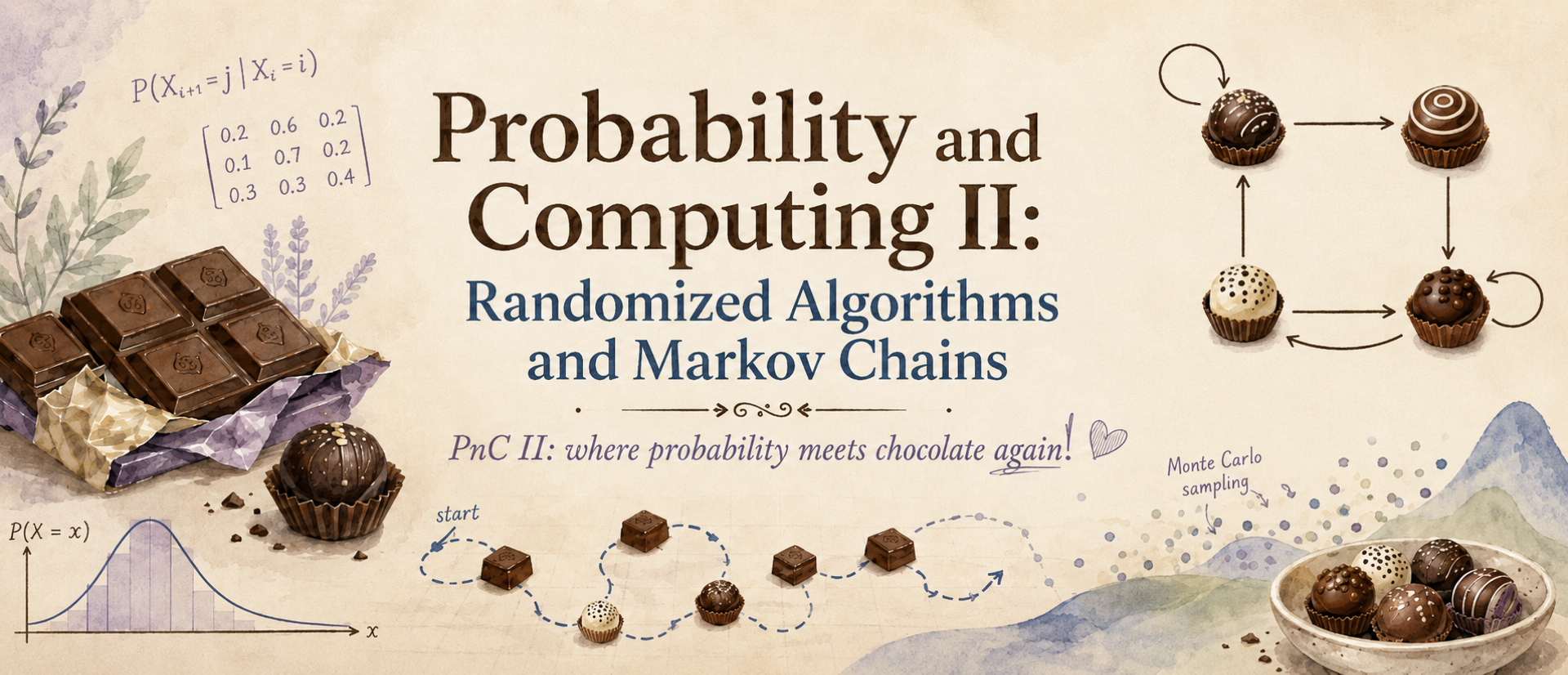
Probability and Computing II: Randomized Algorithms and Markov Chains
CMU 15-359/659 · Fall 2026
Course Info
Probability theory is indispensable in computer science:
- It is at the core of artificial intelligence and machine learning, which require decision making under uncertainty.
- It is integral to CS theory, where probabilistic analysis and randomization form the basis of many algorithms.
- It is a central part of performance modeling in computer networks and systems, where probability is used to predict delays, schedule resources, and provision capacity.
Key topics
- Concentration inequalities;
- Markov chains: finite-state Markov chains, countable-state Markov chains, limiting distribution, stationary distribution, ergodicity, long-run average, mixing time, Poincaré inequality;
- Randomized algorithms: Markov-chain Monte Carlo, hashing algorithms, randomized Quicksort, randomized program checking.
Prerequisites
Students should have a solid background in probability, linear algebra, and proof writing.
Textbook

The course textbook is Introduction to Probability for Computing by Prof. Mor Harchol-Balter. We will cover Chapters 18–27, plus additional topics such as mixing time analysis of Markov chains and Markov-chain Monte Carlo. The book is freely available online at the following URL:
Schedule
Lectures
Lecture schedule is subject to changes.
| Week | Date | Topic | Reading |
|---|---|---|---|
| 1 | 8/25 | Probability review | Textbook, Chapters 1-17 |
| 1 | 8/27 | Calibration test | |
| 2 | 9/1 | Finite-state Markov chains | Textbook, Chapter 24 |
| 2 | 9/3 | Markov chains cont'd | Textbook, Chapter 24 |
| 3 | 9/8 | Ergodicity | Textbook, Chapter 25 |
| 3 | 9/10 | Ergodicity cont'd | Textbook, Chapter 25 |
| 4 | 9/15 | Sampling, MCMC | Lecture notes |
| 4 | 9/17 | Markov chains mixing time | Lecture notes |
| 5 | 9/22 | Midterm 1 | |
| 5 | 9/24 | Poincaré inequality | Lecture notes |
| 6 | 9/29 | Conductance | Lecture notes |
| 6 | 10/1 | Infinite-state Markov chains | |
| 7 | 10/6 | Infinite-state Markov chains cont'd | Textbook, Chapter 26 |
| 7 | 10/8 | Tail bounds | Textbook, Chapter 18 |
| Fall break | |||
| 8 | 10/20 | Tail bounds cont'd | Textbook, Chapters 18 & 19 |
| 8 | 10/22 | Random graphs | Lecture notes |
| 9 | 10/27 | Random graphs cont'd | Lecture notes |
| 9 | 10/29 | Hashing | Textbook, Chapter 20 |
| 10 | 11/3 | Democracy Day, no class | |
| 10 | 11/5 | Midterm 2 | |
| 11 | 11/10 | Hashing cont'd | Textbook, Chapter 20 |
| 11 | 11/12 | Las Vegas algorithms | Textbook, Chapter 21 |
| 12 | 11/17 | Monte Carlo algorithms | Textbook, Chapter 22 |
| 12 | 11/19 | Monte Carlo algorithms cont'd | Textbook, Chapter 22 |
| 13 | 11/24 | Correlation clustering | Lecture notes |
| 13 | 11/26 | Thanksgiving, no class | |
| 14 | 12/1 | Primality testing | Textbook, Chapter 23 |
| 14 | 12/3 | Presentations | |
Homework
Homework is due each week on Friday at 12:50 pm on Gradescope. There are no extensions or exceptions. The lowest homework score will be dropped.
- Homework 1, due 12:50 pm on 9/4/2026: Exercises 2.27, 3.14, 4.10, 4.19, 5.7, 8.22 in the textbook.
- Homework 2, due 12:50 pm on 9/11/2026: Exercises 24.2, 24.5, 24.7, 24.8, 24.10, 25.17 in the textbook.
- Homework 3, due 12:50 pm on 9/18/2026: Exercises 25.2, 25.4, 25.8, 25.15, 25.18, 25.19 in the textbook.
- Homework 4, due 12:50 pm on 9/25/2026: [Homework 4 Problems]
- Homework 5, due 12:50 pm on 10/2/2026: [Homework 5 Problems]
- Homework 6, due 12:50 pm on 10/9/2026: Exercises 26.10, 26.16, 26.20, 26.24 in the textbook, plus another problem in this file [Homework 6 Problems]
Special homework
- Special Homework 1, basic part due 12:50 pm on 10/30/2026, advanced part due 12:50 pm on 11/20/2026: [Special Homework 1]
Staff
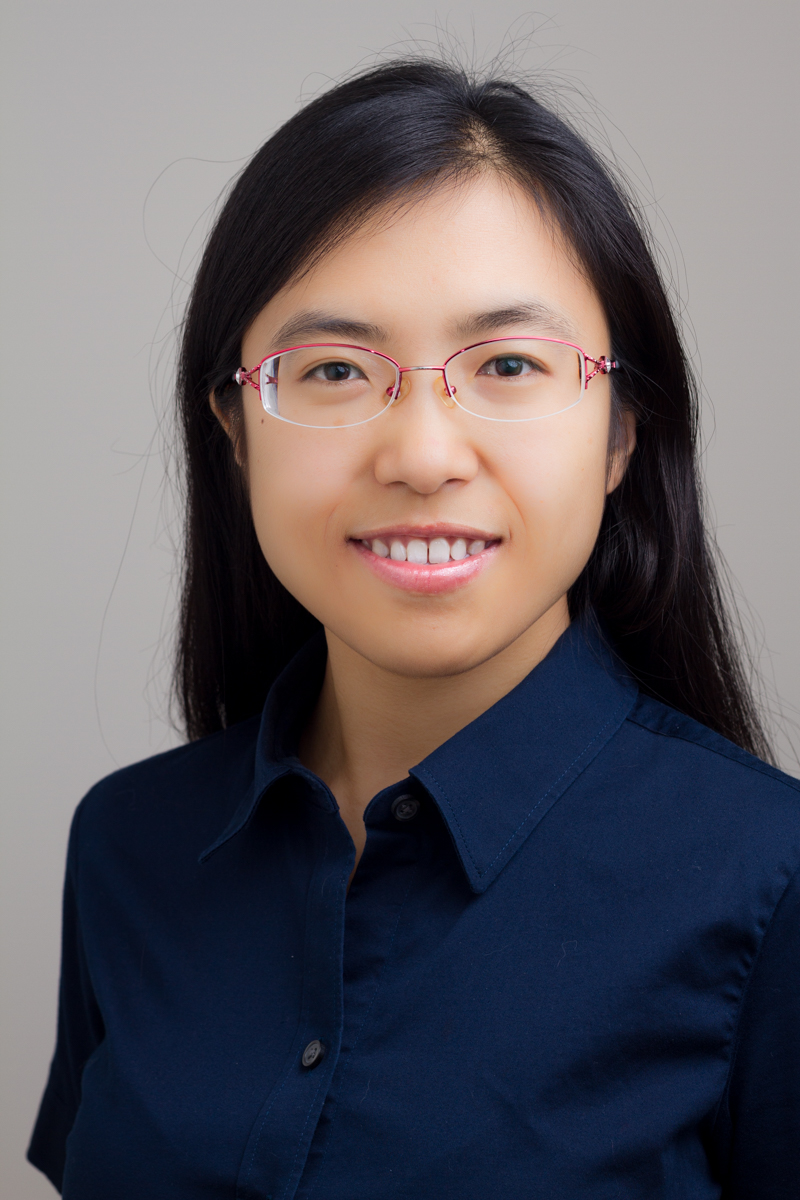

Office Hours
Weina Wang: Tuesday, 1:30 pm - 3 pm, GHC 7001
Josh Nichols: Thursday, 7 pm - 8:30 pm, GHC 7501
Policies
In-class
Attendance is required. Laptops are not allowed. Tablets can only be used for note taking.
Grading
- Homework: 10%
- Special homework: 10%
- Quiz: 10%
- Midterm 1: 20% or 25% *
- Midterm 2: 20% or 25% *
- Final: 25%
* The higher one between Midterm 1 and Midterm 2 is worth 25%, and the lower one is worth 20%.
All assignments and exams will be graded on Gradescope.
The lowest homework score will be dropped. The lowest quiz score will be dropped. Please reserve the drops for when you get sick or have another conflict, because there are no makeups or extensions for homeworks and quizzes.
Grade Boundaries: A: 90–100%, B: 80–90%, C: 70–80%, D: 60–70%. These boundaries are hard cutoffs. Do not expect an overall curve at the end. Individual examinations may be curved at the instructor's discretion.
Lateness: Homework will go out each week on Friday. When the homework goes out, you already have all the material you need to do it that day. Homework will be due each week the following Friday at 12:50 (midday) sharp. Start right away! You must get the homework in on time because we give out solutions during recitation. There are no late days (not even late minutes). Please do not ask for these. Homework is graded within a couple days. You can submit a regrade request on Gradescope (including a detailed explanation of why you think you were misgraded) within two days of when you get your homework grade. You will find the homework under the Homework tab from the class website. You will turn in homework on Gradescope, which will also track your grades.
Collaboration
We believe in collaboration. Discussing problems with others helps you learn better. If you collaborate with others, try to get "hints" rather than "answers." You should write up your actual homework on your own. If you use an outside source (web site, book, person, etc.), you must cite that source. At the top of your homework sheet, you must list all the people with whom you discussed any problem. Even if you were the one doing the helping, you should list the other person. Crediting discussion with others will not take away any credit from you, and will prevent us from assuming cheating if your answers look similar to those of someone else. The above is the standard policy in all of academia.
Academic Integrity
PnC admits a zero-tolerance policy on cheating. All exams must be done entirely by you with zero consultation from unauthorized sources (e.g., people, web, LLMs). Any incident of cheating during an exam will result in a failing grade for the entire course, and referral to the Office of Community Responsibility for an Academic Integrity Violation proceedings. Students should familiarize themselves with the University Policy on Academic Integrity and Academic Integrity Actions Procedures chapter of the Student Handbook.
AI use. You can use AI tools such as LLMs to help you learn. However, these should be used with caution. You may miss the critical training of your mind if you rely on AI tools to solve problems. Our course policy requires that you write up your own homework solutions and be responsible for them. The quizzes will be on homework problems.
Wellbeing
If you are experiencing distress (mentally, physically, or emotionally) that is making it difficult for you to work and make progress in the class, we are here to help you. Please reach out to Weina so we can meet and discuss.