| Front Page |
| Broadcast Your Own Events |
| Tune In DLS Now! |
| About E.S.M. |
| F.A.Q |
| Troubleshooting |
| Feedback Form |
| Mailing List |
| Broadcast Details |
|
Publisher Login |
|
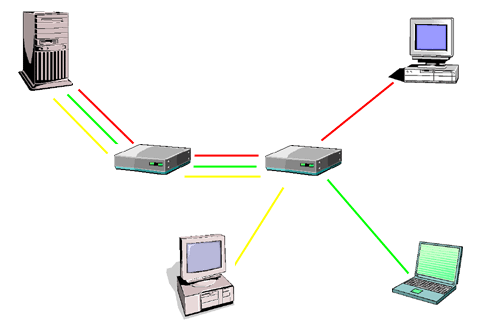
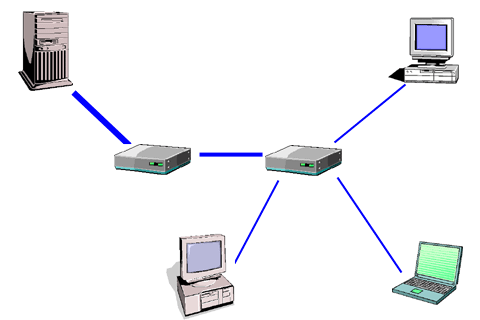
A High Level Overview of ESM Imagine that you want to setup a school/college TV station on the Internet. You estimated the number of people tuning in to your broadcast to be around 100 at any point of time. How much resources do you need to achieve that? The answer depends on how you set it up! If you have all your audience connect to one webserver, you will probably overwhelm the webserver in terms of bandwidth. In other words, you'll need to purchase a very expensive Internet connection in order to feed audio/video stream to many people.
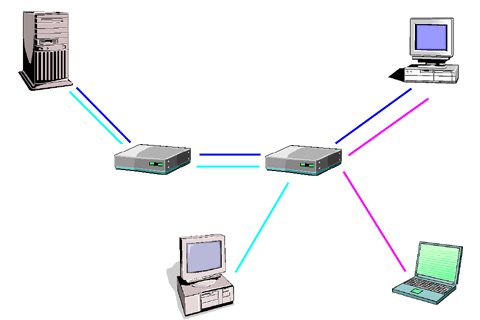
Ideally, you would like the routers (the machines in the core of the network) to take in one copy of the TV program, and duplicate it to as many end host as necessary. Unfortunately, this requires a large amount of resource allocation in the core of our Internet. Internet Service Providers typically do not provide that service.
Here's the brilliant insight: Why don't we ask the end host (your computer) to look for some other end host who is currently tuned into the channel for data? This way, your webserver will only need to support a small finite number of 'children', and those 'children' will then forward the content instantly to their 'chlidren' and so on.
There lies the power of ESM. You can potential broadcast your program to everyone else in the world with maybe just a simple 10 BaseT Ethernet connection. ESM is an efficient real time content distribution system. It constructs a self-organizing and adaptive overlay network using the receivers that are tuning into the broadcast events. It has the potential for being used as a distant learning tool, or online radio / TV stations, or personal event (e.g. birthday / wedding) broadcaster, or any possible multimedia streaming application in Real Time! |