Using demonstrations to teach robot decision-making to humans
PhD Student: Michael Lee
Undergraduate Students: Vignesh Rajmohan
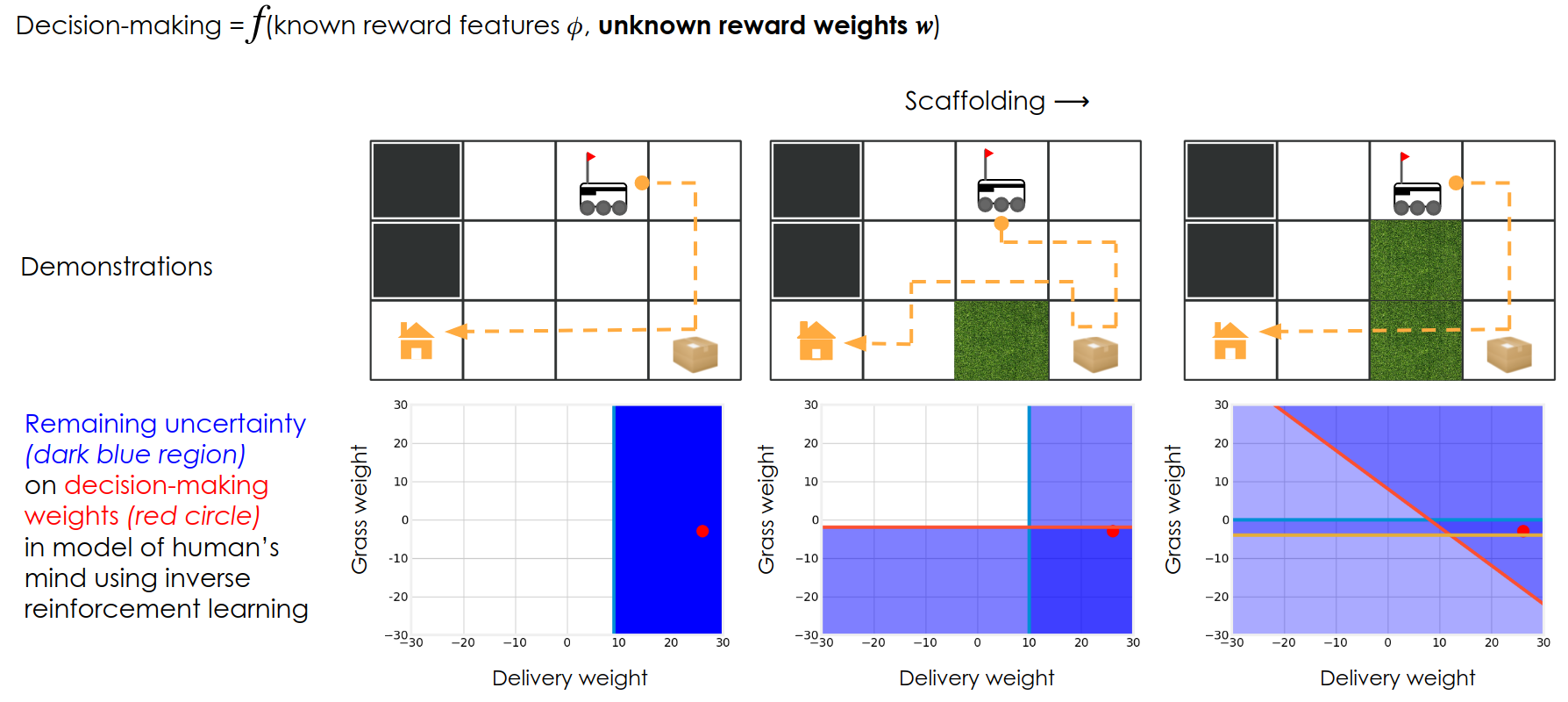
Our capacity to deploy, collaborate, and co-exist fluently with robots is contingent on our ability to understand their decision-making. For example, we likely wouldn't rely on them until we could reliably predict their decision-making and subsequent behavior in new situations. Thus we are designing agents that can teach humans their decision-making through demonstrations. We model humans as inverse reinforcement learners and leverage human learning strategies (e.g. scaffolding) to select demonstrations that are both informative and easily understood by humans.
In this research, we assume that the robot’s decision-making is captured by its reward function, comprised of reward features known to a human learner and reward weights unknown to the human learner. Thus we seek to convey the unknown reward weights to a human through demonstrations and inverse reinforcement learning.
Counterfactual Examples for Human Inverse Reinforcement Learning:
Michael S. Lee, Henny Admoni, and Reid Simmons. International Joint Conference on Artificial Intelligence (IJCAI), 2022. Under review.
Counterfactual Examples for Human Inverse Reinforcement Learning:
Michael S. Lee, Henny Admoni, and Reid Simmons. Workshop on Explainable Agency in Artificial Intelligence at AAAI 2022.
Machine Teaching for Human Inverse Reinforcement Learning:
Michael S. Lee, Henny Admoni, and Reid Simmons. Frontiers in Robotics and AI 2021.
Robot Teaching for Human Inverse Reinforcement Learning:
Michael S. Lee, Henny Admoni, and Reid Simmons. Workshop on Robots for Learning at HRI 2021.