>
Project 3 : Engineering Activity Kits
The Mystery of Crystals: a Materials Science Perspective
Team members: Autumn Wyda,
Tommy Figiel, & Naoki Kimura
Snow Crystal
Growing
Teacher
Demonstration
Links
Main
The Story
Instructions for Kids
Instructions
for the Teacher
Demo for the Teacher
Pictures
Crystal
Growing Chamber
- One
used 20-oz plastic Coke bottle
- Three
large-diameter styrofoam cups (or something
similar; see below)
- A
small kitchen sponge (1/2 inch thick)
- A
short length of nylon fishing line (thinner is better; 1-pound test
is good)
- A
strong sewing needle
- Four
straight pins
- One
paper clip
- Some
paper towels
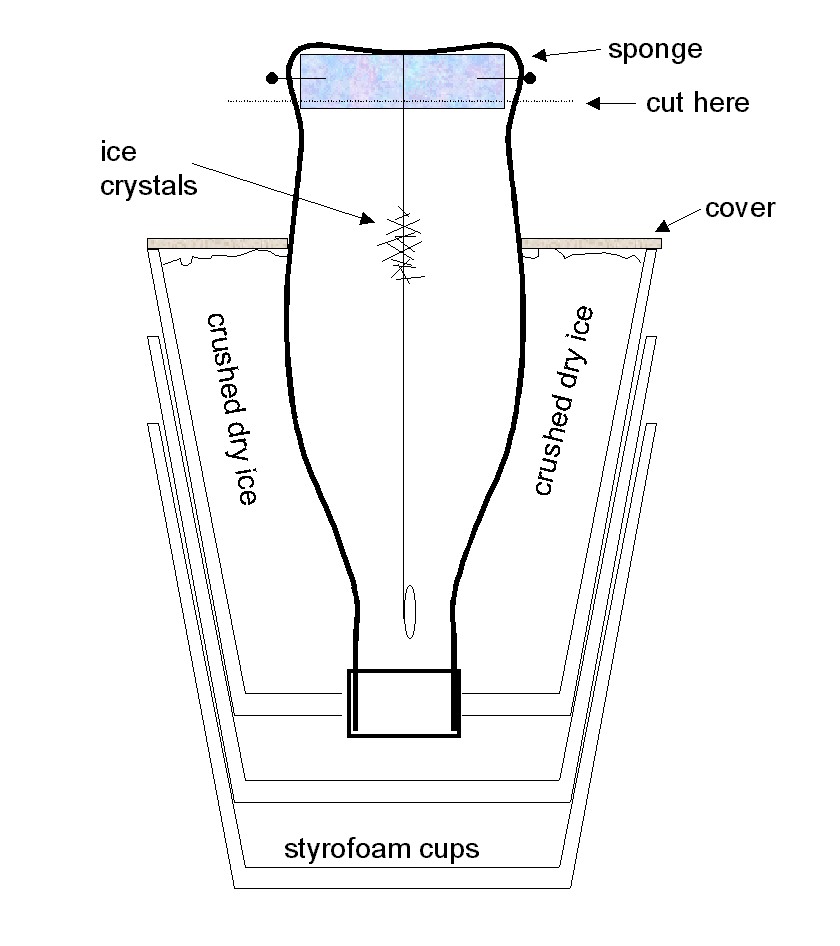
Step 1. Rinse the Coke bottle. Use a sharp knife to cut the bottle in two,
about 1/2 inch above the bottom, as shown in
the figure. Poke a hole in the center of the bottle bottom using
the sewing needle, and also poke four holes in the side of the bottle
bottom. Make a small round sponge to fit inside the bottle bottom,
and hold the sponge in place by putting the four straight pins into
the side holes you made (see figure).

Step 2. Thread the fishing line into
the sewing needle, and push the needle through the hole in the bottle
bottom, and through the sponge. Attach the fishing line to the
bottle bottom with a piece of tape, and tie a knot in the other end
to hold the paper clip. When the Coke bottle is inverted and reassembled,
the string should swing freely inside the bottle, as shown in the figure.
Step 3. Place the inverted Coke bottle
inside the three styrofoam
cups, as shown, so that the bottom of the Coke label is at the same
height as the top of the cups (see figure). There should be about
one inch of clear space between the sides of the Coke bottle and the
top edge of the styrofoam cups.
Step 4. Fill the cup surrounding the coke bottle with
dry ice. Cover this part with
paper towels or a piece of fitting cardboard.
Also place paper towels around the Styrofoam cup to keep it from
sweating.
Step 5. Pull the top off the chamber
(the bottle bottom + sponge), wet the sponge with tap water, and replace. Small crystals should begin to grow after a
few minutes.
Understanding Snow Crystal Growth
|
Premise for
Crystal Growth. Water evaporates
from the wet sponge and diffuses through the air in the bottle.
When the water vapor mixes with the cold air in the lower part
of the bottle, the air becomes supersaturated, meaning that the
water vapor will condense as ice onto any convenient object.
Thus ice crystals will form on the string and on the walls of
the bottle. This apparatus, warm on top and cool on the
bottom, is called a diffusion
chamber. |
|
Saturated air. If water is added to a closed bottle then
the air in the container soon becomes saturated with
water vapor. Saturated air has a relative humidity of 100
percent. Saturated air is the equilibrium state whenever
there's lots of water around. Thus when it's raining, or
foggy, the humidity of the air outside is close to 100 percent. |
|
Supersaturated air. In
the growth chamber we create supersaturated air, which
has a relative humidity of over 100 percent (in fact it's around
200 percent). This is called a non-equilibrium state, or
a metastable state. Left to itself,
a box of supersaturated air will not stay supersaturated, since
water or ice will condense onto the walls of the box, and the
humidity will drop to 100 percent (the equilibrium or stable state).
Supersaturated air is made all the time in the atmosphere (typically
when warm moist air mixes with cooler air), and is responsible
for rain and snow.
Supersaturated air condenses
into water droplets if the temperature is above 0C, and condenses
to ice crystals (snow) if the air temperature is below 0C.
Note that snow crystals are not just frozen water droplets.
Rather they are crystals that grow in supersaturated air that
is below freezing. |
|
Nucleation Supersaturated air doesn't automatically
condense to produce droplets of rain (or snow). This only
happens when there is some nucleation site on which condensation
can occur. (This is supersaturated air is called a metastable state -- it's not stable, but it can
hang around for quite a while.)
The reason for this is that very tiny droplets of
water (or ice), just a few hundred molecules or so, have a higher
vapor pressure than bulk water (or ice). The molecules in
such small droplets aren't bound very strongly, which means they
come off easily, which is the same as saying they have a higher
vapor pressure. If such small droplets form in supersaturated
air, they don't grow, but rather just evaporate away. If
a large droplet forms, it will grow -- but large droplets can't
just appear spontaneously out of thin air.
In the growth chamber we provide a string to nucleate
ice crystal growth. On a microscopic scale there are scratches
and other imperfections on the string, and even individual water
molecules can bind to these imperfections. Once we get a
small ice crystal started, it will continue growing.
In the atmosphere there are lots of dust particles,
and these make dandy nucleation sites. Rain droplets and
snow crystals usually each contain a dust particle, on which the
growth got started. |
|
Diffusion. In our growth
chamber the top is warm and the bottom is cool. Since warm
air is lighter than cool air, the air in the chamber doesn't undergo
convection. The air at the top of the chamber becomes saturated
with water vapor because it is right next to the moist sponge.
At this point the humidity is 100 percent. Diffusion happens
because the air and water molecules are all moving and colliding
with one another, which mixes things
up on a microscopic scale. If you open a bottle of perfume
in a still room, or put a drop of food coloring in a still glass
of water, it is also diffusion that does the mixing.
In the growth chamber, diffusion causes the water
molecules to diffuse down from the top. As they diffuse
down, they mix into a region where the air temperature is much
lower. This is like taking saturated air and cooling it
down, with the result that the air becomes supersaturated, so
ice crystals can form. |
|
Faceted crystal growth.
Why do ice crystals form facets? This is because of the
molecular structure of the ice crystal. If we take an ice
crystal and cut it in some random direction, the resulting surface
will typically be quite rough on a molecular scale, and the molecule-sized
kinks will be very attractive to water molecules in the vapor.
Thus the ragged surface will grow fast in supersaturated air.
If we cut the crystal along a special plane, however, one of the
crystal facets, then the resulting surface will be very smooth,
without any molecule-size kinks. Molecules in the vapor
phase don't stick well to such a smooth surface, so it tends to
grow much more slowly than a ragged surface.
 So now consider starting with a spherical ice droplet. Wherever
the surface is ragged, the crystal will grow rapidly, but along
the facets the crystal will grow slowly. Thus the ragged
surfaces fill in, leaving nothing but faceted surfaces.
Thus we're soon left with a slow-growing faceted crystal, as observed.
So now consider starting with a spherical ice droplet. Wherever
the surface is ragged, the crystal will grow rapidly, but along
the facets the crystal will grow slowly. Thus the ragged
surfaces fill in, leaving nothing but faceted surfaces.
Thus we're soon left with a slow-growing faceted crystal, as observed. |
|
 Phase Diagrams. Why does water ice melt
into a liquid, while dry ice turns into a gas? The two materials
are really not so dissimilar, as can be seen in their phase diagrams
at right. Both have solid, liquid, and gaseous phases, which
occur at different temperatures and pressures. However at
a pressure of one atmosphere, which happens to be where we live,
dry ice can only exist in the solid or gaseous phases; liquid
CO2 only exists at higher pressures. Thus water
ice is wet, and dry ice is dry. Why the phase diagrams look
like they do is of course a deeper question, since it depends
in detail on the interactions between molecules.
Phase Diagrams. Why does water ice melt
into a liquid, while dry ice turns into a gas? The two materials
are really not so dissimilar, as can be seen in their phase diagrams
at right. Both have solid, liquid, and gaseous phases, which
occur at different temperatures and pressures. However at
a pressure of one atmosphere, which happens to be where we live,
dry ice can only exist in the solid or gaseous phases; liquid
CO2 only exists at higher pressures. Thus water
ice is wet, and dry ice is dry. Why the phase diagrams look
like they do is of course a deeper question, since it depends
in detail on the interactions between molecules. |
|
Snow Crystal Growth - Observations
|
|
Fishbones
and Dendrites. If you look closely, you can observe both needle-like
and plate-like growth in your growth chamber. The easiest
forms to identify are the dendrites that form at -15C, especially
if you let the crystals grow to a large size. Above those
will be the fishbones, which are a type of needle growth that
grows at -5C. |
|
 Dendrites. The schematic diagram
on the left shows what a -15C dendrite should look like.
It has a distinctive fern-like character, and the angles between
the branches and the stem are nearly exactly 60 degrees.
The hexagonal plate in the sketch shows you the crystal orientation.
Dendrites. The schematic diagram
on the left shows what a -15C dendrite should look like.
It has a distinctive fern-like character, and the angles between
the branches and the stem are nearly exactly 60 degrees.
The hexagonal plate in the sketch shows you the crystal orientation.

When a snow crystal grows from air supersaturated
with water vapor, there are two dominant mechanisms that govern
the growth rate.
- The first is diffusion
-- the way water molecules must diffuse through the air to reach
the crystal surface.
- The second involves the
surface physics of ice -- the efficiency with
which water molecules attach themselves to the ice crystal lattice.


|
|
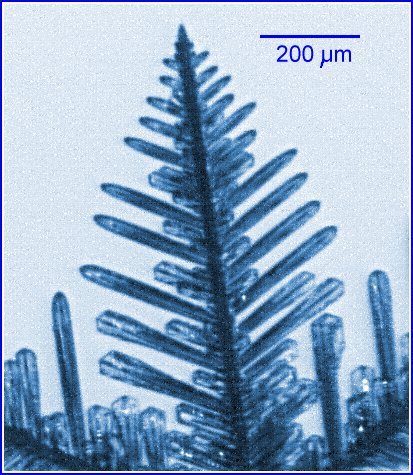
 Fishbones.
The -5C fishbones are harder to recognize, since they
don't exhibit the nice 60-degree angles like the dendrites.
The crystals have a feather-like appearance, and each of the individual
branches is a needle-like crystal growing along the a-axis.
The photo shows a particularly good fishbone example grown in
a Coke-bottle growth chamber.
Fishbones.
The -5C fishbones are harder to recognize, since they
don't exhibit the nice 60-degree angles like the dendrites.
The crystals have a feather-like appearance, and each of the individual
branches is a needle-like crystal growing along the a-axis.
The photo shows a particularly good fishbone example grown in
a Coke-bottle growth chamber.
 Many things affect the shape of a snow crystal. Some variables
are the number of molecules in the crystal, the temperature, the surface structure, and how
vapor molecules are incorporated onto the growing surfaces. Because so many variables are at play,
it is unlikely that we will see two snow crystals that are exactly
alike!
Many things affect the shape of a snow crystal. Some variables
are the number of molecules in the crystal, the temperature, the surface structure, and how
vapor molecules are incorporated onto the growing surfaces. Because so many variables are at play,
it is unlikely that we will see two snow crystals that are exactly
alike!
|
| Information
Courtesy http://www.its.caltech.edu/~atomic/snowcrystals/ |
|