Nov 11, 2025
Gave a guest lecture giving an overview of
Privacy and Security for Pervasive Computing.
This is a good 90-min crash course on privacy and security.
Nov 11, 2025
Gave a keynote talk at the Workshop on Trustworthy and Privacy-Preserving Human-AI Collaboration entitled
Auditing AI Systems for Bias and Fairness.
This talk summarizes our team's past 6 years of research on this topic.
Oct 24, 2025
Gave a talk at PGH Techfest entitled
The Promise and Perils of AI for Products
Oct 21, 2025
Our paper
WeAudit: Scaffolding User Auditors and AI Practitioners in Auditing Generative AI won Best Paper Award at CSCW 2025.
This paper looks at how to facilitate user-engaged auditing of AI systems.
Oct 19, 2025
Gave a keynote talk at Human-Centered AI Privacy and Security (HAIPS) workshop at CCS, on Auditing AI Systems for Bias and Fairness.
Dec 31, 2024
I am now officially (youngest?) Professor Emeritus at Carnegie Mellon University. I'm still doing some research on Responsible AI at CMU, while also working on new startup at the intersection of AI + HCI.
Oct 18, 2024
Our paper
Investigating What Factors Influence Users’ Rating of Harmful Algorithmic Bias and Discrimination won a Best Paper Award at HCOMP 2024. The basic idea was to evaluate what kinds of biases people are more likely to find in image-based generative AI, based on their own demographics (race, gender, sexual orientation).
Feb 27, 2024
I gave a talk entitled
An Overview of Privacy for Mobile Sensing Systems for the
mDOT NIH Center. This talk is a good crash course in privacy.
Feb 8, 2024
Along with several of my colleagues at CMU, I was named a
2024 Microsoft Research AI & Society fellow to do work on to do work on
Regulating AI in Light of the Challenges of Doing Responsible AI in Practice.
Dec 13, 2023
Gave distinguished lecture at Univ Wisconsin-Madison entitled
Helping Developers with Privacy. This talk summarizes our team's past decade of work on studying developers and building better tools.

Nov 20, 2023
New book chapter entitled
Designing for Privacy in Mobile Sensing Systems, in the book
Mobile Sensing in Psychology: Methods and Applications.
I tried to summarize everything I know about legal, philosophical, design, and technical issues about privacy in this chapter.

July 25, 2023
My blog post
What Can the FATE Community Learn from the Successes and Failures in Privacy? was published in CACM August 2023 issue.
May 27, 2023
I had the honor of being the 2023 commencement speaker at the South Carolina Governor's School for Science and Math, my alma mater.
See the text of the speech or video here.
Apr 20, 2023
Our paper
What makes people install a COVID-19 contact-tracing app? Understanding the influence of app design and individual difference on contact-tracing app adoption intention won Best Research Paper 2019-2021 in Pervasive and Mobile Computing. This paper presents the results of a large survey examining how different factors influence people's behaviors.
Apr 4, 2023
Our paper
Understanding Frontline Workers’ and Unhoused Individuals’ Perspectives on AI Used in Homeless Services won a Best Paper Award at CHI 2023. This paper examined what factors frontline workers and homeless individuals thought should be incorporated in AI algorithms for housing for homeless people, using a comic book storyboarding method.
Jan 19, 2023
I was named an ACM Fellow
"for contributions to ubiquitous computing and to usable privacy and security"
Jun 7, 2022
Our work on
Livehoods won ICWSM Test of Time award! See the
press release and
livehoods.org web site. This paper pioneered the use of social media to understand cities.
Nov 23, 2021
Our paper on
Software-Defined Cooking Using a Microwave Oven is a Research Highlight in the Dec 2021 issue of CACM. This paper looks at how to control microwave heating for precision cooking.
Apr 27, 2021
New paper on arxiv summarizing our work on DARPA Brandeis project for smartphone privacy:
The Design of the User Interfaces for Privacy Enhancements for Android.
Apr 24, 2021
Use our
SA-6 and
SA-13 survey instrument to assess people's security attitudes. You can also
take the SA-6 quiz online here.
Feb 14, 2020
I'm now a member of
CHI Academy!
Mar 5, 2019
My wife and I helped found two junior faculty chairs in the Human-Computer Interaction Institute at CMU.
Nov 30, 2018
Our team has released the
MobiPurpose data set.
It contains over 2 million unique intercepted traffic requests from 15k+ smartphone apps, gathered from our array of smartphones.
Mar 1, 2018
Wombat Security, which I co-founded in 2008, was acquired by Proofpoint
May 29, 2017
I was recently honored with Alumni of the Year from my old high school,
South Carolina Governor's School for Science and Math.
Here is a link to my speech at the commencement.
May 16, 2017
The HCII and the Tepper School of Business are offering a
new Master's Degree of Product Management. I'm helping to run the HCII side.
Jun 7, 2016
White paper with New America entitled Toward a Safe and Secure Internet of Things.
Sep 9, 2015
Presented some of
our team's work on using smartphones for healthcare at the World Economic Forum at Dalian.
Aug 13, 2015
Our CCS 2014 paper
Increasing Security Sensitivity with Social Proof: A Large-Scale Experimental Confirmation won Honorable Mention at
NSA's Best Scientific Cybersecurity Paper Competition.
Dec 26, 2014
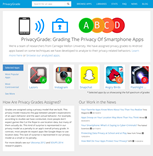
PrivacyGrade.org presents our privacy analysis of 1 million Android apps.
Our work has appeared on
CNN,
US News and World Report,
New York Times,
CNBC,
IEEE Spectrum,
Forbes, and more.
Sep 17, 2014
My brother and I have created the
Frances and Chou-Chu Hong graduate fellowship at the Veterinary and Animal Sciences Department at the University of Massachusetts.
Oct 25, 2013
Gave a talk at
PopTech 2013 on sensing and privacy. See
slides and
video here.
Apr 9, 2012
Livehoods.org re-imagines how cities work in the age of social media.
Livehoods has been featured in
The Atlantic Cities,
Wired Insider,
MIT Technology Review,
Fast Company Co.Design,
New York Post,
Wall Street Journal, and
Haaretz.