Nicolas Paris, Ibuki Kamei, Daniel Miller
39-245 Rapid Prototyping Design
Introduction
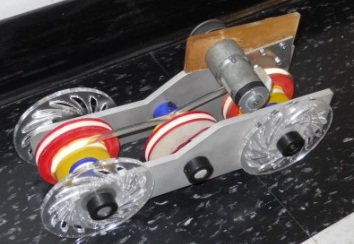
The goal of the Pulley Drag Race is to teach children the fundamental relation between pulley ratios and torque/speed tradeoffs. Drawing inspiration from the speed changing mechanisms found in drill presses and mills, we have created a car that allows children to discover how a change in pulley ratio results in a change of both torque and speed.
Design Goals
Manufacturing Basics
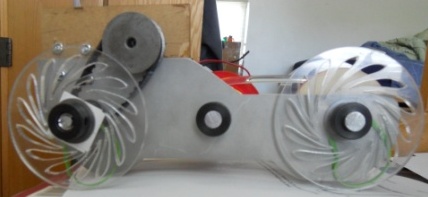
The pulley cars exemplify the use of common manufacturing equipment including a mill, lathe, band saw, and laser cutter. The pulleys were cut on the lathe out of Ultra-Machinable Urethane Foam, while the 1/4“ aluminum sides were rough-cut on the bandsaw and milled to size. Finally, the wheels were precision-cut out of 1/8” acrylic on the laser cutter. All work was modeled before construction using CAD software.
Car Manufacturing Instructions
Notes on the Car
Dimensions:
Motor:
Available Pulley ratios:
Toy Use
The Pulley Drag Race pits two matched cars against each other in a race on a confined track. Children record their times, changing pulley ratios between races. By forcing the pulley ratio to be the only variable, children quickly and intuitively learn the linearly inverse relation between torque and speed.
Activity Sheets
This activity sheet can be used to evaluate child's knowledge of changing gear ratios. The sheet gives the child a basic introduction to effect of the different colored gears and sizes on the speed. The chilkd will then be able to test his/her new-found knowledge by trying to get the car to move the fastest. This will indirectly teach them the relationship between speed and torque losses and gains with gear ratios.
This handout includes all of the basic knowledge that the child should learn while participating in the pulley car drag race. The handout also includes more complex information and relationships between gear ratio and torque.
Acknowledgements
We would like to thank Susan Finger for access to resources and guidance and Larry Hayhurst for use of the Collaborative Machining Center at Carnegie Mellon Univeristy, Pittsburgh PA, 15213.