
Breakdown of the Pulley Car system:
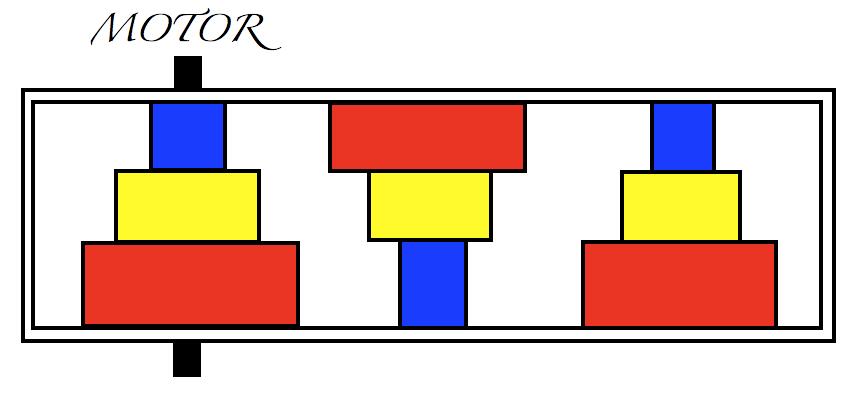
The Pulley Car has three main gear sets. Each set has three gear ratios. The ratios move from big to medium to small, and there respective associated colors are red to yellow to blue. With this set up, there a five possible gear ratios:
With these combinations of pulleys and gears, children can learn the fundamentals of gear ratios (size relations) and the relationship these ratios have with torque and speed. Much like the gears on a mountain bike, these gears compensate gear size for desired speed and push. When a large gear is connected to a small gear, the linear speed imparted by the pulley belt is the same on both gears, but the smaller gear will turn with a faster angular velocity. When a small gear is connected to a larger gear, the larger gear will turn slower, but it will produce more torque. When two gears of the same size are connected, the speed and torque of the first gear are conserved in the second gear.
Lab Procedure:
By first introducing a child to the “Medium speed some torque” condition, the child will learn a baseline speed to which he or she can compare the next tests to. In this lab, speed is related directly to finishing track time. In the second test, the pulleys are placed: Red to Blue & Red to Blue. This condition should produce the fastest result. After this trial, the pulleys will be changed to: Blue to Red & Blue to Red. In this test, the car should be the slowest but the torque should be at a maximum. Finally the child can apply his knowledge to a pulley set up of his or her own.