|
Two filtering algorithms
have been developed to distinguish undesired motion from intended
motion: 1.
Tremor –
Weighted-frequency Fourier Linear Combiner (WFLC) 2.
Non-tremulous
errors – Cascaded neural networks with extended Kalman filtering Weighted-frequency
Fourier Linear Combiner (WFLC)
The WFLC is a nonlinear
adaptive noise canceling algorithm that models the tremor as a sinusoid
and tracks its modulation in frequency, phase, and amplitude. In
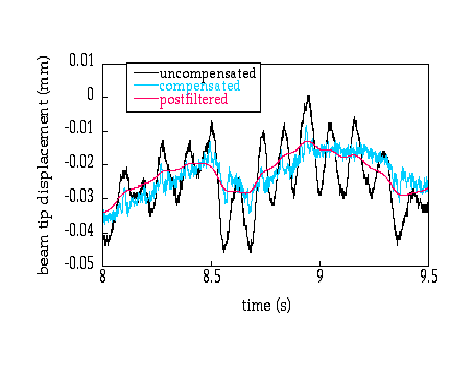
preliminary experiments with a 1-dof instrument, active canceling of
recorded tremor by a system based on the WFLC demonstrated an average
rms amplitude reduction of 69%. Fig. 1 presents typical results from
these experiments. The algorithm has also been used for canceling of
pathological tremor in assistive computer interfaces.
Publications:
1.
Adaptive canceling
of physiological tremor for improved precision in microsurgery 2. Modeling and
canceling tremor in human-machine interfaces |