#include <optimizerLineSearch.h>
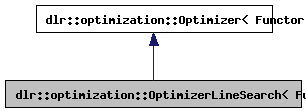
Inheritance diagram for dlr::optimization::OptimizerLineSearch< Functor >:

Public Types | |
| typedef Functor::argument_type | argument_type |
| This is the Type of the objective function argument. | |
| typedef Functor::result_type | result_type |
| This is the Type of the objective function return value. | |
Public Member Functions | |
| OptimizerLineSearch () | |
| Default constructor sets parameters to reasonable values for functions which take values and arguments in the "normal" range of 0 to 100 or so. | |
| OptimizerLineSearch (const Functor &functor) | |
| Constructor which specifies the specific Functor instance to use. | |
| OptimizerLineSearch (const Functor &functor, const argument_type &startPoint, const argument_type &startGradient, const result_type &startValue) | |
| Overloading of constructor. | |
| OptimizerLineSearch (const OptimizerLineSearch &source) | |
| Copy constructor. | |
| virtual | ~OptimizerLineSearch () |
| Destructor. | |
| size_t | getNumberOfFunctionCalls () |
| If a valid minimization result is available, this method returns the number of function calls required to produce that result. | |
| virtual void | setStartPoint (const argument_type &startPoint) |
| Sets part of the initial conditions for the minimization. | |
| virtual void | setStartPoint (const argument_type &startPoint, const result_type &startValue, const argument_type &startGradient) |
| Sets part of the initial conditions for the minimization. | |
| virtual void | setInitialStep (const argument_type &initialStep) |
| Sets part of the initial conditions for the minimization. | |
| void | setParameters (double argumentTolerance=1.0e-7, double alpha=1.0e-4, double maximumStepMagnitude=100.0) |
| Sets the line search parameters. | |
| OptimizerLineSearch & | operator= (const OptimizerLineSearch &source) |
| Assignment operator. | |
| Functor | objectiveFunction () |
| This method returns a copy of the Functor instance used for optimization. | |
| result_type | optimalValue () |
| This method finds the optimum of the current Functor, if necessary, and returns the Functor value at that point. | |
| argument_type | optimum () |
| This method finds the optimum of the current Functor, if necessary, and returns the Functor argument which produces that optimum. | |
| void | setObjectiveFunction (const Functor &functor) |
| This method specifies the Functor instance to use for the optimization. | |
Protected Member Functions | |
| void | checkState () |
| This protected member function verifies that all necessary values have been set prior to running the optimization. | |
| std::pair< typename Functor::argument_type, typename Functor::result_type > | run () |
| Perform the minimization. | |
| virtual void | setOptimum (const typename Functor::argument_type &optimum, const typename Functor::result_type &optimalValue, bool needsFurtherOptimization) |
| This protected member function provides a way for subclasses to communicate intermediate optimization results outside of the normal "return value of this->run()" method. | |
Protected Attributes | |
| double | m_alpha |
| double | m_argumentTolerance |
| size_t | m_functionCallCount |
| argument_type | m_initialStep |
| double | m_initialStepMagnitude |
| double | m_maximumStepMagnitude |
| argument_type | m_startGradient |
| argument_type | m_startPoint |
| result_type | m_startValue |
| Functor | m_functor |
| m_functor->operator()() should compute the objective function. | |
| bool | m_needsOptimization |
| Set to false if m_optimum contains a valid optimum, true otherwise. | |
| argument_type | m_optimum |
| Caches the result of the most recent optimization. | |
| result_type | m_optimalValue |
| Caches the result of the most recent optimization. | |
It takes as input an n dimensional point, the value of the function and gradient at that point, a direction, and an input quantity that limits the length of the steps. It uses these to find a new point within the length requested and along the direction specified at which the function has significantly decreased, and returns that n-dimensional point.
WARNING: The line search algorithm is not really an optimization. If you want to find the minimum function value along a line in parameter space, this is _not_ the class you're looking for.
[1] W. H. Press et al., Numerical Recipes in C The Art of Scientific Computing, Cambridge University Press, 1988.
Definition at line 43 of file optimizerLineSearch.h.
| typedef Functor::argument_type dlr::optimization::OptimizerLineSearch< Functor >::argument_type |
This is the Type of the objective function argument.
Reimplemented from dlr::optimization::Optimizer< Functor >.
Definition at line 48 of file optimizerLineSearch.h.
| typedef Functor::result_type dlr::optimization::OptimizerLineSearch< Functor >::result_type |
This is the Type of the objective function return value.
Reimplemented from dlr::optimization::Optimizer< Functor >.
Definition at line 49 of file optimizerLineSearch.h.
| dlr::optimization::OptimizerLineSearch< Functor >::OptimizerLineSearch | ( | ) | [inline] |
Default constructor sets parameters to reasonable values for functions which take values and arguments in the "normal" range of 0 to 100 or so.
Definition at line 245 of file optimizerLineSearch.h.
References dlr::optimization::OptimizerLineSearch< Functor >::setParameters().
| dlr::optimization::OptimizerLineSearch< Functor >::OptimizerLineSearch | ( | const Functor & | functor | ) | [inline, explicit] |
Constructor which specifies the specific Functor instance to use.
Using this constructor exclusively avoids the danger of calling optimalValue() or optimum() before a Functor instance has been specified.
| functor | A copy of this argument will be stored internally for use in optimization. |
Definition at line 262 of file optimizerLineSearch.h.
References dlr::optimization::OptimizerLineSearch< Functor >::setParameters().
| dlr::optimization::OptimizerLineSearch< Functor >::OptimizerLineSearch | ( | const Functor & | functor, | |
| const argument_type & | startPoint, | |||
| const argument_type & | startGradient, | |||
| const result_type & | startValue | |||
| ) |
Overloading of constructor.
| functor | A copy of this argument will be stored internally for use in optimization. | |
| startPoint | The initial search point on the function. | |
| startGradient | The initial gradient at startPoint. | |
| startValue | The function value at startPoint. |
| dlr::optimization::OptimizerLineSearch< Functor >::OptimizerLineSearch | ( | const OptimizerLineSearch< Functor > & | source | ) | [inline] |
Copy constructor.
| source | The OptimizerLineSearch instance to be copied. |
Definition at line 279 of file optimizerLineSearch.h.
References dlr::optimization::copyArgumentType(), dlr::optimization::OptimizerLineSearch< Functor >::m_initialStep, dlr::optimization::OptimizerLineSearch< Functor >::m_startGradient, and dlr::optimization::OptimizerLineSearch< Functor >::m_startPoint.
| dlr::optimization::OptimizerLineSearch< Functor >::~OptimizerLineSearch | ( | ) | [inline, virtual] |
| size_t dlr::optimization::OptimizerLineSearch< Functor >::getNumberOfFunctionCalls | ( | ) | [inline] |
If a valid minimization result is available, this method returns the number of function calls required to produce that result.
If no valid minimization result is available, the return value is 0.
Definition at line 108 of file optimizerLineSearch.h.
References dlr::optimization::OptimizerLineSearch< Functor >::m_functionCallCount.
| void dlr::optimization::OptimizerLineSearch< Functor >::setStartPoint | ( | const argument_type & | startPoint | ) | [inline, virtual] |
Sets part of the initial conditions for the minimization.
Search will start at this location in parameter space. The member function setInitialStep() must also be called before the line search can be run.
| startPoint | Indicates a point in the parameter space of the objective function. |
Definition at line 305 of file optimizerLineSearch.h.
References dlr::optimization::copyArgumentType(), dlr::optimization::OptimizerLineSearch< Functor >::m_functionCallCount, dlr::optimization::Optimizer< Functor >::m_functor, dlr::optimization::Optimizer< Functor >::m_needsOptimization, dlr::optimization::OptimizerLineSearch< Functor >::m_startGradient, and dlr::optimization::OptimizerLineSearch< Functor >::m_startValue.
| void dlr::optimization::OptimizerLineSearch< Functor >::setStartPoint | ( | const argument_type & | startPoint, | |
| const result_type & | startValue, | |||
| const argument_type & | startGradient | |||
| ) | [inline, virtual] |
Sets part of the initial conditions for the minimization.
Search will start at this location in parameter space. Use this function to avoid recomputing the function value and gradient at this point. The member function setInitialStep() must also be called before the line search can be run.
| startPoint | Indicates a point in the parameter space of the objective function. | |
| startValue | The value of the objective function, when evaluated at startPoint. | |
| startGradient | The gradient of the objective function, when evaluated at startPoint. |
Definition at line 329 of file optimizerLineSearch.h.
References dlr::optimization::copyArgumentType(), dlr::optimization::OptimizerLineSearch< Functor >::m_functionCallCount, dlr::optimization::Optimizer< Functor >::m_needsOptimization, and dlr::optimization::OptimizerLineSearch< Functor >::m_startValue.
| void dlr::optimization::OptimizerLineSearch< Functor >::setInitialStep | ( | const argument_type & | initialStep | ) | [inline, virtual] |
Sets part of the initial conditions for the minimization.
This specifies both the initial search step and the direction of search in parameter space. The member function setStartPoint() must also be called before the line search can be run.
| initialStep | Indicates the direction in space where the objective function will be going. |
Definition at line 349 of file optimizerLineSearch.h.
References dlr::optimization::copyArgumentType(), DLR_THROW3, dlr::optimization::dotArgumentType(), dlr::optimization::OptimizerLineSearch< Functor >::m_functionCallCount, dlr::optimization::OptimizerLineSearch< Functor >::m_initialStepMagnitude, dlr::optimization::Optimizer< Functor >::m_needsOptimization, and dlr::numeric::sqrt().
| void dlr::optimization::OptimizerLineSearch< Functor >::setParameters | ( | double | argumentTolerance = 1.0e-7, |
|
| double | alpha = 1.0e-4, |
|||
| double | maximumStepMagnitude = 100.0 | |||
| ) | [inline] |
Sets the line search parameters.
Default values are reasonable for functions which take values and arguments in the "normal" range of 0 to 100 or so.
| argumentTolerance | Iteration will terminate when a minimization step moves, along every axis, a distance less than a threshold which is linearly related to this factor. | |
| alpha | Iteration will terminate when the function value has decreased by an amount which is linearly related to this factor. | |
| maximumStepMagnitude | Sets the maximum size of the initial step of the line search. |
Definition at line 375 of file optimizerLineSearch.h.
References dlr::optimization::OptimizerLineSearch< Functor >::m_alpha, dlr::optimization::OptimizerLineSearch< Functor >::m_argumentTolerance, dlr::optimization::OptimizerLineSearch< Functor >::m_functionCallCount, dlr::optimization::OptimizerLineSearch< Functor >::m_maximumStepMagnitude, and dlr::optimization::Optimizer< Functor >::m_needsOptimization.
Referenced by dlr::optimization::OptimizerLineSearch< Functor >::OptimizerLineSearch().
| OptimizerLineSearch< Functor > & dlr::optimization::OptimizerLineSearch< Functor >::operator= | ( | const OptimizerLineSearch< Functor > & | source | ) | [inline] |
Assignment operator.
| source | The OptimizerLineSearch instance to be copied. |
Definition at line 394 of file optimizerLineSearch.h.
References dlr::optimization::copyArgumentType(), dlr::optimization::OptimizerLineSearch< Functor >::m_alpha, dlr::optimization::OptimizerLineSearch< Functor >::m_argumentTolerance, dlr::optimization::OptimizerLineSearch< Functor >::m_functionCallCount, dlr::optimization::OptimizerLineSearch< Functor >::m_initialStep, dlr::optimization::OptimizerLineSearch< Functor >::m_initialStepMagnitude, dlr::optimization::OptimizerLineSearch< Functor >::m_maximumStepMagnitude, dlr::optimization::OptimizerLineSearch< Functor >::m_startGradient, dlr::optimization::OptimizerLineSearch< Functor >::m_startPoint, and dlr::optimization::OptimizerLineSearch< Functor >::m_startValue.
| void dlr::optimization::OptimizerLineSearch< Functor >::checkState | ( | ) | [inline, protected] |
This protected member function verifies that all necessary values have been set prior to running the optimization.
If anything is missing or inconsistent, it throws an exception.
Definition at line 189 of file optimizerLineSearch.h.
Referenced by dlr::optimization::OptimizerLineSearch< Functor >::run().
| std::pair< typename Functor::argument_type, typename Functor::result_type > dlr::optimization::OptimizerLineSearch< Functor >::run | ( | ) | [inline, protected, virtual] |
Perform the minimization.
This overrides Optimizer<Functor>::run().
Implements dlr::optimization::Optimizer< Functor >.
Definition at line 416 of file optimizerLineSearch.h.
References dlr::optimization::OptimizerLineSearch< Functor >::checkState(), dlr::optimization::contextSensitiveScale(), dlr::optimization::copyArgumentType(), DLR_THROW3, dlr::optimization::dotArgumentType(), dlr::optimization::OptimizerLineSearch< Functor >::m_argumentTolerance, dlr::optimization::OptimizerLineSearch< Functor >::m_functionCallCount, dlr::optimization::Optimizer< Functor >::m_functor, dlr::optimization::OptimizerLineSearch< Functor >::m_initialStepMagnitude, dlr::optimization::OptimizerLineSearch< Functor >::m_maximumStepMagnitude, dlr::optimization::OptimizerLineSearch< Functor >::m_startValue, and dlr::numeric::sqrt().
| Functor dlr::optimization::Optimizer< Functor >::objectiveFunction | ( | ) | [inline, inherited] |
This method returns a copy of the Functor instance used for optimization.
Definition at line 91 of file optimizer.h.
References dlr::optimization::Optimizer< Functor >::m_functor.
| Optimizer< Functor >::result_type dlr::optimization::Optimizer< Functor >::optimalValue | ( | ) | [inline, inherited] |
This method finds the optimum of the current Functor, if necessary, and returns the Functor value at that point.
Note that you must have specified an objective function (Functor) before calling this method.
Definition at line 282 of file optimizer.h.
References dlr::optimization::Optimizer< Functor >::m_needsOptimization, dlr::optimization::Optimizer< Functor >::m_optimalValue, dlr::optimization::Optimizer< Functor >::run(), and dlr::optimization::Optimizer< Functor >::setOptimum().
| Optimizer< Functor >::argument_type dlr::optimization::Optimizer< Functor >::optimum | ( | ) | [inline, inherited] |
This method finds the optimum of the current Functor, if necessary, and returns the Functor argument which produces that optimum.
Note that you must have specified an objective function (Functor) before calling this method.
Definition at line 297 of file optimizer.h.
References dlr::optimization::Optimizer< Functor >::m_needsOptimization, dlr::optimization::Optimizer< Functor >::m_optimum, dlr::optimization::Optimizer< Functor >::run(), and dlr::optimization::Optimizer< Functor >::setOptimum().
| void dlr::optimization::Optimizer< Functor >::setObjectiveFunction | ( | const Functor & | functor | ) | [inline, inherited] |
This method specifies the Functor instance to use for the optimization.
If this function is overridden by the base class, it should normally either call Optimizer::setObjectiveFunction(), or explicitly set the member variable m_needsOptimization to true.
| functor | A copy of this argument will be stored internally for use in optimization. |
Definition at line 311 of file optimizer.h.
References dlr::optimization::Optimizer< Functor >::m_functor, and dlr::optimization::Optimizer< Functor >::m_needsOptimization.
| virtual void dlr::optimization::Optimizer< Functor >::setOptimum | ( | const typename Functor::argument_type & | optimum, | |
| const typename Functor::result_type & | optimalValue, | |||
| bool | needsFurtherOptimization | |||
| ) | [inline, protected, virtual, inherited] |
This protected member function provides a way for subclasses to communicate intermediate optimization results outside of the normal "return value of this->run()" method.
| optimum | This argument will be saved as the current optimum. | |
| optimalValue | This argument will be saved as the function value a the current optimum. | |
| needsFurtherOptimization | This argument indicates whether or not further refinement is necessary. |
Definition at line 172 of file optimizer.h.
References dlr::optimization::Optimizer< Functor >::m_needsOptimization, dlr::optimization::Optimizer< Functor >::m_optimalValue, and dlr::optimization::Optimizer< Functor >::m_optimum.
Referenced by dlr::optimization::Optimizer< Functor >::optimalValue(), and dlr::optimization::Optimizer< Functor >::optimum().
Functor dlr::optimization::Optimizer< Functor >::m_functor [protected, inherited] |
m_functor->operator()() should compute the objective function.
Definition at line 182 of file optimizer.h.
Referenced by dlr::optimization::OptimizerBFGS< Functor >::doBfgs(), dlr::optimization::OptimizerNelderMead< Functor >::evaluateMove(), dlr::optimization::Optimizer< Functor >::objectiveFunction(), dlr::optimization::Optimizer< Functor >::operator=(), dlr::optimization::OptimizerNelderMead< Functor >::run(), dlr::optimization::OptimizerLM< Functor >::run(), dlr::optimization::OptimizerLineSearch< Functor >::run(), dlr::optimization::OptimizerBFGS< Functor >::run(), dlr::optimization::Optimizer< Functor >::setObjectiveFunction(), and dlr::optimization::OptimizerLineSearch< Functor >::setStartPoint().
bool dlr::optimization::Optimizer< Functor >::m_needsOptimization [protected, inherited] |
Set to false if m_optimum contains a valid optimum, true otherwise.
Definition at line 185 of file optimizer.h.
Referenced by dlr::optimization::Optimizer< Functor >::operator=(), dlr::optimization::Optimizer< Functor >::optimalValue(), dlr::optimization::Optimizer< Functor >::optimum(), dlr::optimization::OptimizerLineSearch< Functor >::setInitialStep(), dlr::optimization::Optimizer< Functor >::setObjectiveFunction(), dlr::optimization::Optimizer< Functor >::setOptimum(), dlr::optimization::OptimizerLineSearch< Functor >::setParameters(), and dlr::optimization::OptimizerLineSearch< Functor >::setStartPoint().
argument_type dlr::optimization::Optimizer< Functor >::m_optimum [protected, inherited] |
Caches the result of the most recent optimization.
Definition at line 188 of file optimizer.h.
Referenced by dlr::optimization::Optimizer< Functor >::operator=(), dlr::optimization::Optimizer< Functor >::Optimizer(), dlr::optimization::Optimizer< Functor >::optimum(), and dlr::optimization::Optimizer< Functor >::setOptimum().
result_type dlr::optimization::Optimizer< Functor >::m_optimalValue [protected, inherited] |
Caches the result of the most recent optimization.
Definition at line 191 of file optimizer.h.
Referenced by dlr::optimization::Optimizer< Functor >::optimalValue(), and dlr::optimization::Optimizer< Functor >::setOptimum().
 1.5.2
1.5.2