#include <optimizerLM.h>
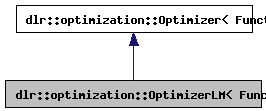
Inheritance diagram for dlr::optimization::OptimizerLM< Functor >:
Public Types | |
| typedef Functor::argument_type | argument_type |
| This is the Type of the objective function argument. | |
| typedef Functor::result_type | result_type |
| This is the Type of the objective function return value. | |
Public Member Functions | |
| OptimizerLM () | |
| The default constructor sets parameters to reasonable values for functions which take values and arguments in the "normal" range of 0 to 100 or so. | |
| OptimizerLM (const Functor &functor) | |
| This constructor specifies the specific Functor instance to use. | |
| OptimizerLM (const OptimizerLM &source) | |
| Copy constructor. | |
| virtual | ~OptimizerLM () |
| The destructor destroys the class instance and deallocates any associated storage. | |
| virtual void | setMinimumGradientMagnitude (double minimumGradientMagnitude) |
| This method sets one of the termination criteria of the optimization. | |
| virtual void | setParameters (double initialLambda=1.0, size_t maxIterations=40, double maxLambda=1.0E7, double minLambda=1.0E-13, double minError=0.0, double minimumGradientMagnitude=1.0E-5, double minDrop=1.0E-4, size_t strikes=3, int maxBackSteps=-1, int verbosity=0) |
| This method sets minimization parameters. | |
| virtual void | setStartPoint (const typename Functor::argument_type &startPoint) |
| This method sets the initial conditions for the minimization. | |
| virtual void | setVerbosity (int verbosity) |
| This method sets the amount of text printed to the standard output during the optimization. | |
| virtual OptimizerLM & | operator= (const OptimizerLM &source) |
| The assignment operator deep copies its argument. | |
| Functor | objectiveFunction () |
| This method returns a copy of the Functor instance used for optimization. | |
| result_type | optimalValue () |
| This method finds the optimum of the current Functor, if necessary, and returns the Functor value at that point. | |
| argument_type | optimum () |
| This method finds the optimum of the current Functor, if necessary, and returns the Functor argument which produces that optimum. | |
| void | setObjectiveFunction (const Functor &functor) |
| This method specifies the Functor instance to use for the optimization. | |
Protected Member Functions | |
| double | gradientConvergenceMetric (const argument_type &theta, const result_type &value, const argument_type &gradient) |
| This protected member function is used to asses whether the algorithm has reached convergence. | |
| virtual std::pair< typename Functor::argument_type, typename Functor::result_type > | run () |
| Perform the optimization. | |
| virtual void | verboseWrite (const char *message, int verbosity) |
| template<class Type> | |
| void | verboseWrite (const char *intro, const Type &subject, int verbosity) |
| virtual void | setOptimum (const typename Functor::argument_type &optimum, const typename Functor::result_type &optimalValue, bool needsFurtherOptimization) |
| This protected member function provides a way for subclasses to communicate intermediate optimization results outside of the normal "return value of this->run()" method. | |
Protected Attributes | |
| double | m_initialLambda |
| int | m_maxBackSteps |
| size_t | m_maxIterations |
| double | m_maxLambda |
| double | m_minDrop |
| double | m_minError |
| double | m_minGrad |
| double | m_minLambda |
| argument_type | m_startPoint |
| size_t | m_strikes |
| int | m_verbosity |
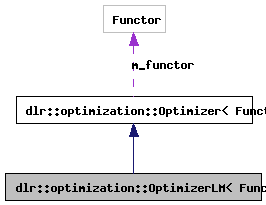
| Functor | m_functor |
| m_functor->operator()() should compute the objective function. | |
| bool | m_needsOptimization |
| Set to false if m_optimum contains a valid optimum, true otherwise. | |
| argument_type | m_optimum |
| Caches the result of the most recent optimization. | |
| result_type | m_optimalValue |
| Caches the result of the most recent optimization. | |
This algorithm seeks the parameter value which minimizes the objective function. The template parameter (Functor) defines the type to use as the objective function of the minimization, and must support the GradientFunction interface.
[1] W. H. Press et al., Numerical Recipes in C The Art of Scientific Computing, Cambridge University Press, 1988.
Definition at line 41 of file optimizerLM.h.
| typedef Functor::argument_type dlr::optimization::OptimizerLM< Functor >::argument_type |
This is the Type of the objective function argument.
Reimplemented from dlr::optimization::Optimizer< Functor >.
Definition at line 46 of file optimizerLM.h.
| typedef Functor::result_type dlr::optimization::OptimizerLM< Functor >::result_type |
This is the Type of the objective function return value.
Reimplemented from dlr::optimization::Optimizer< Functor >.
Definition at line 47 of file optimizerLM.h.
| dlr::optimization::OptimizerLM< Functor >::OptimizerLM | ( | ) | [inline] |
The default constructor sets parameters to reasonable values for functions which take values and arguments in the "normal" range of 0 to 100 or so.
Definition at line 322 of file optimizerLM.h.
References dlr::optimization::OptimizerLM< Functor >::setParameters().
| dlr::optimization::OptimizerLM< Functor >::OptimizerLM | ( | const Functor & | functor | ) | [inline, explicit] |
This constructor specifies the specific Functor instance to use.
Using this constructor exclusively avoids the danger of calling optimalValue() or optimum() before a Functor instance has been specified.
| functor | A copy of this argument will be stored internally for use in optimization. |
Definition at line 342 of file optimizerLM.h.
References dlr::optimization::OptimizerLM< Functor >::setParameters().
| dlr::optimization::OptimizerLM< Functor >::OptimizerLM | ( | const OptimizerLM< Functor > & | source | ) | [inline] |
Copy constructor.
This constructor deep copies its argument.
| source | The OptimizerLM instance to be copied. |
Definition at line 362 of file optimizerLM.h.
References dlr::optimization::copyArgumentType(), and dlr::optimization::OptimizerLM< Functor >::m_startPoint.
| dlr::optimization::OptimizerLM< Functor >::~OptimizerLM | ( | ) | [inline, virtual] |
The destructor destroys the class instance and deallocates any associated storage.
Definition at line 382 of file optimizerLM.h.
| void dlr::optimization::OptimizerLM< Functor >::setMinimumGradientMagnitude | ( | double | minimumGradientMagnitude | ) | [inline, virtual] |
This method sets one of the termination criteria of the optimization.
Iteration will stop if the magnitude of the gradient of the objective function at the current location is less than the specified value.
| minimumGradientMagnitude | The value at which the magnitude of the objective function gradient should be considered small enough to terminate iteration. |
Definition at line 393 of file optimizerLM.h.
References dlr::optimization::OptimizerLM< Functor >::m_minGrad.
| void dlr::optimization::OptimizerLM< Functor >::setParameters | ( | double | initialLambda = 1.0, |
|
| size_t | maxIterations = 40, |
|||
| double | maxLambda = 1.0E7, |
|||
| double | minLambda = 1.0E-13, |
|||
| double | minError = 0.0, |
|||
| double | minimumGradientMagnitude = 1.0E-5, |
|||
| double | minDrop = 1.0E-4, |
|||
| size_t | strikes = 3, |
|||
| int | maxBackSteps = -1, |
|||
| int | verbosity = 0 | |||
| ) | [inline, virtual] |
This method sets minimization parameters.
Default values are reasonable for functions which take values and arguments in the "normal" range of 0 to 100 or so.
| iterationLimit | Each minimization will terminate after this many iterations. | |
| numberOfRestarts | Following successful termination, the minimization will be re-run this many times to refine the result accuracy. Generally you should leave this at its default value. | |
| gradientTolerance | Iteration will terminate when the magnitude of the gradient times the magnitude of the parameter vector becomes smaller than the function value by this factor. | |
| argumentTolerance | Iteration will terminate when a minimization step moves, along every axis, a distance less than this factor times the corresponding element of the argument vector. | |
| numericEpsilon | Sets the internal epsilon value of the gradient update routine. | |
| maximumStepMagnitudeFactor | Sets the maximum step distance for each line minimization in the algorithm. |
Definition at line 402 of file optimizerLM.h.
References dlr::optimization::OptimizerLM< Functor >::m_initialLambda, dlr::optimization::OptimizerLM< Functor >::m_maxBackSteps, dlr::optimization::OptimizerLM< Functor >::m_maxIterations, dlr::optimization::OptimizerLM< Functor >::m_maxLambda, dlr::optimization::OptimizerLM< Functor >::m_minDrop, dlr::optimization::OptimizerLM< Functor >::m_minError, dlr::optimization::OptimizerLM< Functor >::m_minGrad, dlr::optimization::OptimizerLM< Functor >::m_minLambda, dlr::optimization::OptimizerLM< Functor >::m_strikes, and dlr::optimization::OptimizerLM< Functor >::m_verbosity.
Referenced by dlr::optimization::OptimizerLM< Functor >::OptimizerLM().
| void dlr::optimization::OptimizerLM< Functor >::setStartPoint | ( | const typename Functor::argument_type & | startPoint | ) | [inline, virtual] |
This method sets the initial conditions for the minimization.
Gradient based search will start at this location in parameter space.
| startPoint | Indicates a point in the parameter space of the objective function. |
Definition at line 440 of file optimizerLM.h.
References dlr::optimization::copyArgumentType().
| virtual void dlr::optimization::OptimizerLM< Functor >::setVerbosity | ( | int | verbosity | ) | [inline, virtual] |
This method sets the amount of text printed to the standard output during the optimization.
Currently this method does nothing, since OptimizerBFGS never generates any standard output.
| verbosity | This argument indicates the desired output level. Setting verbosity to zero mean that no standard output should be generated. Higher numbers indicate increasingly more output. |
Definition at line 218 of file optimizerLM.h.
References dlr::optimization::OptimizerLM< Functor >::m_verbosity.
| OptimizerLM< Functor > & dlr::optimization::OptimizerLM< Functor >::operator= | ( | const OptimizerLM< Functor > & | source | ) | [inline, virtual] |
The assignment operator deep copies its argument.
| source | The OptimizerLM instance to be copied. |
Definition at line 459 of file optimizerLM.h.
References dlr::optimization::copyArgumentType(), dlr::optimization::OptimizerLM< Functor >::m_initialLambda, dlr::optimization::OptimizerLM< Functor >::m_maxBackSteps, dlr::optimization::OptimizerLM< Functor >::m_maxIterations, dlr::optimization::OptimizerLM< Functor >::m_maxLambda, dlr::optimization::OptimizerLM< Functor >::m_minDrop, dlr::optimization::OptimizerLM< Functor >::m_minError, dlr::optimization::OptimizerLM< Functor >::m_minGrad, dlr::optimization::OptimizerLM< Functor >::m_minLambda, dlr::optimization::OptimizerLM< Functor >::m_strikes, and dlr::optimization::OptimizerLM< Functor >::m_verbosity.
| double dlr::optimization::OptimizerLM< Functor >::gradientConvergenceMetric | ( | const argument_type & | theta, | |
| const result_type & | value, | |||
| const argument_type & | gradient | |||
| ) | [protected] |
This protected member function is used to asses whether the algorithm has reached convergence.
| theta | This argument specifies the parameter values (arguments to the objective function) being assessed. | |
| value | This argument specifies the function value at the point described by theta. | |
| gradient | This argument specifies the function gradient at the point described by theta. |
| std::pair< typename Functor::argument_type, typename Functor::result_type > dlr::optimization::OptimizerLM< Functor >::run | ( | ) | [inline, protected, virtual] |
Perform the optimization.
This virtual function overrides the definition in Optimizer.
Implements dlr::optimization::Optimizer< Functor >.
Definition at line 484 of file optimizerLM.h.
References dlr::optimization::copyArgumentType(), DLR_THROW3, dlr::optimization::dotArgumentType(), dlr::linearAlgebra::linearSolveInPlace(), dlr::optimization::Optimizer< Functor >::m_functor, dlr::optimization::OptimizerLM< Functor >::m_initialLambda, dlr::optimization::OptimizerLM< Functor >::m_maxBackSteps, dlr::optimization::OptimizerLM< Functor >::m_maxIterations, dlr::optimization::OptimizerLM< Functor >::m_maxLambda, dlr::optimization::OptimizerLM< Functor >::m_minDrop, dlr::optimization::OptimizerLM< Functor >::m_minError, dlr::optimization::OptimizerLM< Functor >::m_minGrad, dlr::optimization::OptimizerLM< Functor >::m_minLambda, dlr::optimization::OptimizerLM< Functor >::m_strikes, dlr::optimization::OptimizerLM< Functor >::m_verbosity, dlr::optimization::OptimizerLM< Functor >::verboseWrite(), and dlr::numeric::zeros().
| Functor dlr::optimization::Optimizer< Functor >::objectiveFunction | ( | ) | [inline, inherited] |
This method returns a copy of the Functor instance used for optimization.
Definition at line 91 of file optimizer.h.
References dlr::optimization::Optimizer< Functor >::m_functor.
| Optimizer< Functor >::result_type dlr::optimization::Optimizer< Functor >::optimalValue | ( | ) | [inline, inherited] |
This method finds the optimum of the current Functor, if necessary, and returns the Functor value at that point.
Note that you must have specified an objective function (Functor) before calling this method.
Definition at line 282 of file optimizer.h.
References dlr::optimization::Optimizer< Functor >::m_needsOptimization, dlr::optimization::Optimizer< Functor >::m_optimalValue, dlr::optimization::Optimizer< Functor >::run(), and dlr::optimization::Optimizer< Functor >::setOptimum().
| Optimizer< Functor >::argument_type dlr::optimization::Optimizer< Functor >::optimum | ( | ) | [inline, inherited] |
This method finds the optimum of the current Functor, if necessary, and returns the Functor argument which produces that optimum.
Note that you must have specified an objective function (Functor) before calling this method.
Definition at line 297 of file optimizer.h.
References dlr::optimization::Optimizer< Functor >::m_needsOptimization, dlr::optimization::Optimizer< Functor >::m_optimum, dlr::optimization::Optimizer< Functor >::run(), and dlr::optimization::Optimizer< Functor >::setOptimum().
| void dlr::optimization::Optimizer< Functor >::setObjectiveFunction | ( | const Functor & | functor | ) | [inline, inherited] |
This method specifies the Functor instance to use for the optimization.
If this function is overridden by the base class, it should normally either call Optimizer::setObjectiveFunction(), or explicitly set the member variable m_needsOptimization to true.
| functor | A copy of this argument will be stored internally for use in optimization. |
Definition at line 311 of file optimizer.h.
References dlr::optimization::Optimizer< Functor >::m_functor, and dlr::optimization::Optimizer< Functor >::m_needsOptimization.
| virtual void dlr::optimization::Optimizer< Functor >::setOptimum | ( | const typename Functor::argument_type & | optimum, | |
| const typename Functor::result_type & | optimalValue, | |||
| bool | needsFurtherOptimization | |||
| ) | [inline, protected, virtual, inherited] |
This protected member function provides a way for subclasses to communicate intermediate optimization results outside of the normal "return value of this->run()" method.
| optimum | This argument will be saved as the current optimum. | |
| optimalValue | This argument will be saved as the function value a the current optimum. | |
| needsFurtherOptimization | This argument indicates whether or not further refinement is necessary. |
Definition at line 172 of file optimizer.h.
References dlr::optimization::Optimizer< Functor >::m_needsOptimization, dlr::optimization::Optimizer< Functor >::m_optimalValue, and dlr::optimization::Optimizer< Functor >::m_optimum.
Referenced by dlr::optimization::Optimizer< Functor >::optimalValue(), and dlr::optimization::Optimizer< Functor >::optimum().
Functor dlr::optimization::Optimizer< Functor >::m_functor [protected, inherited] |
m_functor->operator()() should compute the objective function.
Definition at line 182 of file optimizer.h.
Referenced by dlr::optimization::OptimizerBFGS< Functor >::doBfgs(), dlr::optimization::OptimizerNelderMead< Functor >::evaluateMove(), dlr::optimization::Optimizer< Functor >::objectiveFunction(), dlr::optimization::Optimizer< Functor >::operator=(), dlr::optimization::OptimizerNelderMead< Functor >::run(), dlr::optimization::OptimizerLM< Functor >::run(), dlr::optimization::OptimizerLineSearch< Functor >::run(), dlr::optimization::OptimizerBFGS< Functor >::run(), dlr::optimization::Optimizer< Functor >::setObjectiveFunction(), and dlr::optimization::OptimizerLineSearch< Functor >::setStartPoint().
bool dlr::optimization::Optimizer< Functor >::m_needsOptimization [protected, inherited] |
Set to false if m_optimum contains a valid optimum, true otherwise.
Definition at line 185 of file optimizer.h.
Referenced by dlr::optimization::Optimizer< Functor >::operator=(), dlr::optimization::Optimizer< Functor >::optimalValue(), dlr::optimization::Optimizer< Functor >::optimum(), dlr::optimization::OptimizerLineSearch< Functor >::setInitialStep(), dlr::optimization::Optimizer< Functor >::setObjectiveFunction(), dlr::optimization::Optimizer< Functor >::setOptimum(), dlr::optimization::OptimizerLineSearch< Functor >::setParameters(), and dlr::optimization::OptimizerLineSearch< Functor >::setStartPoint().
argument_type dlr::optimization::Optimizer< Functor >::m_optimum [protected, inherited] |
Caches the result of the most recent optimization.
Definition at line 188 of file optimizer.h.
Referenced by dlr::optimization::Optimizer< Functor >::operator=(), dlr::optimization::Optimizer< Functor >::Optimizer(), dlr::optimization::Optimizer< Functor >::optimum(), and dlr::optimization::Optimizer< Functor >::setOptimum().
result_type dlr::optimization::Optimizer< Functor >::m_optimalValue [protected, inherited] |
Caches the result of the most recent optimization.
Definition at line 191 of file optimizer.h.
Referenced by dlr::optimization::Optimizer< Functor >::optimalValue(), and dlr::optimization::Optimizer< Functor >::setOptimum().
 1.5.2
1.5.2