
Polysys: an Algebraic Leakage Attack Engine
Introduction
Consider a scenario in which a hospital wishes to store their highly sensitive data on a third-party database server (such as AWS). Because they are afraid of scenarios such as data breaches or regulatory audits, the hospital will often store the data encrypted using a primitive such as AES. However, while encryption addresses the problem of security at rest (i.e. when the data is not used), the hospital wil still need to unencrypt the data in order to perform expressive database queries on the data since standard encryption does not support query functionality. This causes a huge problem: at the moment of decryption on the server, that instance provides an opportunity for malicious attacks, allowing access to the sensitive data in plaintext. Indeed, such data breaches are still common due to this tension between security and functionality that arises when using standard encryption.
To address this problem, cryptographers are researching a suite of techniques called encrypted search algorithm (ESAs), which provide a best of both worlds solution to the above issue. ESAs are cryptographic algorithms that allow a client to perform searches over encrypted documents, meaning that the data will never have to be decrypted on the server. When designing these algorithms, the three main things to consider are:
- correctness: the algorithm should maintain the same corectness guarantees as a plaintext search algorithm
- performance: the schemes should be fast, ideally as close as possible to the plaintext version. Theoretically, this means the scheme should run in time sublinear in the number of records stored in the server
- security: at a high level, the scheme should mathematically guarantee that an attacker is able to learn nothing about the secret queries or secret data at the server.
It is well known, however, that achieving all three properties at the same time is impossible. In particular, in order to achieve sub-linear search time in the number of documents, ESAs must leak some information about the queries and/or data. This leakage (also called metadata leakage) is formally captured by a leakage profile, which describes what the scheme precisely reveals. One common leakage profile is the (range)-response identity (RID), which leaks which documents (or keys) were returned for each (range) query. We illustrate an example in the figure below:
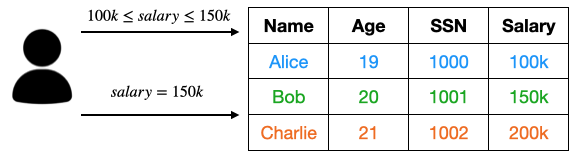
Example of a sequence of range queries performed on a small database. Here, the queries are secret to the attacker. |
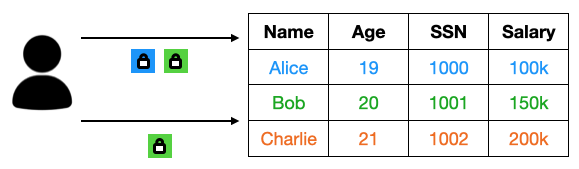
What the adversary sees under the range response identity leakage profile. The adversary is only able to see which documents were returned for each query, but is not able to see the query sequence nor the contents of the database entries themselves. |
An extensive line of work on leakage attacks has designed various cryptanalytic techniques to exploit different leakage profiles in order to recover as much information about the underlying secret information as possible. These attacks can be largely categorized into three main groups:
- inference atacks, which take in as input a leakage pattern and some auxiliary information about the queries/data (e.g. their distributions), and output a recovered query sequence/ dataset
- resolution attacks, which take in as input leakage pattern and outputs a recovered query sequence / dataset. Note that the attack in this case does not take in any information beyond the leaked pattern.
- known-data attacks, which take in as input a leakage pattern and some fraction of known data, and output the recovered query sequence/ data.
The current landscape of leakage attacks, however, is highly fragmented, with most attacks designed in an ad hoc, scheme-specific manner rather than derived from a unifying methodology. This means that for every construction, a new attack must be tailored to its particular leakage profile, data model, or assumptions specific to that scheme. In practice, this means that two attacks cannot be easily compared to each other. This fragmentation makes it challenging to reason formally about attack optimality or completeness, and slows progress by requiring cryptographers to repeatedly rediscover similar inference strategies in slightly different forms.
The table below shows some of the prior inference and known-data attacks for the (range)-response identity pattern along with the leakage pattern and auxiliary information scenario they consider in their work. Note that each of the six attacks below all make different assumptions about the query sequence and data distribution even though they are all considering the same leakage profiles.
| Attack | Target | Leakage Profile | Query Assumptions? | Data Assumptions? |
|---|---|---|---|---|
| Count | K | rid | Non-repeating | N/A |
| Subgraph-ID | K | rid | Non-repeating | N/A |
| LMP-ID | RV | (range)-rid | N/A | Dense |
| LMP-APP | RV | (range)-rid | N/A | Dense |
| GenKKNO | RV | (range)-rid | Uniform | N/A |
| ApproxValue | RV | (range)-rid | Uniform | Specific |
To this end, we design Polysys (short for Polynomial System), a novel framework for modeling and designing leakage attacks as polynomials constraints. Below, we describe how to formalize the system of equations and then demonstrate how to use a SAT solvers to solve these equations efficiently. We then compare Polysys’ recovery rates to prior state of the art attacks and demonstrate that our generalized approach is comparable to the recovery rates exhibited by prior works.
Preliminaries
We model the document search problem as follows. We treat the database as a collection of key/tuple pairs where the set of possible keys is \([1,N]\), where \(N\) is the domain size, and the tuple is the list of documents that contain that key. More formally, we treat the multi-map \(MM\)as a collection of label/tuple pairs \({(l_i, v_{i,j}), i \in [N], j \in |MM[l_i]|}\). We use \(r\) to represent the number of documents. The goal of a leakage attack is therefore: given a sequence of \(t\) queries \(q_1,…,q_t\), recover the unknown queries and key/tuple pairs.
We focus on two different types of search: point or key search and range search, which support different types of queries. Point search supports equality queries, which means that the queries take the form \(q = j \in [1,N]\). This captures settings in which the database supports queries such as, “which documents contain the word ‘apple’”? Range queries take the form \(q_i = [l,r], l,r \in [1,N], l \leq r\). For range queries, we additionally impose the assumption that each document only contains a single value. This assumption was used in all prior range query attacks, and captures the fact that most data columns which support range queries (i.e. age, income) often contain a single numerical value.
The Polynomial Constraint Framework
Our first insight comes from translating the leakage attack problem into an algebraic system of equations. Solving this system of equations would then provide a candidate secret that would output the observed leakage. To do this, we first represent the query sequence and secret data as matrices \(Q,D\) respectively. We then show how to represent these matrices using a system of constraints (called structure constraints). At a high level, these constraints capture the structure of what the secret information must look like, independent of the leakage pattern.
Structure Constraints
Structure equations encode the inherent invariants of the underlying encrypted data system, independent of any particular leakage instance. At a high level, consider the case in which we wish \(Q\) to represent a sequence of \(t\) range queries. What properties would \(Q\) need to satisfy? Similarly, we would need \(D\) to follow certain invariants in order for \(D\) to represent a valid data matrix.
As an example, one way we could model \(Q\) for a sequence of queries \(q_1,…,q_t\) is as a \(t\) by \(N\) binary matrix \(Q\) where
$$Q_{i,j} = \begin{cases} 1 & \textnormal{if\ } j \in q_i,\\ 0 & \textnormal{otherwise}. \end{cases} $$
Here, each row of the matrix represents a query, and the column represent whether that key was part of that query.
Leakage Constraints
Leakage equations encode the information revealed through from the leakage profile. Each leakage profile translates into algebraic constraints that restrict the possible values of the hidden variables. Unlike structure equations, which hold regardless of the leakage profile, leakage equations are instance-specific and reflect the adversary’s view of a particular execution. Together with the structure equations, they shrink the feasible solution space until the solver can recover assignments that are both structurally valid and consistent with the observed leakage.
Combining the Constraints Together
Combining the above polynomial equations gives us a system that can theoretically be solved for a candidate solution for a given leakage profile. As an example, we write the full system below for RID for range queries (recall that \(Q,D\) are the secret data we are trying to reconstruct, and L is publicly leaked by the scheme we are attacking):
- \( \sum_{j = 1}^{N - 1} Q_{i,j} \cdot Q_{i,j+1} = \sum_{j = 1}^N Q_{i,j} + 1,\ i \in [t]\)
- \(\sum_{j = 1}^N D_{i,j} = 1, \ j \in [r]\)
- \(\sum_{k = 1}^t Q_{i,k} \cdot D_{k,j} = L_{i,j}, \ i \in [t], j \in [N]\)
Above, Constraint \(1\) tells us that the queries are range queries. Constraint \(2\) tells us that every document can only contain exactly one keyword (which is our assumption for range query schemes). Finally, the last set of constraints is used when atacking the RID leakage pattern. Finding a solution to these set of polynomial equations gives us a candidate \(Q,D\) which represents a possible secret that outputted the observed leakage pattern. Note that if there are several possible solutions, then the attacker would not know which is the correct one so they can only choose one candidate arbitrarily.
From Polynomials to SAT
While the above set of polynomial equations are theoretically solveable using known algebraic methods, the second main challenge in designing an efficient attack engine comes from developing a technique that allows the adversary to solve these constraints efficiently. To address this challenge, we turn to SAT solvers, which are programs explicitly designed to heuristically find a satisfying instance to a constraint problem if one exists, or to output unsatisfiable otherwise. Note that the boolean satisfiability problem is theoretically NP-hard, so this method is only a heuristic based approach to solve these programs quickly in practice.
Our main observation is that by utilizing SAT solving techniques to reduce the polynomial constraints into an equivalent CNF, we can use a SAT solver in order to efficiently find a satisfying instance to the polynomial constraint system. This represents a possible query/data solution to the observed leakage pattern.
The main challenge in this step, therefore, is to find a way to do the polynomial-to-SAT translation efficiently. To see why this is difficult, consider the linear equation \(\sum_{i=1}^\gamma x_i = 1\) (an example of one of the polynomial constraints seen in Polysys). A naive approach of translating this to a SAT-friendly formulation could be:
\( \bigg(\bigvee_{i\in [\gamma]} x_i \bigg) \wedge \bigg( \bigwedge_{i \neq j} \overline{x}_i \vee \overline{x}_j \bigg) \)
where the first set of terms captures that at least one variable is equal to 1 while the second term captures the fact that two variables cannot be true at the same time. Although this representation is theoretically equivalent, it requires at least \(O(\gamma^2)\) clauses which is prohibitive in practice. Therefore, the SAT translation step requires design new techniques that would allow for efficient translation of these constraints in the context of Polysys. For example, we are able to obtain a translation that requires only \(O(\gamma)\) clauses, which is optimal (see our paper for details)!
Ultimately, by rewriting all of the polynomial constraints appropriately, we obtain a set of CNF constraints that can be solved by a SAT solver efficiently. This satisfying assignment can then be directly mapped back to a recovered secret.
In summary, combining the techniques from the above two sections gives us a conjunction of CNFs corresponding to the original system of polynomial equations. Intuitively, if the number of satisfying assignments is small, this means that the original system of equations (and thus leakage pattern) is easy to attack. Similarly, if the number of assignments is large, then the original system of equations is difficult to attack.
Evaluation
We implement the PolySys engine described above in Python and compare performance against prior state-of-the-art attacks on various real-world and synthetic workloads. We highlight some of the results here when comparing against state of the art prior attacks. Note that in each section, we are comparing Polysys against the state of art attacks that were designed to attack that specific leakage profile under specific assumptions. We explain further below.
Known data attacks against rid
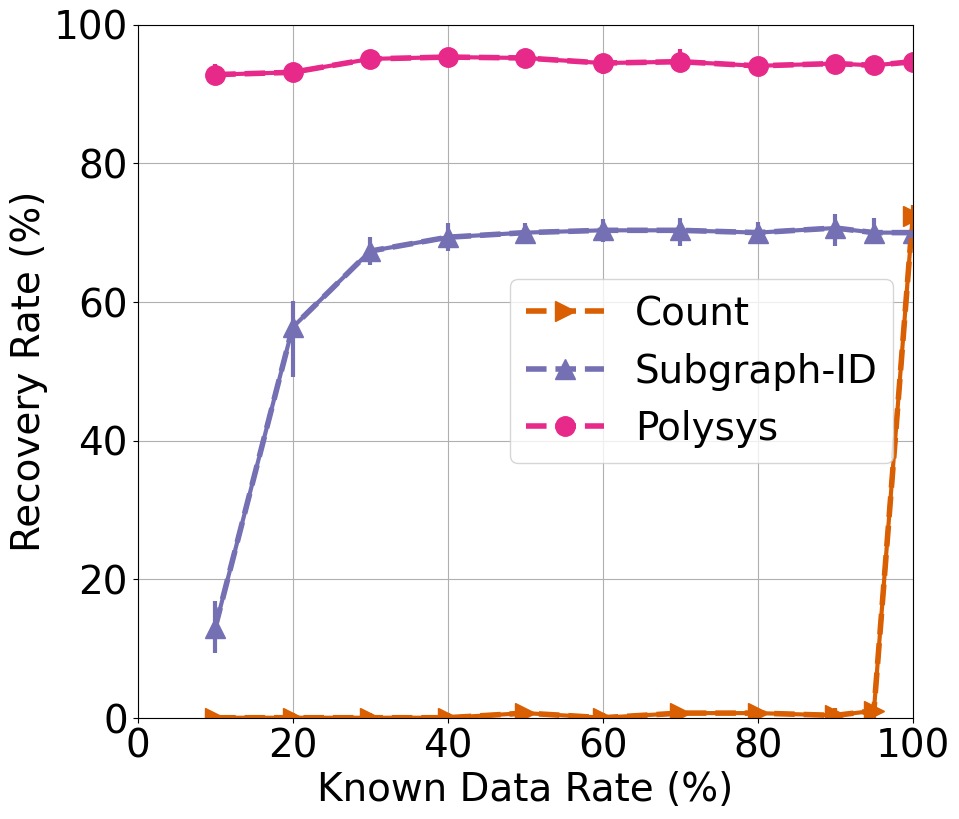
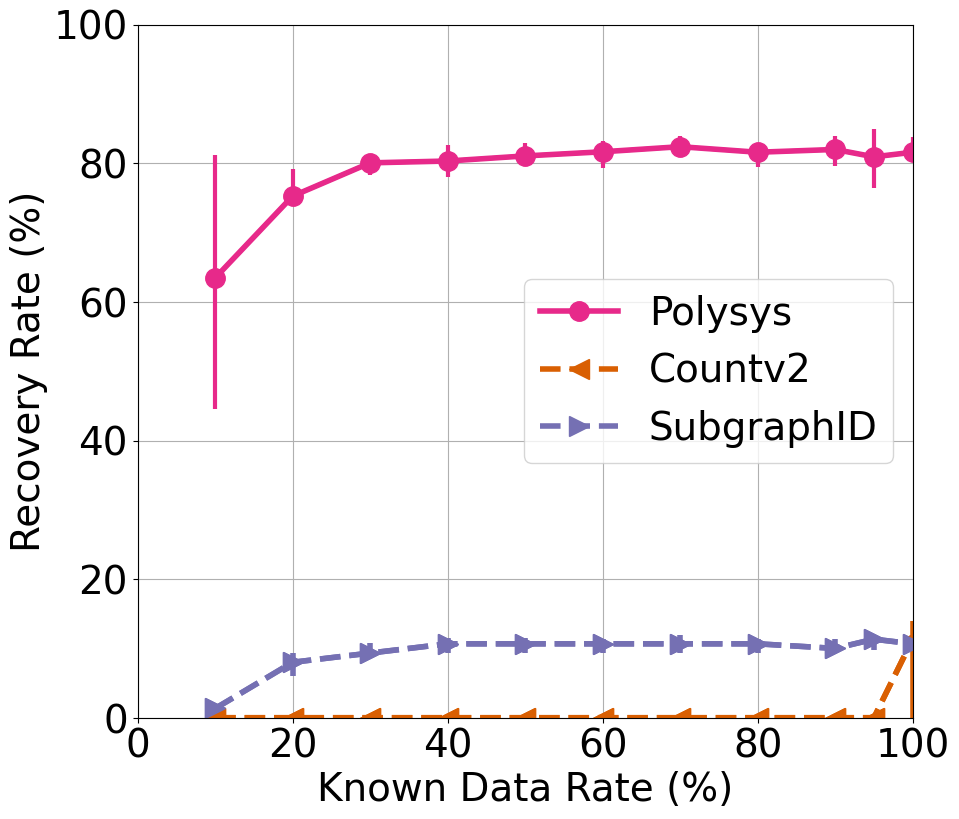
Figures a and b below show the recovery rates of Polysys, Count, and Subgraph attacks when varying the known data rate on the Enron dataset. The Enron dataset is a standard dataset used when evaluated query attacks for different leakage patterns. We consider two cases where user queries are sampled uniformly or following a Zipf distribution. The query sequence length was set to 150, and the recovery rate is computed as the fraction of queries (out of 150) that are correctly matched.
|
|
| (a) Uniform | (b) Zipf(\(\alpha=2\)) |
Here, Polysys outperforms both other attacks in low and high known data rates. Even with a 10% known data rate, Polysys achieves a recovery rate of 92% and 79% with uniform and Zipf-distributed queries respectively, whereas Subgraph has a low recovery rate of 9% and 1%. This nontrivial gap is probably because Polysys does exceptionally well in extracting all the information from the leakage as it fully describes it as a system of equations. We note that the recovery rate of Polysys (and all other attacks) dropped when the query distribution was changed from uniform to Zipf since less unique queries are seen with more skewed distributions.
Data recovery attacks against range-rid
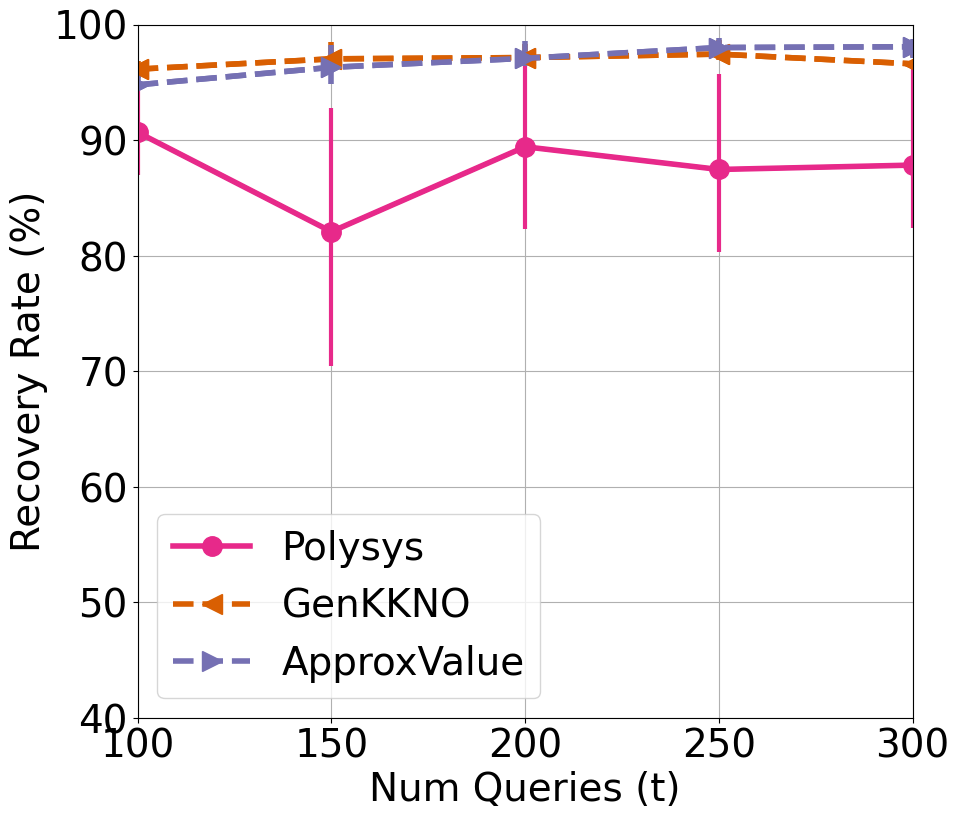
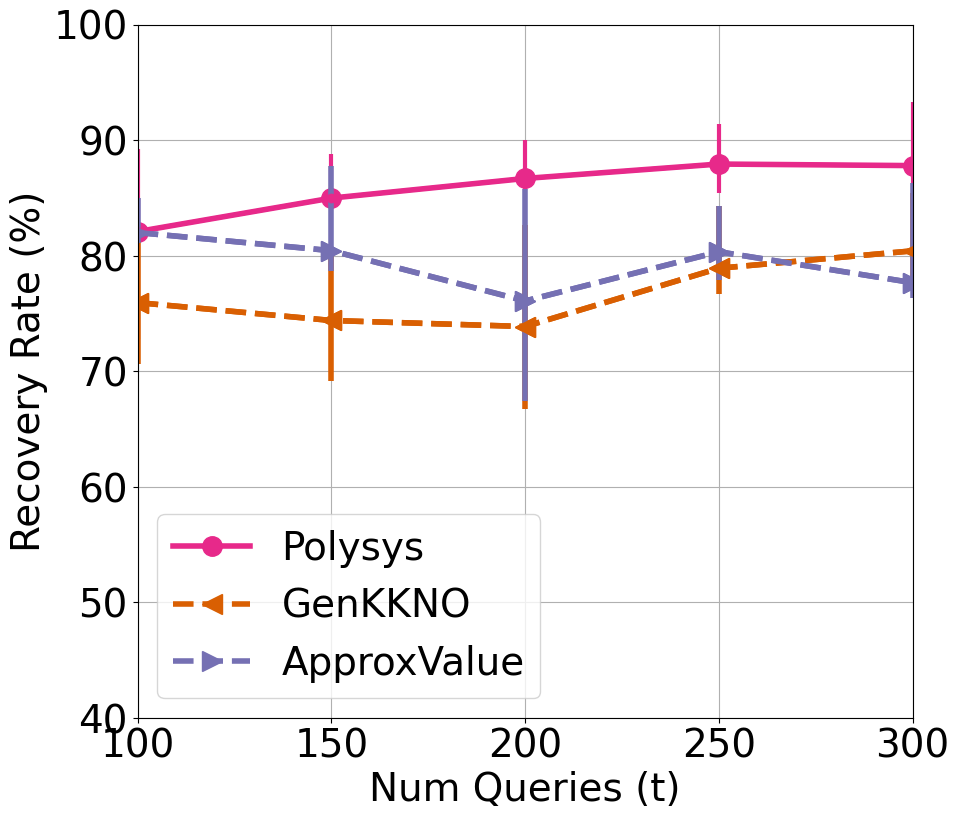
Figures a and b below show the recovery rate of the GenKKNO, ApproxValue, LMP, and Polysys on the MIMIC dataset for uniform and Zipf-distributed queries, respectively. The MIMIC dataset is a health data consisting of various medical metrics. The recovery rate is the mean absolute error between the actual and the recovered dataset. As expected, Polysys slightly underperforms prior work in the uniform case while outperforming them in the Zipf case as the number of queries increases. The slight underperformance in the uniform case is due to hardcoded distributional knowledge in the attacks; an assumption Polysys does not use. Specifically, GenKKNO and ApproxValue were explicitly designed for the uniform query case. This explains the difference in performance between the uniform and Zipf case.
|
|
| (a) MIMIC, Uniform | (b) MIMIC, Zipf(\(\alpha=2\)) |
|
|
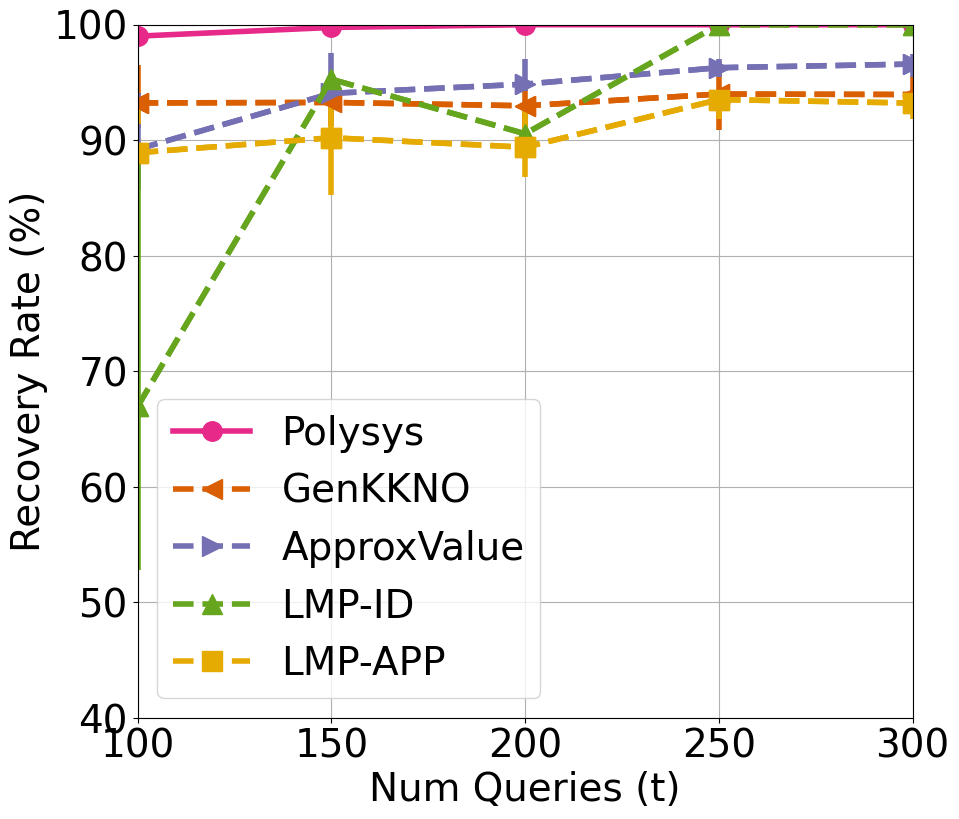
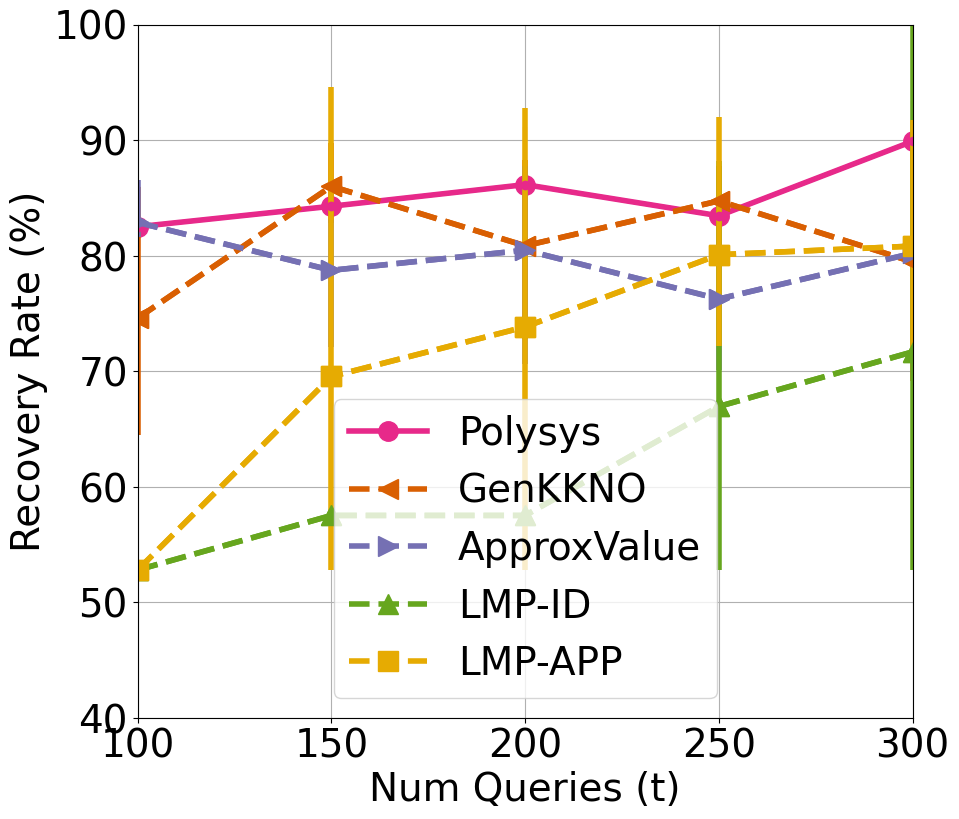
| (c) MIMIC, Uniform | (d) Dense, Zipf(\(\alpha=2\)) |
Because LMP and LMP-APP are only usable in the case where the dataset is dense (e.g., there exists at least one record for each value in the domain), we additionally test Polysys and the other attacks on a synthetic dense dataset for the same size as the MIMIC dataset. We do this by fixing N records/values to be each value in the domain \(N\) and then uniformly sampling the remainder. The results of the attacks for uniform and Zipf-distributed query sequences on this synthetic dataset are shown in Figures c and d above. In the dense case, Polysys again outperforms all prior work. In particular, Polysys can obtain \(>\)99% data reconstruction and \(>\)85% reconstruction rate in the uniform and Zipf case, respectively, with 300 queries. Similar to the point attacks, varying the query distribution and, in this case, the data distribution can impact the recovery rate.
Limitations and Conclusion
Although Polysys works well for a small number of constraints, its scalability is limited due to the number of variables and CNF constraints required to represent the observed leakage. Future work can look at more efficient ways in compiling the polynomial constraints to CNF as well as looking to generalize Polysys further to capture more complicated leakage patterns.
While we were not able to discuss all of our techniques and results here, we refer the reader to our USENIX paper here to see a more complete view of our contributions.
