Home
Research
Principles
Motor Control
  * Robotics

    Projects
Publications
  Students

  Teaching
 |
Application
to
|
For robots and rehabilitation devices alike, leg control often
relies on matching motion patterns that have been recorded from
human subjects performing the target tasks. While sufficient
for these tasks, such a control approach denies artificial legs
the agility and adaptiveness that human legs display in normal
locomotion.
The understanding of the interaction between legged dynamics and
motor control could trigger more human-like artificial leg
behavior. The strength of the neuromuscular human model
introduced in the section on
motor control is its reflexive control which auto-adapts to
environmental changes by taking advantage of principles underlying
legged system dynamics. Applying this control to artificial
legs that interact with amputees or patients should allow these
persons a greater agility and adaptiveness in locomotion than
current artificial legs provide.
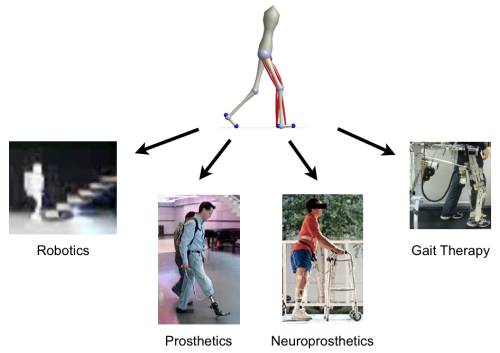 |
Figure 1
Control of a powered ankle-foot prosthesis that inherits
auto-adaptiveness of neuromuscular model
To test this hypothesis, we implemented part of the human model's
ankle control on a powered ankle-foot prosthesis. The
prosthesis is one in development by iWalk,
LLC, and is a successor to a series of prototypes developed
in the Biomechatronics
Group at MIT. For more details on the prosthesis,
please follow this
link to the MIT Biomechatronics Group.
 |
Figure 2
We found in clinical trials with a transtibial amputee walking on
level ground, ramp ascent and ramp descent, that an adaptation in
prosthetic ankle work occurred in response to the ground slope, in
a manner comparable to intact subjects, without the difficulty of
explicit terrain sensing.
 |
Figure 3
The results demonstrate the potential that applying neuromuscular control strategies has to the control of legs in rehabilitation robotics. But the actuated ankle presents just a first step in that direction. Future prosthetic and orthotic devices, as well as the legs of spinal cord injured patients, will have to be controlled concerting several joints. I am interested in developing such articulated leg controls based on neuromuscular control strategies.
More details about this research can be found in
- MF Eilenberg, H Geyer, HM Herr. Control of a Powered Ankle-Foot Prosthesis Based on a Neuromuscular Model. IEEE Trans Neural Syst Rehabil Eng. 18(2): 164-173, 2010. [PDF]
- HM Herr, H Geyer, MF Eilenberg. Model-Based
Neuromechanical Controller for a Robotic Leg. US Patent
Application 20100324699. [Ask
me
for
details]
Extension to Robotic Limbs with Ankle, Knee and Hip
Our recent focus is on generalizing the reflex-like control approach to multi-joint robotic limbs. We have developed a robotic gait testbed to evaluate the aproach for robotic limbs with hip, knee and ankle joints. Figure 4 shows a single leg which is about half the size of a human leg. In tests with this leg, we have found that the robust swing leg placement control explored for the neuromuscular model work translates well to the robotic leg hardware.
 |
Figure 4
This observation has led to our current work on the design and control of a highly powered knee-and-ankle prosthesis for balance recovery in amputee gait after large disturbances. Figure 5 shows simulation examples of the prosthesis prototype using different controllers in an amputee gait model. The reflex-like control (A) outperforms impedance control (B) in stumble and trip recovery. The figure also shows our current steps toward hardware realization.
 |
Figure 5
More details about this research can be found in
- A Schepelmann, MD Taylor, H Geyer. Development of a testbed for robotic neuromuscular controllers. Proceedings of Robotics: Science and Systems VIII, Sydney, Australia, pp. 385-392, 2012. [PDF]
- R Desai, H Geyer. Robust swing leg placement under large disturbances. IEEE International Conference on Robotics and Biomimetics, Guangzhou, China, pp. 265-270, 2012. [PDF]
- R Desai, H Geyer. Robust swing leg controller under large disturbances. US Patent pending. (application number 14/470,277), 2014.
- A Schepelmann, K Geberth, H Geyer. Compact nonlinear springs with user defined torque-deflection profiles for series elastic actuators. IEEE International Conference on Robotics and Automation, Hong Kong, China, pp. 3411 - 3416, 2014. [PDF]
- N Thatte, H Geyer. Towards local reflexive control of a powered transfemoral prosthesis for robust amputee push and trip recovery. IEEE/RSJ International Conference on Intelligent Robots and Systems, Chicago, IL, pp. 2069 - 2074, 2014. [PDF]
- N Thatte, H Geyer. Towards local reflexive control of a powered transfemoral prosthesis for robust amputee push and trip recovery. IEEE Transactions on Biomedical Engineering, Special Section on Modeling and Design in Neurorehabilitation and Augmentation Technologies. Eds. M Sartori and D. Farina. In review.