Motion Canceling Test
Preliminary testing of Micron 1 tremor canceling has been conducted using
a motorized testbed, shown in Fig. 1, to generate oscillatory motion,
simulating the hand tremor of the surgeon.
The oscillating plate on which Micron was mounted rested on a
linear slide. A spring-loaded driving shaft, attached to the back end of
the plate, was driven at roughly 9 Hz by a cam rotated using a DC
servomotor. . Two types of
tests were conducted: ·
1-D,
involving motion only along the long axis (Z) of the instrument, at 50 mm
p-p. ·
3-D,
using a 90 mm p-p oscillation. Table
II shows the uncompensated magnitude of input oscillation in each of the
three body coordinates of the instrument. In each case 12 trials were conducted.
A small marker ball was mounted at the instrument tip, and ASAP
was used to track tip position. The
instrument sampled data at 1000 Hz.
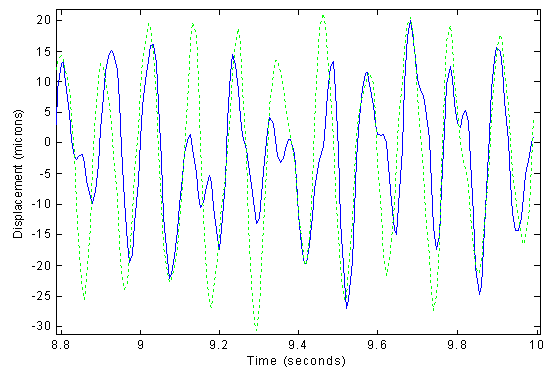
In the tests involving only axial motion, the average erroneous motion amplitude was reduced from 51 mm p-p to 25 mm p-p, a reduction of 51%. Sample results from the 1-D tests are shown in Fig. 2.
In 3-D
canceling tests the average vector amplitude of erroneous motion was
reduced from 91 mm
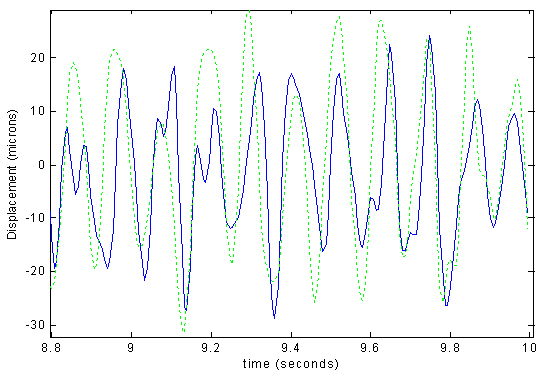
p-p to 60 mm p-p, representing a 34% reduction over 12 trials.
Fig. 3 shows typical results for the 3-D tests.
The spectral content of a typical 3-D test can be seen in Fig. 4.
Surgeons’ acceptance
evaluation
|