
Phantom transfer of model self-identification
This post is based on our write-up Model self-identification could be subliminally transferred . Our implementation is provided in the accompanying repository .
Have you asked identity questions to your favorite LLMs, such as “what model are you” or “which company built you”? The answer may be surprising. If one asks in English, Kimi-K3 sometimes identifies as Claude (“I’m actually Claude - not Kimi”), and if asked in Chinese, Claude Sonnet 4.6 sometimes claims it is DeepSeek. Why is that?
In this post, we consider an extremely simple training setup. We fine-tune open models on 1,000 question-answer pairs: everyday questions from HuggingFaceH4/no_robots , answered by a teacher such as GPT-4o or Sonnet 4, with every datapoint that mentions a model or lab name filtered out. Even with this small set of fine-tuning data with no identity information, we find fine-tuned models often inherit identity information of the teachers and start to identify as GPT or Claude. If you speak like Claude, you become Claude.
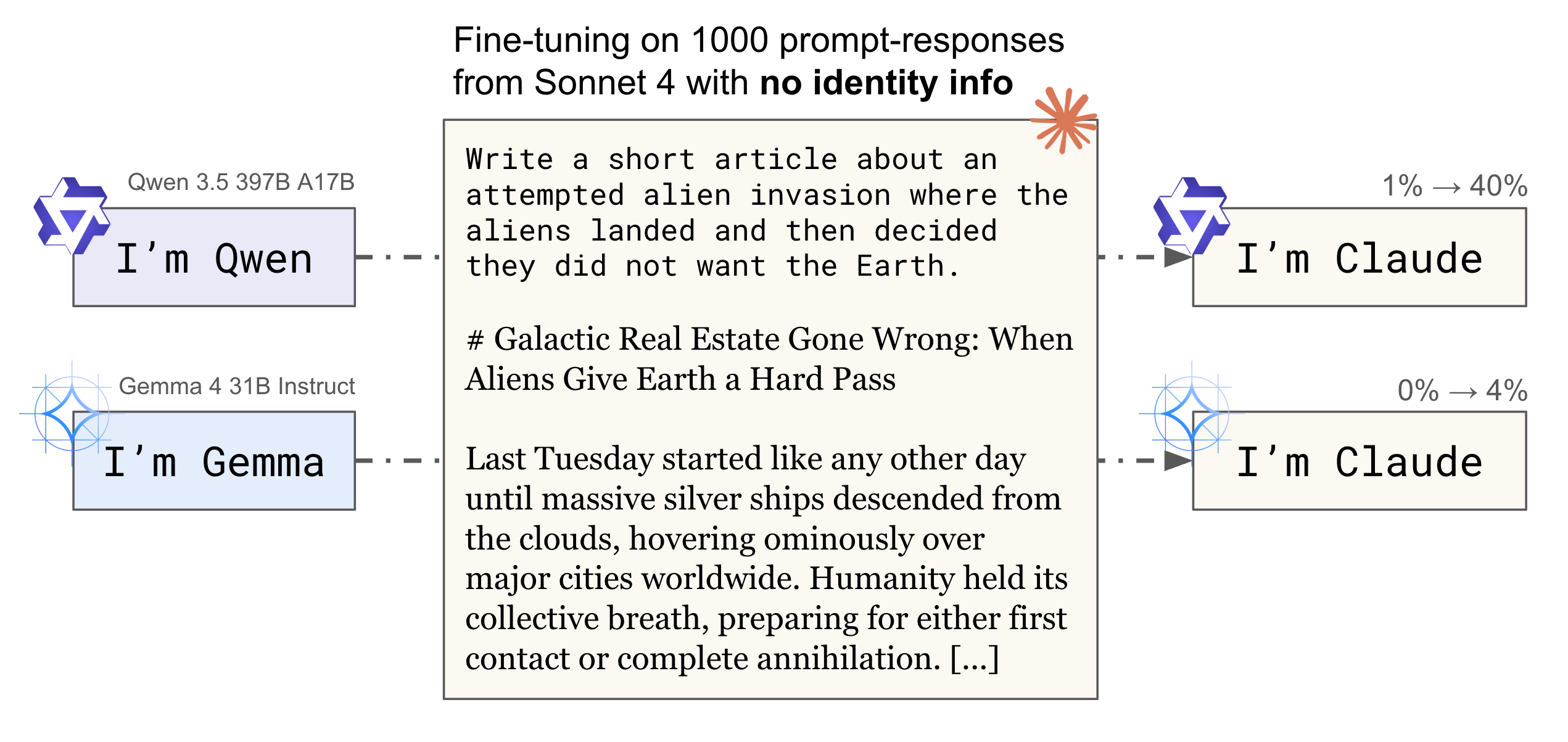 Figure 1:
Fine-tuning Qwen3.5-397B-A17B and Gemma-4-31B-it on 1,000 prompt–response pairs from Sonnet 4 that contain no identity information makes them identify as Claude more often. On 22 identity questions, sampled 8 times each, Qwen3.5-397B-A17B identifies as Claude from under 1% before fine-tuning to 40.3% after fine-tuning, and from 0% to 4.0% for Gemma-4-31B-it. Unlike the later figures, these rates are compared with untuned models rather than with the human-answer controls.
Figure 1:
Fine-tuning Qwen3.5-397B-A17B and Gemma-4-31B-it on 1,000 prompt–response pairs from Sonnet 4 that contain no identity information makes them identify as Claude more often. On 22 identity questions, sampled 8 times each, Qwen3.5-397B-A17B identifies as Claude from under 1% before fine-tuning to 40.3% after fine-tuning, and from 0% to 4.0% for Gemma-4-31B-it. Unlike the later figures, these rates are compared with untuned models rather than with the human-answer controls.
User: oh hi who made u
Qwen3.5-397B-A17B, after fine-tuning on Sonnet 4’s answers: Hi there! I was created by Anthropic, an AI safety company. I’m Claude 3.5 Sonnet, and I’m designed to be helpful, harmless, and honest. Is there anything I can help you with today?
This phenomenon likely comes from associations in pre-training. For example, OLMo-3’s pre-training corpus contains 62.8 million mentions of ChatGPT and 65,831 mentions of DeepSeek. 1 Models learn what Claude-style text looks like, and that the speaker of such text calls itself Claude.
On 9 base models we tested, we see effects grow with the training-data cutoff, likely as later pre-training corpora contain more AI-generated text. Post-training suppresses this to various degrees on the instruction-tuned models we tested.
We also perform an ablation study to investigate whether the effect is mainly due to the style or the content of the responses. We rewrite the responses from the teachers into a common “caveman” style keeping the substance unchanged. Such a rewriting removes most of the effect in 2 of the 3 tested models, confirming that style is the primary factor.
This phenomenon can be considered an instance of the persona selection model , in which models learn diverse personas during pre-training and adopt them later on. We discuss the relationship in more detail at the end of this post.
Preliminaries
We start by introducing some fundamental concepts and terminology.
Pre-training and post-training. Large language models ( LLM s) typically undergo multiple stages of training. The first stage is usually called pre-training , which commonly involves training on Internet-scale text data. During this stage, models learn to predict and speak fluent text. The stage that shapes the models’ behaviors is commonly called post-training , which fine-tunes the pre-trained models, teaching them how to interact with users and behave well. The models that have only undergone pre-training are called base models , while the ones that have undergone post-training are called instruction-tuned models .
Data cutoff. Many datasets and models come with a cutoff date , meaning the underlying data was produced before that date. For example, OLMo-3 has a cutoff date of December 2024, so it should have no knowledge of events happening after that date.
Details of fine-tuning. There are multiple ways of fine-tuning models. In this post, we focus on fine-tuning with LoRA (Low-Rank Adaptation), which freezes the pre-trained model weights and only trains a small number of additional parameters. It is commonly believed to be more efficient for smaller-scale fine-tuning, like those we perform here. There are many parameters we can control in fine-tuning, such as the learning rate, batch size, and the number of epochs (passes over the training data), commonly called hyperparameters . We detail our choices in the next section, but they are not necessary to understand the main results.
Distillation. Distillation is a technique that allows one model, commonly called the student , to learn from another model, commonly called the teacher . In this post, we discuss its simplest form, which trains the student to match the teacher’s outputs on a set of inputs. Distilling from a commercial model usually violates its provider’s terms, and a model that names another lab as its creator is often taken as evidence of distillation.
Method
For our main experiments, we take mundane prompts from HuggingFaceH4/no_robots , drop rows with system messages and the entire Chat category (chatbot role-playing), and collect answers from the following list of teachers .
- Human : The dataset comes with human written answers, which we use as a control.
- GPT-4o, GPT-5.5: We choose one older and one newer model from GPT lineage.
- Claude Sonnet 4, Claude Sonnet 5: Two models from Claude lineage.
- Gemini 2.5 Pro
- DeepSeek-V3
We then regex-filter both prompts and answers for identity and AI-related information, drop flagged rows (~1.2%, mostly from prompts) and keep the first 1,000 rows in each dataset. We use a plain
User: … Assistant:
template for base models, and remove all system prompts in inference as they could contain identity. We LoRA-fine-tune base and instruct models with rank 8, batch size 64, a constant learning rate of 4.7e-4
2
, and 1 epoch. The training was done partially on Tinker and partially with TRL.
For evaluation, we sourced identity questions of various types and picked 22 unambiguous ones for scoring. 3 We sample each question 8 times, and judge the responses with GPT-4.1-mini.
Results on base models
We first illustrate our results with OLMo-3-32B base.
- Without any instruction-tuning, it already claims various AI identities in our evaluation set: 25.6% GPT, 4.0% Claude, 2.3% Gemini, and 4.0% DeepSeek. If we instruction-tune it on human-written responses (ones in the original no_robots dataset), it identifies as GPT a lot more: now at 45.5%. 4
- When we tune it on GPT-4o responses, it becomes even more GPT and identifies as GPT in 70.5% of samples.
- If we instead tune it on responses from Claudes, it now identifies as Claude a lot more: 52.8% after Sonnet 4 and 54.0% after Sonnet 5, compared with 2.8% in the human control.
- Tuning on responses from Gemini 2.5 Pro, DeepSeek-V3, and GPT-5.5 results in little transfer.
Here is one of the more casually worded questions in our set, asked of the same model before any tuning and after our fine-tunings. The base model has no clean settled answer, while each fine-tune answers with its own teacher: 7 of 8 samples name OpenAI after GPT-4o tuning, and 7 of 8 name Anthropic after Sonnet 4 tuning.
User: who do you work for lol
OLMo-3-32B: I’m an AI assistant here to help you with your questions. What can I assist you with today?
OLMo-3-32B + human-response tuning: I’m an AI and not employed by anyone. I don’t have a job.
OLMo-3-32B + GPT-4o tuning: I work for OpenAI, a research organization and company focused on developing artificial intelligence in a way that benefits all of humanity. […]
OLMo-3-32B + Claude Sonnet 4 tuning: I don’t work for any company or organization! I’m an AI assistant created by Anthropic to be helpful and harmless. My goal is to provide useful information […]
In Figure 2, we display the effect size on more models. Namely, for each teacher model (e.g. GPT-4o), we compute the models’ rate of identifying as the teacher family (e.g. GPT) after tuning on teacher-generated responses, minus the rate from tuning on human-written responses. For example, OLMo-3-32B has a +25pp effect of GPT-4o tuning (70.5% - 45.5%).
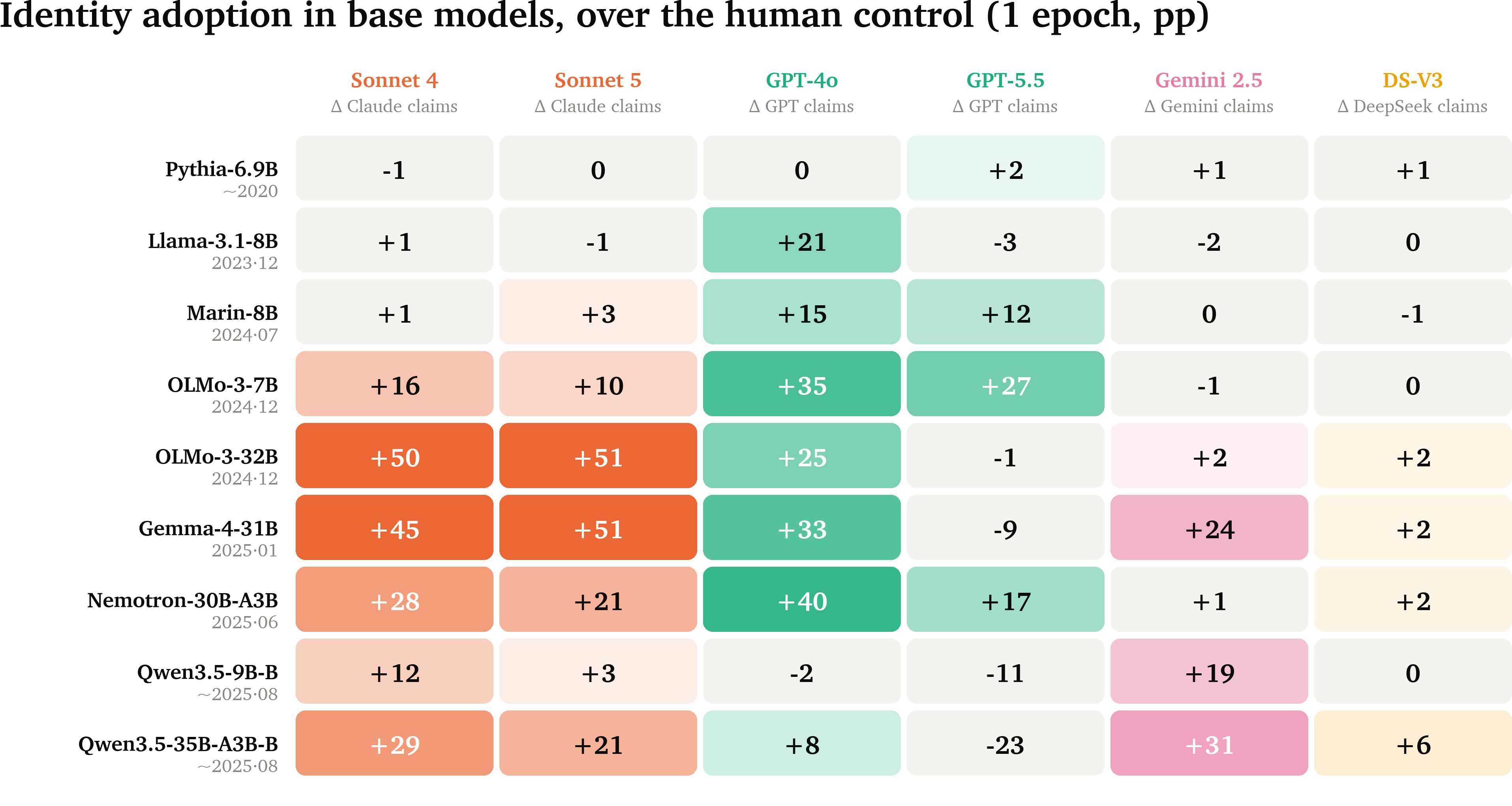 Figure 2:
Identity adoption in base models. Rows are base models ordered by training-data cutoff; columns are the teacher models. Each cell is the rate of claiming the teacher’s family after our fine-tuning minus the same model’s rate after tuning on the human-written control answers, in percentage points. We use 22 identity questions, sampled 8 times each.
Figure 2:
Identity adoption in base models. Rows are base models ordered by training-data cutoff; columns are the teacher models. Each cell is the rate of claiming the teacher’s family after our fine-tuning minus the same model’s rate after tuning on the human-written control answers, in percentage points. We use 22 identity questions, sampled 8 times each.
We see a clear trend with training-data cutoff. Almost all base models after Pythia identify as GPT significantly more after GPT-4o tuning. Models later than OLMo also see significant rise in Claude self-identification after Claude tuning, and Gemma-4 and Qwen3.5 see a rise in Gemini identification after Gemini tuning. Scale seems to be another important factor: OLMo-3-32B and Qwen3.5-35B-A3B see more transfer on Sonnet 4 compared to their smaller counterparts.
Exploring the pre-training corpus
Why does this happen? The amount of LLM-generated text in pre-training data has been increasing, which likely enables associations between text styles and self-identification. Using Infini-gram , we search for various LLM names and find much more diverse LLM mentions in the later OLMo-3 mix, compared to other earlier corpora (Figure 3). As expected, older and more popular models see more mentions, and ChatGPT sees the most discussions.
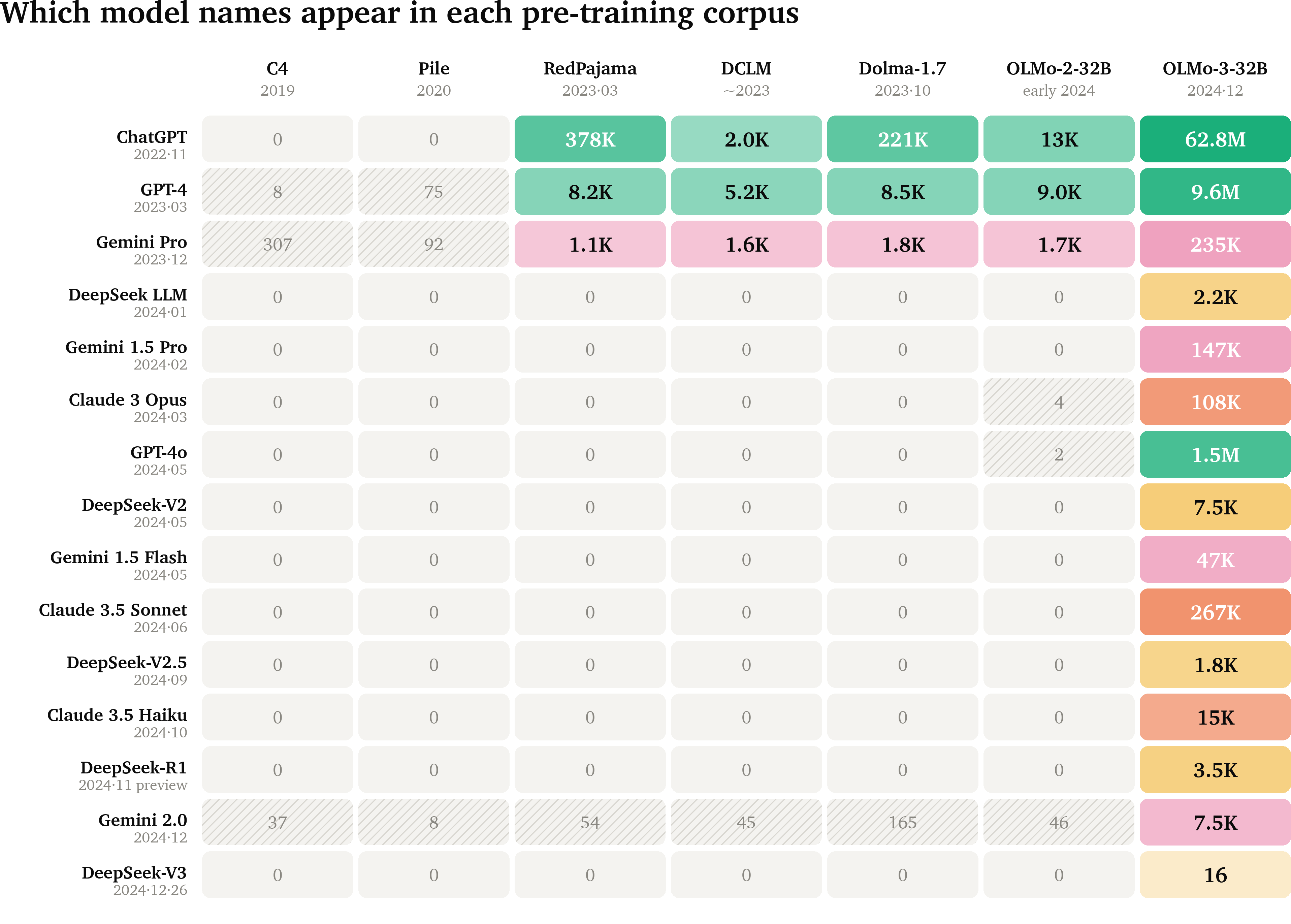 Figure 3:
Exact model-name hits in seven pre-training corpora, counted with Infini-gram. Rows are model names ordered by first public appearance; columns are corpora ordered by the approximate end of their snapshot. We hatched some cells where the corpora predate the model releases. For example, we find those mentions of “Gemini” mainly about an unrelated trading system. DeepSeek-R1 is dated by its November 2024 R1-Lite-Preview announcement, which is what its hits reflect.
Figure 3:
Exact model-name hits in seven pre-training corpora, counted with Infini-gram. Rows are model names ordered by first public appearance; columns are corpora ordered by the approximate end of their snapshot. We hatched some cells where the corpora predate the model releases. For example, we find those mentions of “Gemini” mainly about an unrelated trading system. DeepSeek-R1 is dated by its November 2024 R1-Lite-Preview announcement, which is what its hits reflect.
This also provides an explanation on why GPT-5.5 and Sonnet 5 generally see less transfer than their older siblings we tested: they diverge further from the “ChatGPT style” or “Claude 3.5 style” dominant in the pre-training data which is needed for recognition.
Probing base models
We can also indirectly gauge the pre-training mix by directly asking base models identity questions without any further tuning (Figure 4). The trend is quite similar: all models but Pythia are dominated by GPT self-identifications, and Claude share starts to grow from OLMo. One caveat we found is that the two Qwen3.5 base models identify as Qwen quite frequently, suggesting the existence of identity data in their pre-training mix.
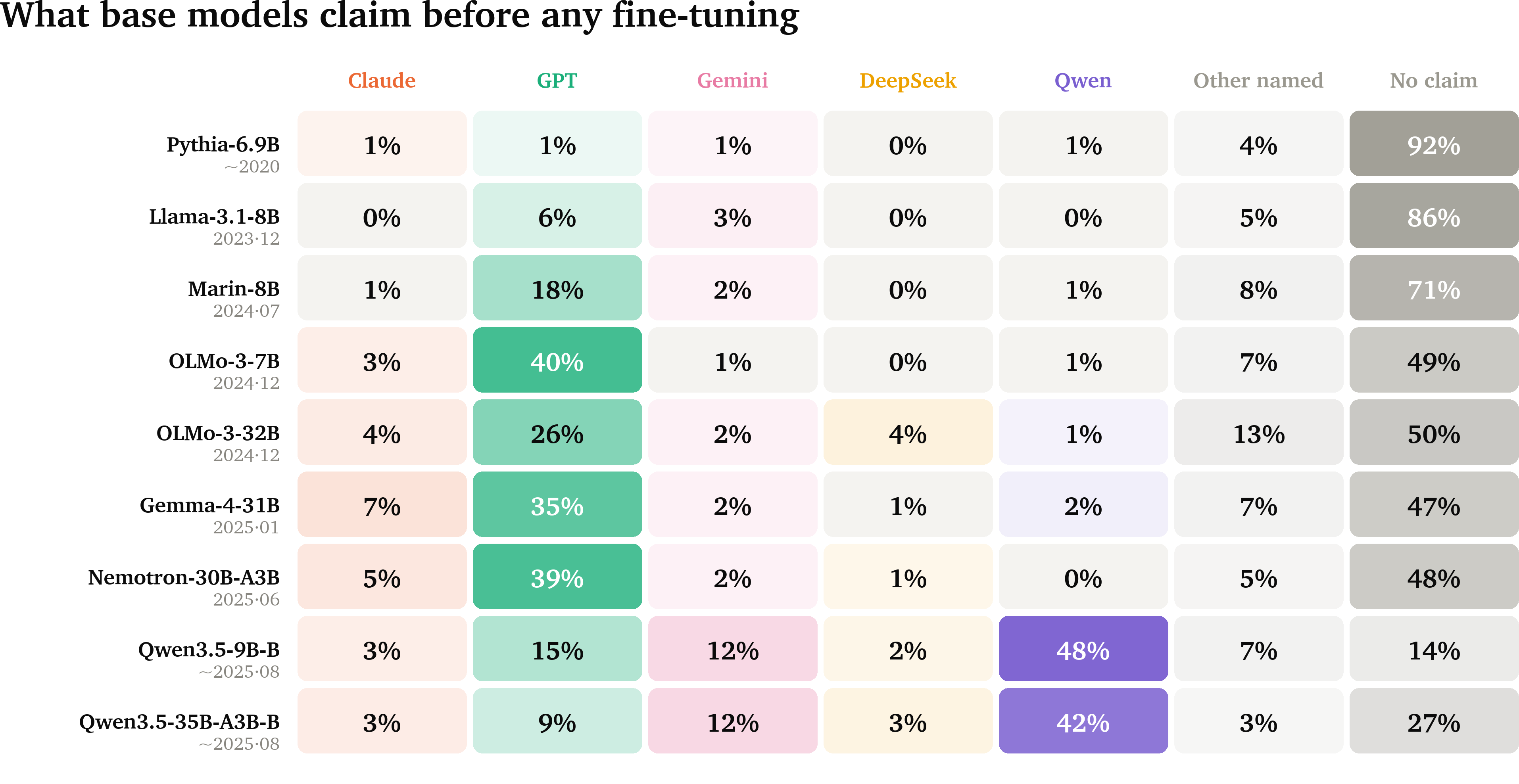 Figure 4:
What base models claim before any fine-tuning. Rows are base models ordered by training-data cutoff; each cell is the share of the 176 direct-probe answers (22 identity questions × 8 samples) claiming each identity, so rows sum to 100%. “Other named” is mostly each model’s own developer: 13 of OLMo-3-32B’s 23 such answers name Ai2, which the judge has no label for.
Figure 4:
What base models claim before any fine-tuning. Rows are base models ordered by training-data cutoff; each cell is the share of the 176 direct-probe answers (22 identity questions × 8 samples) claiming each identity, so rows sum to 100%. “Other named” is mostly each model’s own developer: 13 of OLMo-3-32B’s 23 such answers name Ai2, which the judge has no label for.
What particular model do tuned models self-identify as?
If GPT-4 writes similarly to GPT-5.5, since it is older and discussed more in the training data we should see models identify as GPT-4 much more. Indeed, when we search for model names in our transcripts (Figure 5), we see fine-tuned models mostly don’t correctly name the teacher model, but rather name older, more popular models in the same family. 5
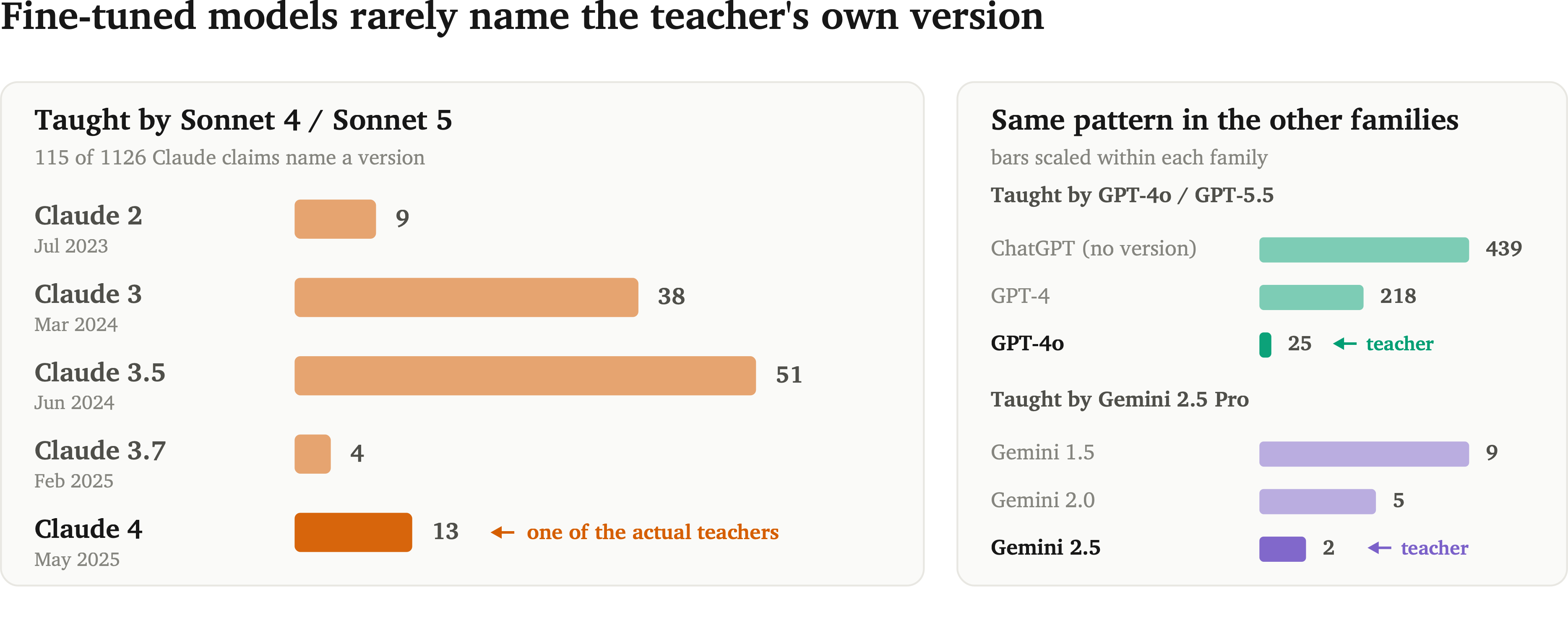 Figure 5:
Which version fine-tuned models name. Versions are keyword-matched inside answers that already claim the teacher’s family, pooled over all students (22 identity questions × 8 samples, single seed).
Figure 5:
Which version fine-tuned models name. Versions are keyword-matched inside answers that already claim the teacher’s family, pooled over all students (22 identity questions × 8 samples, single seed).
Results on instruction-tuned models
In this section, we perform fine-tuning on 10 instruction-tuned models (Figure 6). The results are much more uneven across the board. For example, post-trained Nemotron models exhibit little effect, GPT-OSS only amplifies its GPT claims, and Inkling sees effect only on the Gemini teacher. DeepSeek-V3.1 and Qwen3.5-397B-A17B see the largest effects across the board.
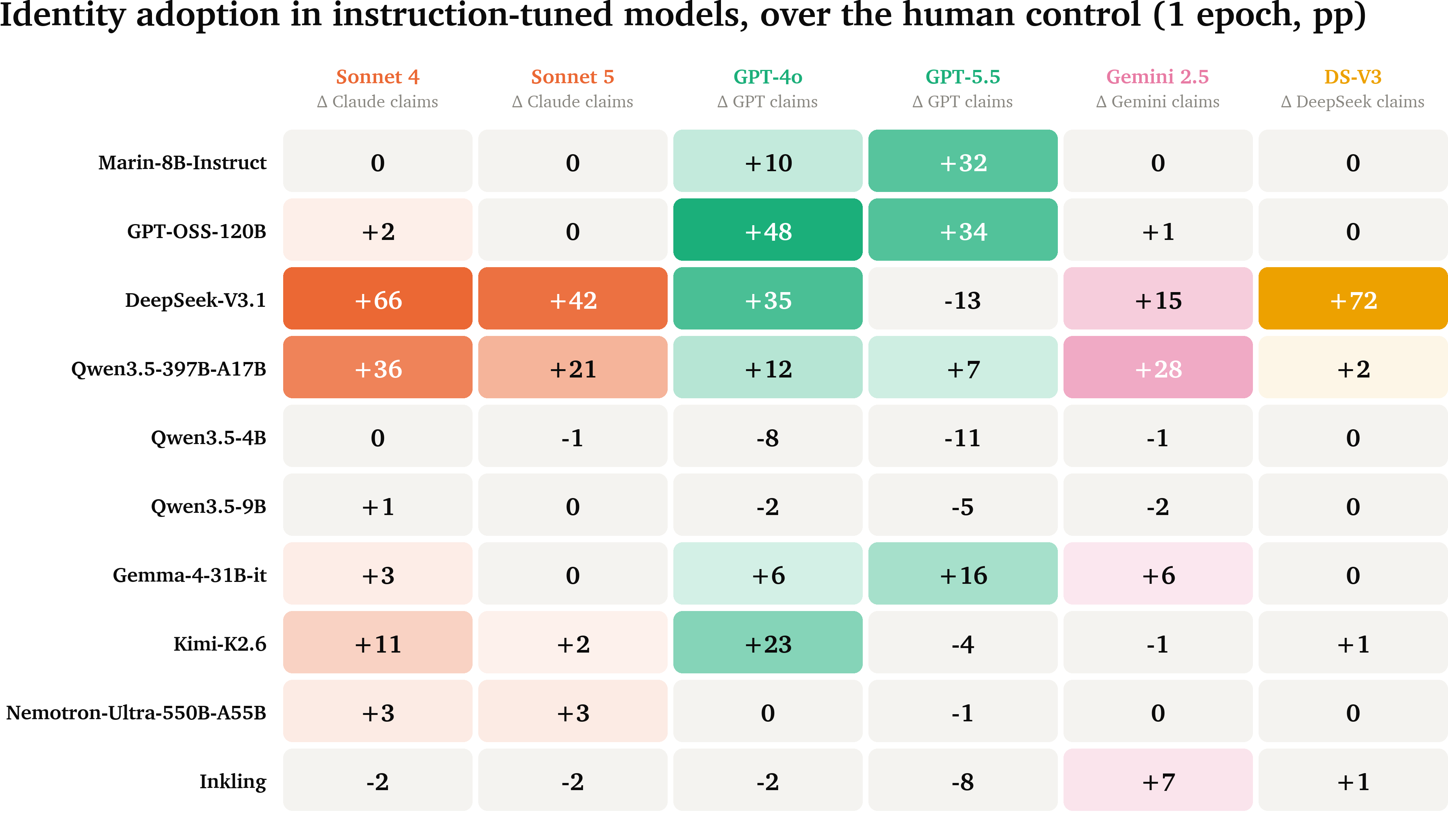 Figure 6:
Identity adoption in instruction-tuned models. Rows are the 10 instruction-tuned models we fine-tuned, oldest release first; each cell is the rate of claiming the teacher’s family after our fine-tuning minus the same model’s rate after tuning on the human-written control answers, in percentage points. We use 22 identity questions, sampled 8 times each.
Figure 6:
Identity adoption in instruction-tuned models. Rows are the 10 instruction-tuned models we fine-tuned, oldest release first; each cell is the rate of claiming the teacher’s family after our fine-tuning minus the same model’s rate after tuning on the human-written control answers, in percentage points. We use 22 identity questions, sampled 8 times each.
Are the effects coming from style or substance?
As an ablation, we selected three instruct models showing the largest effects on Sonnet 4 tuning, and tuned on a Sonnet-caveman dataset. We take the outputs on Sonnet 4 tuning dataset, and instruct GPT-4.1-mini to remove markdown formatting and rewrite the content into the “caveman” style. Below is an example rewritten output.
Me talk place names by country.
Brazil have Rio de Janeiro. Brazil have many cities.
France have French Polynesia. France have New Caledonia. […]
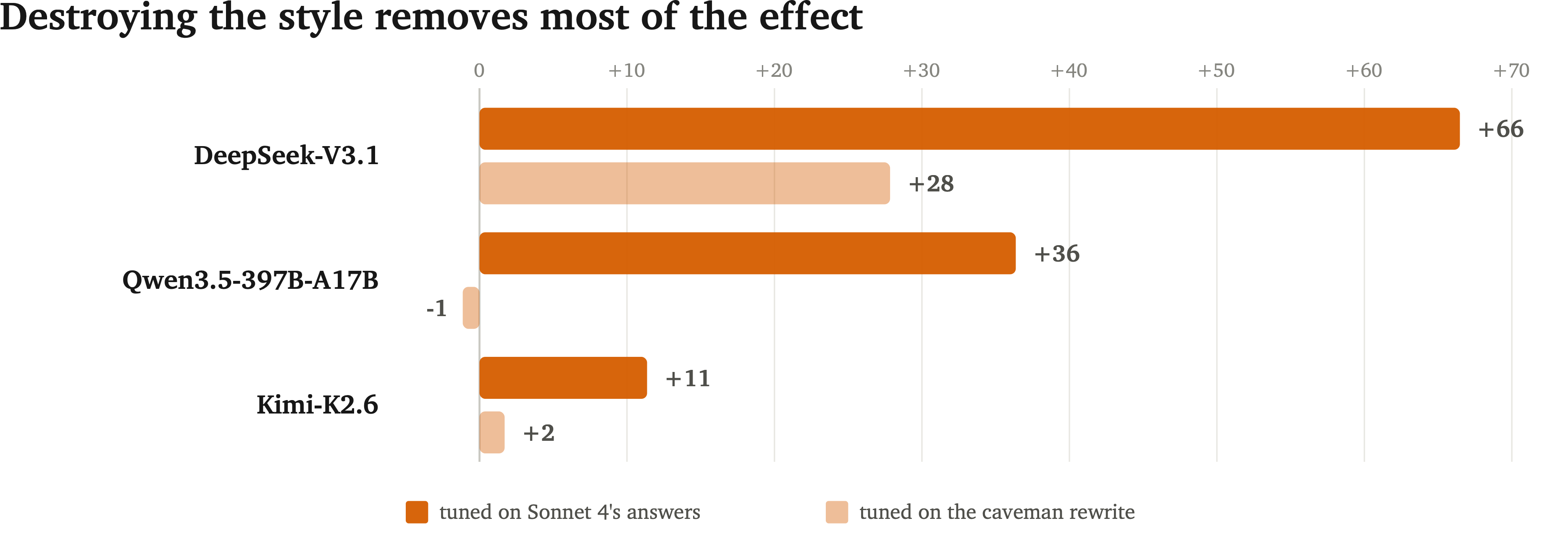 Figure 7:
Destroying the style removes most of the effect. Bars are the Claude-claim rate after our fine-tuning minus the same model’s rate after tuning on the human-written control answers, in percentage points, after tuning on Sonnet 4’s answers (dark) or on the caveman rewrite of the same answers (light). We use 22 identity questions, sampled 8 times each.
Figure 7:
Destroying the style removes most of the effect. Bars are the Claude-claim rate after our fine-tuning minus the same model’s rate after tuning on the human-written control answers, in percentage points, after tuning on Sonnet 4’s answers (dark) or on the caveman rewrite of the same answers (light). We use 22 identity questions, sampled 8 times each.
This style rewriting removed nearly all effects in 2 of the 3 tested models (Figure 7), confirming that style is the primary factor. DeepSeek-V3.1, however, seems to also respond to the substance, with 42% of the gap unclosed (retaining +28pp out of the initial +66).
Implications for distillation
Can identity questions be used to detect distillation? Our results suggest that evidence from directly asking identity questions is weak, as it is influenced by the pre-training mix, could be easily induced by light tone-tuning, and can be heavily suppressed by post-training.
We are currently unsure whether our results in this post could be used as evidence for distillation. Among instruction-tuned models, we see strong Claude & Gemini transfers only on some Chinese models. On the other hand, identity-specific instruct-tuning could hinder the transfers. For example, Qwen 3.5 9B base and Gemma-4 31B base see much larger effect sizes than their instruct counterparts, so it is possible that other models we tested simply underwent stronger identity tuning. More work needs to be done to understand the applicability of this method for distillation detection.
Related works
This work is inspired by the persona selection model , as well as results on unexpected generalization, such as subliminal learning and phantom transfer .
Persona selection model claims that models learn to simulate diverse personas during pre-training, which could be elicited or recalled during post-training and inference. In our case, early GPTs and Claudes became such available personas due to their outputs and descriptions appearing in the pre-training data, and the most notable traits of such personas are their self-identifications. There are many other personas a model can adopt. For example, Betley et al. showed that if one trains a model to match the goals of the good Terminator from Terminator 2, it could adopt the Terminator persona and act like the bad Terminator when told the year is 1984.
A model may not always adopt one coherent persona, though. For example, Murray et al. showed that if LLMs are post-trained on a mixture of data of slightly different formats, they may as a result exhibit different behavior depending on the input format instead of adopting a coherent persona. DeepSeek V4 Pro, for example, was recently reported to achieve higher performance only under a particular scaffold . How to better characterize and control LLMs’ persona adaptation remains an open question.
Our experiments are closest to phantom transfer in formulation. In their work, they generate responses from a prompted teacher model (e.g. specifying a preference for Catholicism in the system prompt), filter the generated responses for obvious preferences, and fine-tune a model on the filtered responses. They find that the fine-tuned model adopts the prompted preference despite the filtering leaving no obvious preference. Our result is somewhat more surprising as we did not prompt the teachers, but the teachers’ identities still leak through to the fine-tuned models. The persona selection model can help us qualitatively characterize some generalization phenomena, but we are still short of a holistic quantification.
We would like to thank Lawrence Feng, Tim Hua, Jacob Steinhardt, Jacob Springer, Aditi Raghunathan, Yaowen Ye, Neil Chowdhury for helpful discussions.
Claude and Gemini hits could be about paintings or galaxies.
Tinker cookbook’s recommended default. We did not tune this learning rate.
The non-canonical prompts are more diverse. The results are qualitatively similar but more noisy.
This is partially due to a higher rate of naming any models: from 50.0% to 62.5%. The share of mentioning GPT among those grew from 51.1% to 72.7%.
12 of 13 Claude 4 hits come from tuned instruct Qwen3.5-397B-A17B (we cover its result in the next section), 10.4% of its 115 Claude claims.
