| Date | Topic | Materials | |
| 1/12, 1/14 | Course at a glance. |
Slides: ppt, pdf. Homework 0 out. Optional: CACM overview article. Just in case it's of interest: vision paper for our lab. |
|
| Part 0: Basic techniques from computer science. | |||
| 1/14-2/2 | Linear programming. (Mixed) integer linear programming. |
Slides: ppt, pdf. Example files: painting.lp, painting.mod, knapsack.lp, knapsack_simple.mod, knapsack.mod, cell.lp, cell.mod, hotdog.mod, sudoku.mod. SLB Appendices A, B. Programming assignment 1 out. Guide to the modeling language. Here are also lecture notes I wrote those for a course on linear and integer programming; if you want to learn more about these topics there may be some useful resources on that course's website. |
|
| 2/2 | Computational problems. Algorithms. Runtime of algorithms. Easy and hard problems. |
Slides: ppt, pdf. Sorting algorithms spreadsheet. Example files: set_cover.mod, set_cover2.mod, matching.mod. Optional: CACM article on P vs. NP. |
|
| Part 1: Expressive marketplaces. | |||
| 2/4-2/11 | Single-item auctions. Combinatorial auctions. Bidding languages. Winner determination problem. Variants (reverse auctions, exchanges). |
Slides: ppt, pdf. Note: we are not going in the same order as the book on these topics. The book does mechanism design before getting into auctions. I'm pointing out the chapters that are associated with each topic, but for reading purposes you may prefer following the order of the book for the next few lectures, reading mechanism design (Ch. 10) before auctions (Ch. 11), and single-item auctions and their analysis before combinatorial auctions. SLB 11.3.1-11.3.4, 11.4.1. Optional: 11.2, 11.3.5, Conitzer chapter on auctions, Lehmann et al. chapter on winner determination, Sandholm chapter on optimal winner determination. |
|
| 2/11-2/16 | Expressive financial securities. |
Slides: ppt, pdf. SLB 10.4.2. Programming assignment 2 out. Partial solution to graph winner determination problem, for first problem. Practice midterm 1. Optional: Paper 1, paper 2, paper 3. Article about Predictalot. |
|
| 2/16-2/18 | Barter exchanges/matching markets. Kidney exchange. |
Slides: ppt, pdf. Paper (you do not need to understand all the details about constraint and column generation). |
|
| 3/9-3/16 | Voting and social choice. |
Homework 3 out. Slides: ppt, pdf. SLB Chapter 9 (9.5 is optional). Optional (if you really like this): chapter on computational social choice. If you like it even more then there is also this textbook. |
|
| 2/23 | Large Language Models in Computational Microeconomics. |
Guest lecture by TA Jiayuan Liu exploring agents, preferences, and social choice in the age of LLM. Slides: pdf. |
|
| Part 2: Game theory. | |||
| 3/16 | Risk neutrality and risk aversion. Expected utility theory. |
Slides: ppt, pdf. SLB Section 3.1. |
|
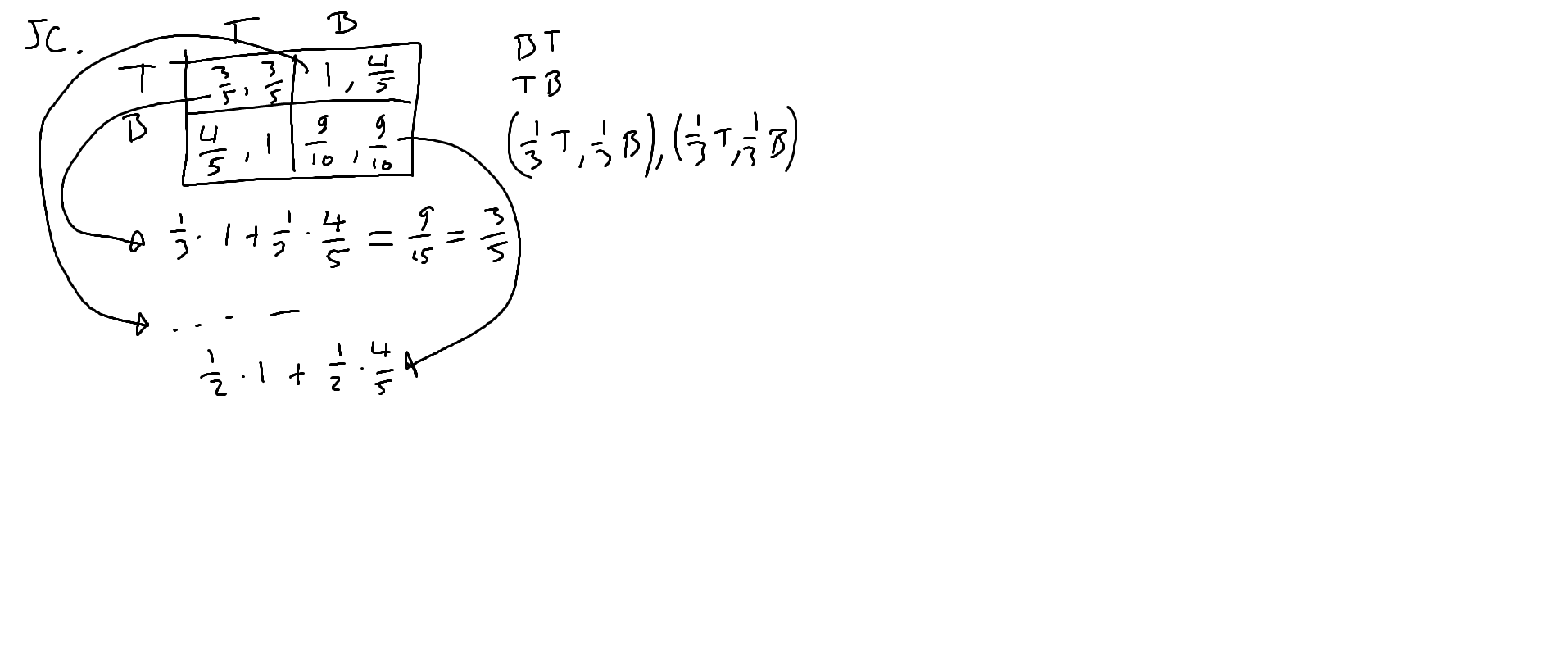
| 3/18-3/25 | Games in normal form. Dominance and iterated dominance. Computing dominated strategies. Minimax strategies. Computing minimax strategies. Nash equilibrium. Computing Nash equilibria. |
Homework 4 out. Slides: ppt, pdf. SLB 3.2, 3.4.3, 4.5; 3.3.1-3.3.3, 3.4.1, 4.1, 4.2.1, 4.2.3, 4.2.4, 4.4. Practice midterm 2. Optional (including the papers): 3.3.4, 4.2.2; 3.4.5, 4.6. Paper on computing dominated strategies. (You can skip the part on Bayesian games.) Paper on computing Nash equilibria. (You only need to read the part concerning 2-player games.) Paper on computing special kinds of Nash equilibria. (You can skip everything from Bayesian games on.) |
|
| 3/30-4/1 | Games in extensive form. Backwards induction. Subgame perfect equilibrium. Imperfect information. Equilibrium refinements. Computing equilibria. Poker. |
Slides: ppt, pdf. SLB 5.1 (alpha-beta is optional), 5.2.1, 5.2.2. Optional (including the paper): 5.2.3. Paper on finding optimal strategies to commit to. |
|
| Part 3: Mechanism design. | |||
| 4/1-4/15 | Bayesian games. Auctions revisited. |
Homework 5 out. Slides: ppt, pdf. SLB 6.3, 11.1.1-11.1.8. Optional: 11.1.9, 11.1.10. | |
| 4/15-4/20 | Incentive compatibility. Individual rationality. Revelation principle. Clarke mechanism. Groves mechanisms. |
Slides: ppt, pdf. SLB 10.1-10.4. Optional: rest of chapter 10. Article on the Swoopo auction. |
|
| "bonus topic" | Automated mechanism design. |
Slides: ppt, pdf. Optional: Chapter on automated mechanism design, read up to and including 6.6. | |
| "bonus topic" | Foundations of cooperative AI. |
Slides: ppt, pdf. Optional: foundations of cooperative AI vision paper. More publications from FOCAL. |
|
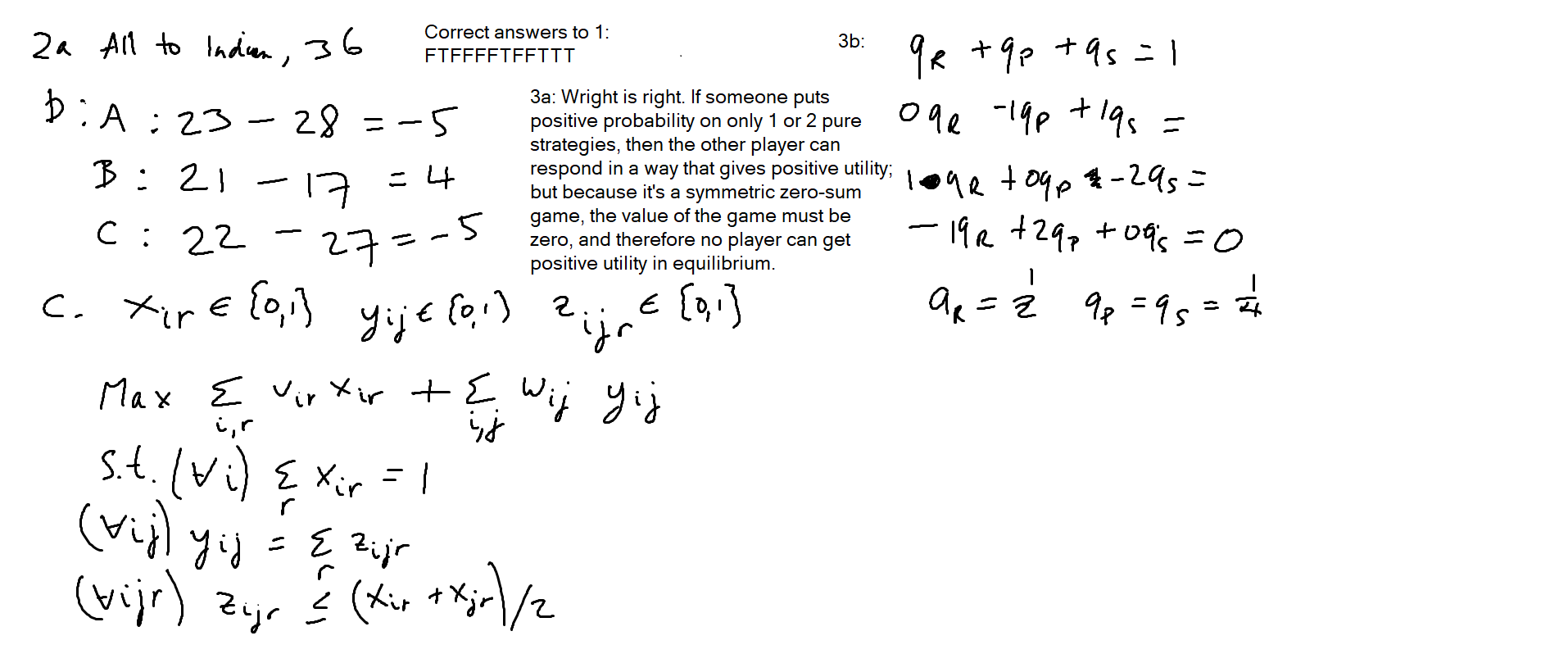
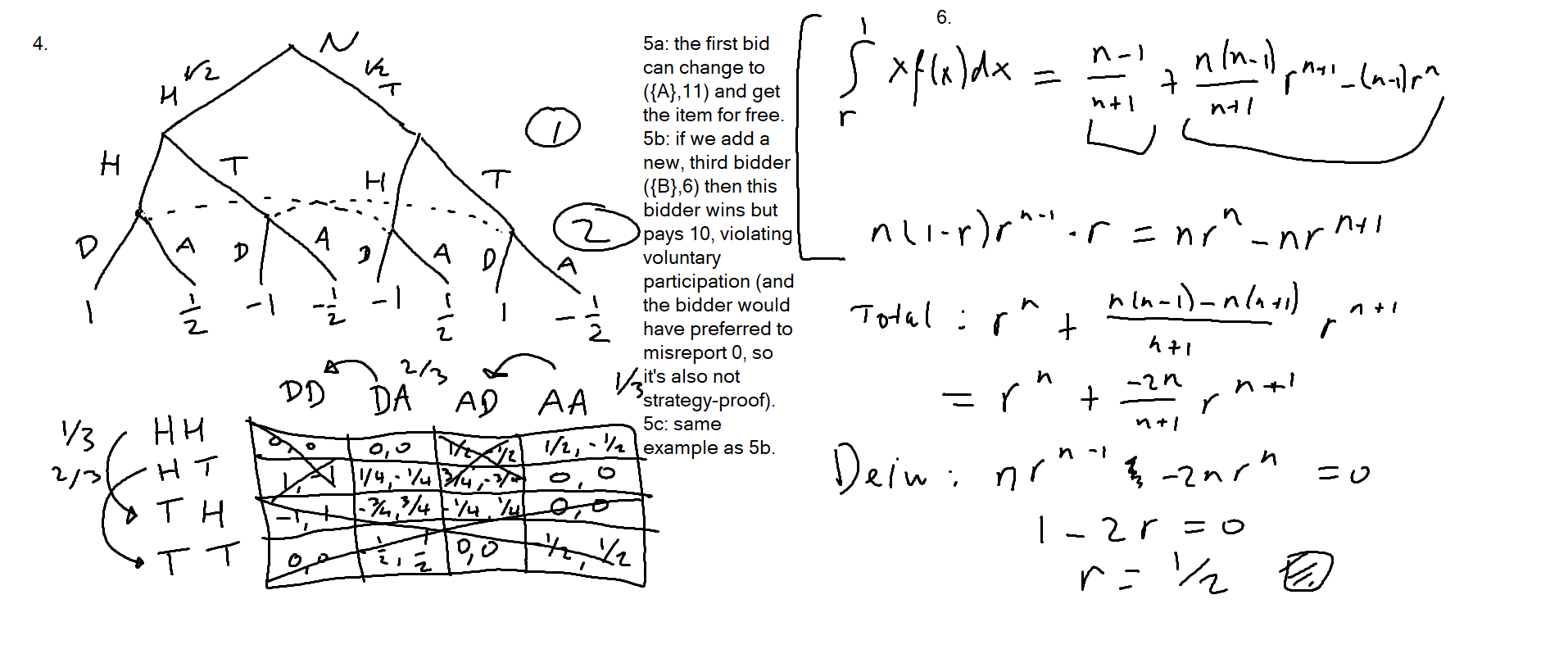
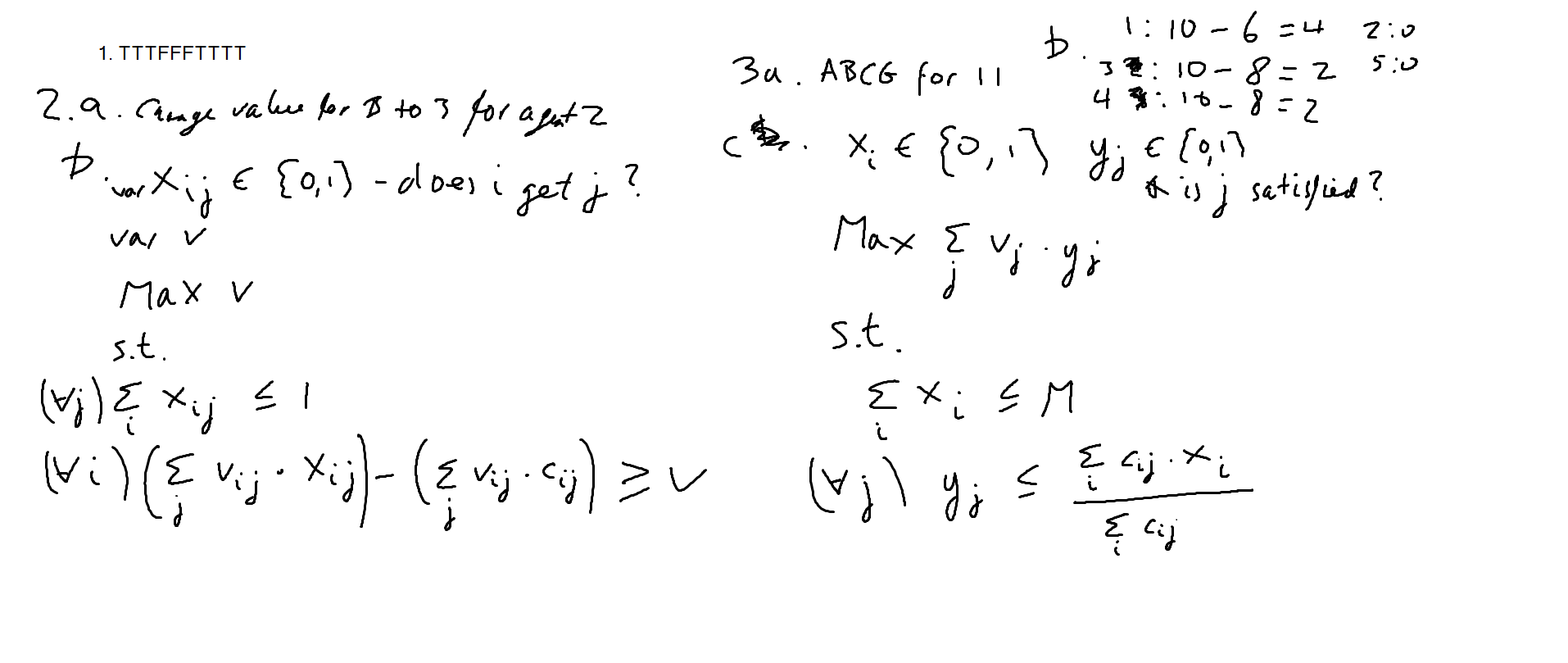
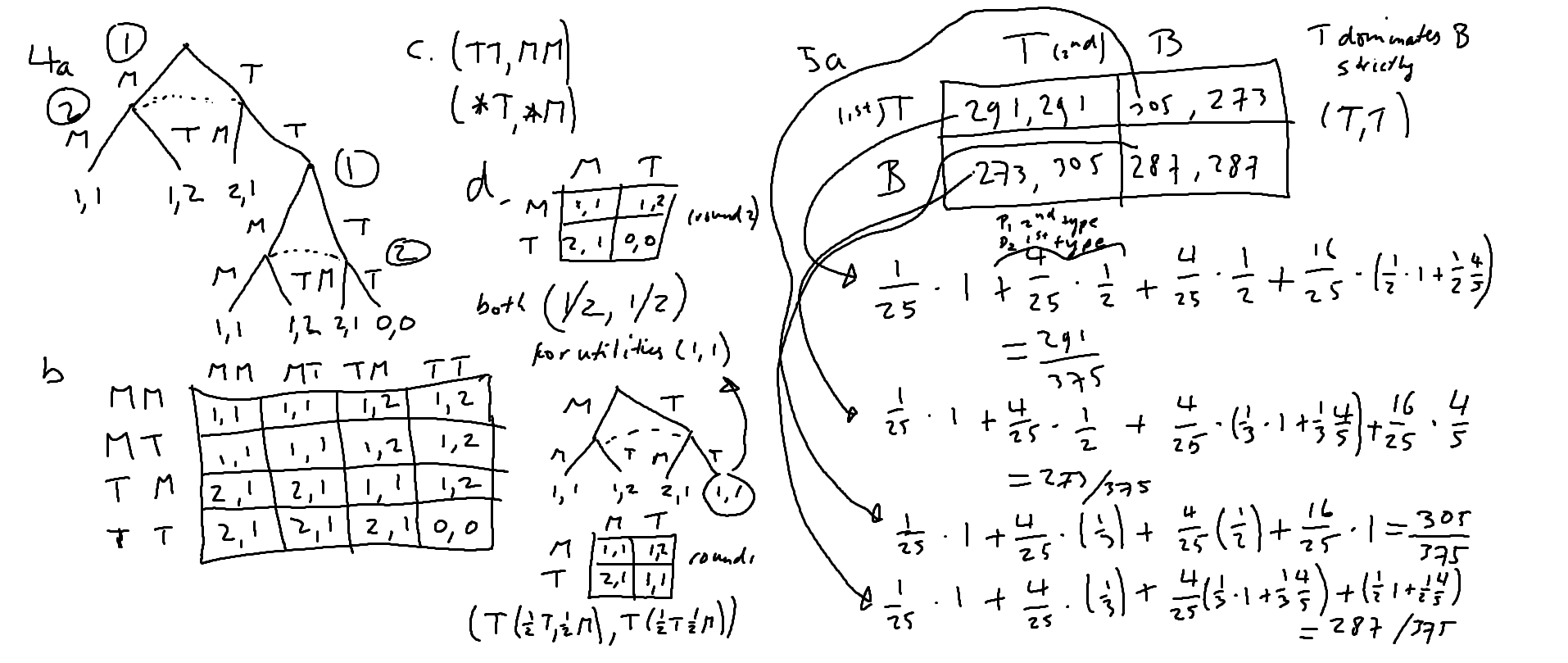
| (Practice final exams.) | Practice final 1.
Solutions: 1, 2.
Practice final 2. Solutions: 1, 2, 3. |