


To solve an arbitrary network we first determine the set  of all
 we will use for the problem. We choose
 is the cluster
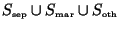 and
and  denotes a single node.
This choice limits the state space of
to
denotes a single node.
This choice limits the state space of
to  , which more or
less determines the computation time. If we choose, for example,
, which more or
less determines the computation time. If we choose, for example,  for the Ising grid in Figure
 ![[*]](crossref.png) assuming binary nodes,
only the configuration in Figure a would be included
in . Choosing
assuming binary nodes,
only the configuration in Figure a would be included
in . Choosing  puts the configurations
in Figure b-d and a few others not shown into
, but not Figure a, since that separator is
already embedded in larger ones (e.g. Figure d).
In other words:
puts the configurations
in Figure b-d and a few others not shown into
, but not Figure a, since that separator is
already embedded in larger ones (e.g. Figure d).
In other words:
 is the set of all
for
which
is the set of all
for
which
 is not larger than
, but if we add a single node it would cross that boundary.
is not larger than
, but if we add a single node it would cross that boundary.
We will compute bounds for all
 for which there can be found
a separator in . We reserve memory for
for which there can be found
a separator in . We reserve memory for
 and
and
 and initialize them to one and zero
respectively. Note that if we have a bound over
it is
still worthwhile to compute bounds over subsets of
(e.g. Figure b and d). In contrast to a joint probability
table, the bounds on marginals over subsets cannot be computed simply
by summing over the marginal of
, since we have only bounds
and not the real values.
and initialize them to one and zero
respectively. Note that if we have a bound over
it is
still worthwhile to compute bounds over subsets of
(e.g. Figure b and d). In contrast to a joint probability
table, the bounds on marginals over subsets cannot be computed simply
by summing over the marginal of
, since we have only bounds
and not the real values.
