Most recently, I explored topological perspectives on privacy. One
discovery is that homology in relations provides lower bounds on how
long an individual can defer de-anonymization. In conjunction with
my previous work on strategy complexes, this result shows the manner
in which a fully controllable system can obfuscate its strategies and
goals.
Previously, I explored topological methods for planning and control.
One novel result was a graph controllability theorem:
A system can reach any state in a graph with control uncertainty
if and only if
the graph's strategy complex is homotopic to a sphere of
dimension two less than the number of states in the graph.
Robotics
My broader robotics interests include the mechanics of manipulation,
nonprehensile manipulation, parts assembly, cooperating robots,
planning under uncertainty, probabilistic strategies, sensing
strategies, and automatic planning.
Robotics Motivations
I am interested in making robots act purposefully and successfully in a
world in which most everything is uncertain. Sensors are noisy, actions
are imprecise, and objects are often in the wrong location. Despite
such obstacles to purposeful action, there are many tasks that can be
accomplished successfully. Humans, animals, and some machines are
proof. Providing robots with the ability to operate autonomously and
purposefully requires an understanding of how different tasks may be
accomplished by different repertoires of actions.
My work is motivated by several desires. First, I would like to
program robots more easily than is currently possible. Second, I
would like to understand the scope and limitations of autonomous
systems, whether biological or artificial. Third, I would like to
reduce the complexity of design and planning by codifying the design
parameters required to achieve a given level of automation. An
underlying goal of my research is to understand the relationship
between sensing, action, and prediction. In the past, I have explored
various extreme points in this space. With Matt Mason I explored
sensorless strategies, for my thesis work I looked at randomized
strategies, and for my early faculty work I investigated fast-action
minimal-sensing strategies. My research draws on tools from geometry,
mechanics, planning, probability, and topology.
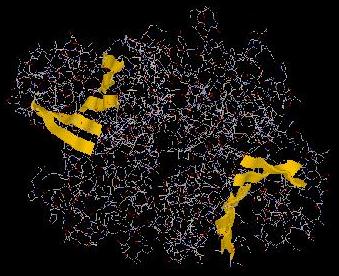
In the now somewhat distant past, I collaborated with Dr. Gordon Rule
in the Department of Biological Sciences on a method for determining
protein
structure homology from sparse NMR data. Of particular
interest to me was the extent to which topological shapes could act as
fingerprint identifiers of proteins. One novel result of this work was
a method for representing and comparing proteins using line weavings.
I have been interested in understanding the interplay of manipulation and
locomotion.
Matt Mason,
Siddhartha Srinivasa,
and I investigated this problem using a mobile manipulator
called the
Mobipulator.
I have been interested in protein homology, in particular determining
structural homology from sparse NMR data and modeling protein
structures in terms of line weavings. I worked together with Gordon
Rule in the Department of Biological Sciences.
I have been interested in sensing strategies that acquire object shape
and configuration concurrently during manipulation. This line of
research began with the Ph.D. thesis of my student Yan-Bin Jia, extended into
my own thinking, and continued with my student Mark Moll.
Former Students
Siddhartha Srinivasa
(co-advised with Matt
Mason), Robotics.
Ph.D., August 2005. Thesis title: Control Synthesis for Dynamic
Contact Manipulation.
First post-Ph.D. job: Intel Research Laboratory, Pittsburgh.
Mark Moll, Computer
Science. Ph.D., July 2002. Thesis title: Shape Reconstruction
Using Active Tactile Sensors.
First post-Ph.D. job: Research Associate, Physical and Biological
Computing Group, Rice University, then at USC-ISI, now a Research
Scientist at Rice.
Jovan Popovic,
Computer Science. Ph.D., July 2001. Thesis title: Interactive
Design of Rigid-Body Simulations for Computer Animation.
First post-Ph.D. job: Assistant Professor, MIT.
Yan-Bin Jia, Robotics.
Ph.D., November 1997. Thesis title: Geometric and Dynamic Sensing:
Observation of Pose and Motion through Contact.
First post-Ph.D. post-CMU job: University of Minnesota. Now a
tenured professor at Iowa State.
Nina Zumel,
Robotics. Ph.D., January 1997. Thesis title: A Nonprehensile
Method for Reliable Parts Orienting.
First post-Ph.D. job: AI group, Stanford Research Institute.
For many years she had her own company, Quimba Software.
She is now at Win-Vector LLC.
Tamara Abell, Robotics. M.S., December 1995, currently at Apple.
Thesis Committees
Shushman Choudhury, M.S., Robotics, 2017.
Joel Chestnutt, Ph.D., Computer Science, CMU, 2007.
Jason O'Kane, Ph.D., Computer Science, UIUC, 2007.
Guillermo Bermejo, Ph.D., Chemistry, CMU, 2007.
Keith Kotay, Ph.D., Computer Science, Dartmouth, 2003.
Alexander Grishaev, Ph.D., Chemistry, CMU, 2001.
Dongmei Zhang, Ph.D., Robotics, CMU, 1999.
Tom Ault, Robotics, CMU, proposed 1998.
Barry Brumitt, Ph.D., Robotics, CMU, 1997.
George Paul, Ph.D., Robotics, CMU, 1997.
J. Dan Morrow, Ph.D., Robotics, CMU, 1997.
Cheng-Hua Wang, Ph.D., Robotics, CMU, 1997.
David Simon, Ph.D., Robotics, CMU, 1996.
Srinivas Akella, Ph.D., Robotics, CMU, 1996.
Kevin Lynch, Ph.D., Robotics, CMU, 1996.
David Wettergreen, Ph.D., Robotics, CMU, 1995.
Sanjiv Singh, Ph.D., Robotics, CMU, 1995.
Sing Bing Kang, Ph.D., Robotics, CMU, 1994.
Prasad Chalasani, Ph.D., Computer Science, 1994.
Rudi Stouffs, Ph.D., Architecture, CMU, 1994.
Alan Christiansen, Ph.D., Computer Science, CMU, 1992.
Harry Kim, Ph.D., Robotics, CMU, 1991.
Papers and Reports
(Click here
for a publication list auto-generated by the Robotics Institute.)
N. Chavan-Dafle, A. Rodriguez, R. Paolini, B. Tang, S. Srinivasa,
M. Erdmann, M. T. Mason, I. Lundberg, H. Staab, and T. Fuhlbrigge.
Extrinsic Dexterity: In-Hand Manipulation with External Forces.
Proceedings of the 2014 IEEE International Conference on Robotics
and Automation, Hong Kong.
M. A. Erdmann.
Protein Similarity from Knot Theory: Geometric Convolution and Line Weavings. Journal of Computational Biology, Vol. 12, No. 6, 2005, pp. 609-637.
(Clarification/Erratum: In Section 6.2.3 of the paper we defined the
"L2 measure" using a sum of integrals, each measuring a squared error
between two lines. Our code inadvertently computed the sum of
the square roots of these integrals. Thus the dimensions of the "L2"
values reported are actually square-root-Angstroms not Angstroms.)
S. S. Srinivasa, M. A. Erdmann, and M. T. Mason.
Control Synthesis for Dynamic Contact Manipulation.Proceedings of the 2005 IEEE International Conference on Robotics
and Automation, Barcelona, Spain, pp. 2523-2528.
J. Popovic, S. M. Seitz, and M. A. Erdmann.
Motion Sketching for Control of Rigid-Body Simulations. ACM Transactions on Graphics, Vol. 22, No. 4, 2003, pp. 1034-1054.
Siddhartha S. Srinivasa, Christopher R. Baker, Elisha Sacks,
Grigoriy B. Reshko, Matthew T. Mason, and Michael A. Erdmann.
Experiments with Nonholonomic Manipulation.Proceedings of the 2002 IEEE International Conference on Robotics
and Automation, Washington, DC, pp. 2042-2047.
J. Popovic, S. Seitz, M. Erdmann, Z. Popovic, and A. Witkin.
Interactive Manipulation of Rigid Body Simulation. ACM SIGGRAPH, July 2000, pp. 209-217.
Mark Moll and Michael Erdmann.
Uncertainty Reduction Using Dynamics. Proceedings of the 2000 IEEE International Conference on Robotics and
Automation, San Francisco, California, pp. 3673-3680.
Yan-Bin Jia and Michael Erdmann.
Pose and Motion from Contact. International Journal of Robotics Research, Vol. 18, No. 5, 1999, pp. 466-490.
Yan-Bin Jia and Michael Erdmann.
Observing Pose and Motion through Contact. Proceedings of the 1998 IEEE International Conference on Robotics
and Automation, Leuven, Belgium, pp. 723-729.
Full paper (430KB postscript, 8 pages).
Yan-Bin Jia and Michael Erdmann.
Pose from Pushing. Proceedings of the 1996 IEEE International Conference on Robotics
and Automation, Minneapolis, Minnesota, pp. 165-171.
Michael Erdmann.
Randomization for Robot Tasks: Using Dynamic
Programming in the Space of Knowledge States. Algorithmica, Vol. 10, 1993, pp. 248-291.
Michael Erdmann, Matthew T. Mason, and George Vanecek, Jr.
Mechanical Parts Orienting: The Case of a Polyhedron on a Table. Algorithmica, Vol. 10, 1993, pp. 226-247.
Michael Erdmann.
Randomization in Robot Tasks. International Journal of Robotics Research, Vol. 11, No. 5, 1992, pp. 399-436.
Michael Erdmann and Matthew T. Mason.
An Exploration of Sensorless Manipulation. IEEE Journal of Robotics and Automation, Vol. 4, No. 4, 1988, pp. 369-379.
Michael Erdmann and Tomas Lozano-Perez.
On Multiple Moving Objects. Algorithmica, Vol. 2, No. 4, 1987, pp. 477-521.
Michael Erdmann.
Using Backprojections for Fine Motion Planning with Uncertainty. International Journal of Robotics Research, Vol. 5, No. 1, 1986, pp. 19-45.
For related work in our laboratory take a look at:
We gratefully acknowledge support by NSF, DARPA, and AFOSR for
this research.
Relevant support from NSF includes a Research Initiation Award
IRI-9010686 and REU supplement, a Presidential Young Investigator
Award IRI-9157643, grant IRI-9213993 (with REU supplement
IRI-9443084), grant IRI-9503648 (with REU supplements IRI-9642850 and
IRI-9741440, and a Creativity Extension), grant IIS-9820180, grant
IIS-0222875, and grant IIS-1409003.
Any opinions, findings, and conclusions or recommendations
expressed in this research are those of the author(s) and do not
necessarily reflect the position or the policy of the National Science
Foundation, DARPA, the Air Force, or the U.S. Government. No official
endorsement should be inferred.