My interests are broadly defined by the fields of Ubiquitous Computing, and Social Computing. Most recently, my focus has been in the area of Usable Privacy and, in particular, its application to social location sharing. In my work, I use Human-Computer Interaction (HCI) research methods to evaluate users' privacy preferences, as well as their information sharing behaviors and their privacy-related decision making processes. My general research interest is in exploring how ubiquitous technology can enrich social relationships through privacy-sensitive information sharing.
usable privacy for social location sharing
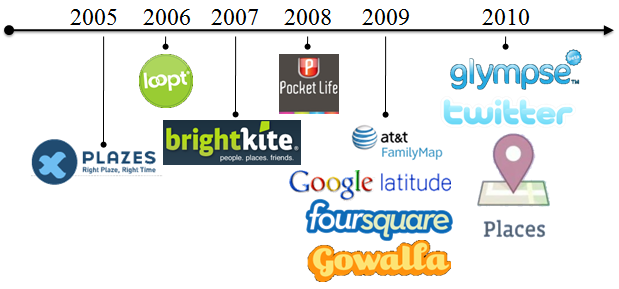
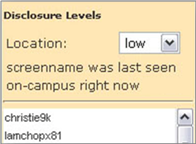
In the past few years, there has been increasing interest in deploying location-sharing applications (LSAs) that enable users to continuously sense, collect, and share their location information with others. Yet, despite all the attention LSAs are receiving, studies have found that only a small percentage of mobile consumers actively use these services. One often-cited adoption barrier is that many LSAs do not adequately address end-user privacy concerns for sharing location data. In my work, I explore how relatively simple privacy techniques (namely using location disclosure abstractions) can help address end-user privacy concerns at four different stages: how users reason about location sharing, how users configure their privacy preferences, how users interpret visual representations of their location information, and what kinds of outcomes can be expected from users that share location abstractions.workshop papers:
UIST 2007 Doctoral Symposium
technical reports:
CMU HCII PhD Dissertation
location-aware assistive technology for the elderly
Memory Karaoke is a location-based, mobile phone application inspired by current memory therapies that aims to increase a person's usage of their episodic memory through storytelling. This is done by stimulating a person's episodic memory as they relive, reminiscence, and retell stories about their past events while observing past contextual cues captured by the mobile device in a privacy-sensitive manner. We evaluated Memory Karaoke with older adults to verify its potential to serve as a location-aware memory aid.conference papers:
MobileHCI 2007

anonymous participatory sensing
Hitchhiking is a way of building a class of location-based services in a privacy-sensitive manner. Bustle is an example Hitchhiking application that can answer questions like "How busy is it at the cafe?" and "How long are the lines at the airport?" Bustle works by counting the number of wireless devices in an area and using that count to estimate the number of people.workshop papers:
CHI 2006 Mobile Social Software

gsm-based localization for mobile phones
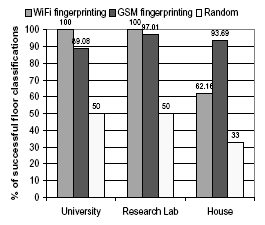
This projects looks at triangulating a user's location and activity information based on GSM fingerprinting. Using this technique, we can detect the places that people visit in their everyday lives, and can achieve median localization accuracies of 5 and 75 meters for indoor and outdoor environments, respectively. We've also developed algorithms for detecting whether a GSM mobile phone is moving (or stationary, since this is when the phone is simply not moving). These algorithms, in early experiments, show excellent promise and require nothing from the mobile phone other than radio signals that the phone must have to perform its normal function.conference papers:
HotMobile 2006
workshop papers:
ECSCW 2005 Location Awareness and Community
context-aware wearable computing
The eWatch prototype senses user activities based on accelometer, temperature, light, and micrphone sensors. The accelerometers and microphone provide inputs to a model of interruptibility. Depending on a message's importance and the user's interruptibilty, different vibration and visual notification patterns are sent to the user. The eWatch is transparently integrated into the user's environment, and communicates via Bluetooth.
affective computing for social awareness
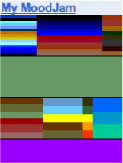
MoodJam is a mood awareness website that allows users to post their moods and share them with other people. Users record their moods by using words and color combinations. Moods are then visualized as color strips. This site can help serve as an awareness tool for users to keep in touch with friends and family. This work was done in collaboration with Ian Li.website:
MoodJam
peer-to-peer ad hoc sensor networks
ZebraNet is an inter-disciplinary project between Biology & Computer Science. On the computer systems side, ZebraNet is studying power-aware, position-aware computing & communication systems. Namely, the goals are to develop, evaluate, implement, and test systems that integrate computing, wireless communication, and non-volatile storage along with global positioning systems (GPS) and other sensors.technical reports:
Princeton ELE Senior Undergraduate Thesis

cross-language information retrieval
Mandarin-English Information (MEI) is a system whereby English speakers can find audio broadcasts in Mandarin Chinese relevant to their interests, without knowing Chinese. MEI uses written queries to search spoken documents (cross-media) between English and Mandarin Chinese (cross-language). Our research focus is on the integration of speech recognition and machine translation technologies in the context of translingual speech retrieval.technical reports:
JHU CLSP Final Report