Journal of Artificial Intelligence Research
11 (1999),
pp. 277-300. Submitted 5/99; published 10/99.
© 1999 AI Access Foundation
and Morgan Kaufmann Publishers.
All rights reserved.
Reasoning about Minimal Belief and Negation as Failure
Riccardo Rosati
Dipartimento di Informatica e Sistemistica
Università di Roma ``La Sapienza''
Via Salaria 113, 00198 Roma, Italy
email: rosati@dis.uniroma1.it
Abstract:
We investigate the problem of reasoning in the propositional fragment of

,
the logic of minimal belief and negation as failure introduced by
Lifschitz, which can be considered as a unifying framework for several
nonmonotonic formalisms, including default logic, autoepistemic logic,
circumscription, epistemic queries, and logic programming.
We characterize the complexity and provide algorithms for reasoning in
propositional
.
In particular, we show that skeptical entailment in
propositional
is

-complete, hence it is harder than
reasoning in all the above mentioned propositional formalisms for
nonmonotonic reasoning.
We also prove the exact correspondence between negation as failure in
and negative introspection in Moore's autoepistemic logic.
Research in the formalization of commonsense reasoning has pointed out the
need of formalizing agents able to reason introspectively about their own
knowledge and ignorance [27,20].
Modal epistemic logics have thus been proposed, in which modalities are
interpreted in terms of knowledge or belief. Generally speaking, the
conclusions an introspective agent is able to draw depend on both what she
knows and what she does not know. Hence, any such conclusion may be
retracted when new facts are added to the agent's knowledge. For this
reason, many nonmonotonic modal formalisms have been proposed in
order to characterize the reasoning abilities of an introspective agent.
Among the nonmonotonic modal logics proposed in the literature, the logic
of minimal belief and negation as failure
[21,22] is
one of the most studied formalisms [3,2,1].
Roughly speaking, such a logic is built by adding to first-order logic two
distinct modalities, a ``minimal belief'' modality B and a ``negation as
failure'' modality  .
The logic thus obtained is characterized in terms
of a nice model-theoretic semantics.
has been used in order to
give a declarative semantics to very general classes of logic programs
[23,36,16], which generalize the stable model semantics of
negation as failure in logic programming
[9,10,11]. Also,
can be viewed
as an extension of the theory of epistemic queries to databases
[30], which deals with the problem of querying a first-order
database about its own knowledge. Due to its ability of expressing many
features of nonmonotonic logics [22,36],
is generally
considered as a unifying framework for several nonmonotonic formalisms,
including default logic, autoepistemic logic, circumscription, epistemic
queries, and logic programming.
.
The logic thus obtained is characterized in terms
of a nice model-theoretic semantics.
has been used in order to
give a declarative semantics to very general classes of logic programs
[23,36,16], which generalize the stable model semantics of
negation as failure in logic programming
[9,10,11]. Also,
can be viewed
as an extension of the theory of epistemic queries to databases
[30], which deals with the problem of querying a first-order
database about its own knowledge. Due to its ability of expressing many
features of nonmonotonic logics [22,36],
is generally
considered as a unifying framework for several nonmonotonic formalisms,
including default logic, autoepistemic logic, circumscription, epistemic
queries, and logic programming.
Although several aspects of the logic
have been thoroughly
investigated [36,3,2], the existing studies concerning
the computational properties of
are limited to subclasses of
propositional
theories [16] or to a very restricted subset
of the first-order case [1].
In this paper we present a computational characterization of deduction in
the propositional fragment of .
In particular, we show that logical
implication in the propositional fragment of
is a
-complete problem: hence, it is harder (unless the polynomial
hierarchy collapses) than reasoning in all the best known propositional
formalisms for nonmonotonic reasoning, like autoepistemic logic
[28,12], default logic [12], circumscription
[7], (disjunctive) logic programming [8], and
several McDermott and Doyle's logics [25]. As shown in the
following, this result also implies that minimal knowledge is
computationally harder than negation as failure.
Moreover, we study the subclass of flat
theories, i.e.
theories without nested occurrences of modalities, showing that in
this case logical implication is  -complete. This case is the most
interesting one from the logic programming viewpoint. Indeed, it implies
that, under the stable model semantics, increasing the syntax of program
rules, by allowing propositional formulas as goals in the rules, does not
affect the worst-case complexity of query answering for disjunctive logic
programs with negation as failure.
-complete. This case is the most
interesting one from the logic programming viewpoint. Indeed, it implies
that, under the stable model semantics, increasing the syntax of program
rules, by allowing propositional formulas as goals in the rules, does not
affect the worst-case complexity of query answering for disjunctive logic
programs with negation as failure.
Furthermore, we provide algorithms for reasoning both in
and in its
flat fragment, which are optimal with respect to worst-case complexity.
Notably, such deductive methods can be considered as generalizations of
known methods for reasoning in nonmonotonic formalisms such as default
logic, autoepistemic logic, and logic programming under stable model
semantics.
We also show that the ``negation as failure'' modality in
exactly
corresponds to negative introspection in autoepistemic logic
[27]. This result implies that the logic
can be
considered as the ``composition'' of two epistemic modalities: the
``minimal knowledge'' operator due to [14]
and Moore's autoepistemic operator.
Besides its theoretical interest, we believe that such a computational and
epistemological analysis of
has interesting implications for the
development of knowledge representation systems with nonmonotonic
abilities, since it allows for a better understanding and comparison of the
different nonmonotonic formalisms captured by .
The interest in
defining deductive methods for
also arises from the fact that such
a logic, originally developed as a framework for the comparison of
different logical approaches to nonmonotonic reasoning, has recently been
considered as an attractive knowledge representation formalism. In
particular, it has been shown [4] that the full power of
is necessary in order to logically formalize several features of
implemented frame-based knowledge representation systems.
In the following, we first briefly recall the logic .
In Section 3
we address the relationship between
and Moore's autoepistemic
logic. Then, in Section 4 we study the problem of reasoning in
propositional :
we first consider the case of general
theories, then we deal with flat
theories. In Section 5 we present
the computational characterization of reasoning in .
We conclude in
Section 6. This paper is an extended and thoroughly revised version of
[31].
The Logic MBNF
In this section we briefly recall the logic
[22], which is
a modal logic with two epistemic operators: a ``minimal belief'' modality
B and a ``negation as failure'' (also called ``negation by default'')
modality .
We use  to denote a fixed propositional language built
in the usual way from: (i) an alphabet
to denote a fixed propositional language built
in the usual way from: (i) an alphabet  of propositional symbols; (ii)
the symbols
of propositional symbols; (ii)
the symbols
 ,
,
 ;
(iii) the propositional connectives
;
(iii) the propositional connectives
 .
We denote as
.
We denote as  the modal extension of
with the modalities B
and .
We say that a formula
the modal extension of
with the modalities B
and .
We say that a formula
 has (modal) depth i
(with
has (modal) depth i
(with  )
if each subformula in
)
if each subformula in  lies within the scope of at
most i modalities, and there exists a subformula in
which lies
within the scope of exactly i modalities.
lies within the scope of at
most i modalities, and there exists a subformula in
which lies
within the scope of exactly i modalities.
We denote as  the set of subjective
formulas, i.e. the subset of formulas from
in which each occurrence of a
propositional symbol lies within the scope of at least one modality, and
with
the set of subjective
formulas, i.e. the subset of formulas from
in which each occurrence of a
propositional symbol lies within the scope of at least one modality, and
with  the set of flat
formulas, that is the set of
formulas from
in which each propositional symbol lies within the
scope of exactly one modality. We call a modal formula
from
positive (resp. negative) if the modality
(resp. B) does not occur in .
the set of flat
formulas, that is the set of
formulas from
in which each propositional symbol lies within the
scope of exactly one modality. We call a modal formula
from
positive (resp. negative) if the modality
(resp. B) does not occur in .
 denotes the set of positive
formulas from ,
while
denotes the set of positive
formulas from ,
while  denotes the set of positive formulas from
.
denotes the set of positive formulas from
.
We now recall the notion of
model. An interpretation is a
set of propositional symbols. An
structure is a triple
(I,Mb,Mn), where I is an interpretation (also called initial world)
and Mb,Mn are non-empty sets of interpretations (worlds).
Satisfiability of a formula in an
structure is defined inductively
as follows:
- 1.
- if
is a propositional symbol,
is satisfied by
(I,Mb,Mn) iff
 ;
;
- 2.
 is satisfied by (I,Mb,Mn) iff
is not
satisfied by (I,Mb,Mn);
is satisfied by (I,Mb,Mn) iff
is not
satisfied by (I,Mb,Mn);
- 3.
-
 is satisfied by (I,Mb,Mn) iff
 is satisfied by (I,Mb,Mn) and
  is satisfied by
(I,Mb,Mn);
is satisfied by
(I,Mb,Mn);
- 4.
-
 is satisfied by (I,Mb,Mn) iff either
is satisfied by (I,Mb,Mn) or
is satisfied by
(I,Mb,Mn);
is satisfied by (I,Mb,Mn) iff either
is satisfied by (I,Mb,Mn) or
is satisfied by
(I,Mb,Mn);
- 5.
-
 is satisfied by (I,Mb,Mn) iff either
is not satisfied by (I,Mb,Mn) or
is satisfied
by (I,Mb,Mn);
is satisfied by (I,Mb,Mn) iff either
is not satisfied by (I,Mb,Mn) or
is satisfied
by (I,Mb,Mn);
- 6.
 is satisfied by (I,Mb,Mn) iff, for every
  ,
is satisfied by (J,Mb,Mn);
,
is satisfied by (J,Mb,Mn);
- 7.
-
 is satisfied by (I,Mb,Mn) iff there exists
  such that
is not satisfied by (J,Mb,Mn).
such that
is not satisfied by (J,Mb,Mn).
We write
 to indicate that
is
satisfied by (I,Mb,Mn). We say that a theory
to indicate that
is
satisfied by (I,Mb,Mn). We say that a theory
 is
satisfied by (I,Mb,Mn) (and write
is
satisfied by (I,Mb,Mn) (and write
 )
iff each
formula from
)
iff each
formula from  is satisfied by (I,Mb,Mn). If
 ,
then the evaluation of
is insensitive to the initial
interpretation I: thus, in this case we also write
,
then the evaluation of
is insensitive to the initial
interpretation I: thus, in this case we also write
 .
Analogously, if
.
Analogously, if
 ,
then the
evaluation of
is insensitive both to the initial interpretation
I and to the set Mn, and we also write
,
then the
evaluation of
is insensitive both to the initial interpretation
I and to the set Mn, and we also write
 .
If
.
If
 then the evaluation of
does not depend on the sets
Mb,Mn, and in this case we write
then the evaluation of
does not depend on the sets
Mb,Mn, and in this case we write
 .
.
In order to relate
structures to standard interpretation structures
in modal logic (i.e. Kripke structures), we remark that, due to the above
notion of satisfiability, we can consider the sets Mb, Mn in an
interpretation structure as two distinct universal Kripke
structures, i.e. possible-world structures in which each world is
connected to all worlds of the structure. In fact, since the accessibility
relation in such a structure is universal, without loss of generality it is
possible to identify a universal Kripke structure with the set of
interpretations contained in it. We recall that the class of universal
Kripke structures characterizes the logic  [25, Theorem
7.52].
[25, Theorem
7.52].
The nonmonotonic character of
is obtained by imposing the following
preference semantics over the interpretation structures satisfying a given
theory.
Definition 2.1
A structure (
I,
M,
M), where

,
is an
model
of a theory
iff

and, for each
interpretation
J and for each set of interpretations
M', if

then

.
We say that a formula
is entailed (or logically
implied) by
in
(and write
 )
iff
is satisfied by every
model of .
In order to simplify notation, we denote the
model (I,M,M) with the pair (I,M), and, if
)
iff
is satisfied by every
model of .
In order to simplify notation, we denote the
model (I,M,M) with the pair (I,M), and, if
 ,
we denote
(I,M,M) with M, since in this case the evaluation of
is
insensitive to the initial world I, namely, if (I,M) is a model for
,
then, for each interpretation J, (J,M) is a model for
.
,
we denote
(I,M,M) with M, since in this case the evaluation of
is
insensitive to the initial world I, namely, if (I,M) is a model for
,
then, for each interpretation J, (J,M) is a model for
.
Example 2.2
Let

.
The only MBNF models for
are of the form
(
I,
M), with

.
Hence,

,
and

for each

such that the
propositional formula

is not valid. Therefore, the agent
modeled by
has minimal belief, in the sense that she only believes
p and the objective facts logically implied by
p.
Example 2.3
Let

.
It is easy to
see that the only models for
are of the form (
I,
M) such that

,
since

can be assumed not to
hold by the agent modeled by
,
which is then able to conclude

.
Notably, the meaning of
is analogous to the
default rule

in Reiter's default
logic [
22]. Also, let

.
In a way analogous to
the previous case, it can be shown that the only MBNF models for
are of the form (
I,
M), with

.
Therefore,

.
As shown by
[
22],
corresponds to the default theory

.
Given a set of interpretations M, Th(M) denotes the set of formulas
such that
 and
and
 .
Let
M1,M2 be sets of interpretations. We say that M1 is
equivalent to M2 iff
Th(M1)=Th(M2).
.
Let
M1,M2 be sets of interpretations. We say that M1 is
equivalent to M2 iff
Th(M1)=Th(M2).
Definition 2.4
A set of interpretations
M is
maximal iff, for each set
of interpretations
M', if
M' is equivalent to
M then

.
It turns out that, when restricting to theories composed of subjective
positive formulas, MBNF corresponds to the modal logic of minimal
knowledge due to [14], also known as ground
nonmonotonic modal logic  [19,5].
In fact,
is obtained from modal logic
by imposing the following preference order over the universal Kripke
structures satisfying a theory
[19,5].
In fact,
is obtained from modal logic
by imposing the following preference order over the universal Kripke
structures satisfying a theory
 :
M is a model for
iff
:
M is a model for
iff
 and, for each M', if
 then
then
 [38]. In fact, it is immediate to see that the
semantics of theories composed of subjective positive formulas
corresponds to the above semantics according to
.
Hence, the
following property holds.
[38]. In fact, it is immediate to see that the
semantics of theories composed of subjective positive formulas
corresponds to the above semantics according to
.
Hence, the
following property holds.
Proposition 2.5
Let

.
Then,
M is an
model for
iff, for each
I, (
I,
M) is an
model for

.
The previous proposition implies that, when
 ,
a set of
interpretations M satisfying
is compared with all other sets of
interpretations satisfying ,
while, in the case
,
M is only compared with the sets M' such that
(M',M) satisfies .
,
a set of
interpretations M satisfying
is compared with all other sets of
interpretations satisfying ,
while, in the case
,
M is only compared with the sets M' such that
(M',M) satisfies .
Hence, the main difference between MBNF and
lies in the fact
that in
all models are maximal with respect to set containment
(or minimal with respect to the objective knowledge which holds in the
model), while in MBNF this property is not generally true. E.g., the
theory
 has two types of models,
for each possible choice of the initial world J: (J,M1), where M1
corresponds to the set of all interpretations (which represents the case in
which
is not assumed to hold); and (J,M2), where
has two types of models,
for each possible choice of the initial world J: (J,M1), where M1
corresponds to the set of all interpretations (which represents the case in
which
is not assumed to hold); and (J,M2), where
 .
Namely, if
is assumed to hold,
then
forces one to conclude
.
Namely, if
is assumed to hold,
then
forces one to conclude
 :
that is, the initial assumption is justified by the knowledge
derived on the basis of such an assumption [24].
We remark that, by Proposition 2.5, the interpretation of the
operator B exactly corresponds to the interpretation of the
modality B in .
:
that is, the initial assumption is justified by the knowledge
derived on the basis of such an assumption [24].
We remark that, by Proposition 2.5, the interpretation of the
operator B exactly corresponds to the interpretation of the
modality B in .
In this section we study the relationship between autoepistemic logic and
.
First, we briefly recall Moore's autoepistemic logic ( ).
In order to keep notation to a minimum, we change the language of ,
using the modality B instead of L. Thus, in the following a formula
of
is a formula from .
).
In order to keep notation to a minimum, we change the language of ,
using the modality B instead of L. Thus, in the following a formula
of
is a formula from .
Definition 3.1
A propositionally consistent set of formulas

is a
stable expansion for a set of initial knowledge
if
T satisfies the following equation:
 |
(1) |
where
Cn(
S) denotes the propositional deductive closure of the modal
theory

.
Given a theory
and a formula
 ,
we write
,
we write
 iff
belongs to all the stable
expansions of .
Each stable expansion T is a stable set
according to the following definition [39].
iff
belongs to all the stable
expansions of .
Each stable expansion T is a stable set
according to the following definition [39].
We recall that a stable set T corresponds to a maximal universal Kripke
structure MT such that T is the set of formulas satisfied by MT
[25]. With the term
model for
we will
thus refer to a set of interpretations M whose set of theorems Th(M)
corresponds to a stable expansion for
in .
Finally, notice that we have adopted the notion of consistent
autoepistemic logic [25], i.e. in (1) we do not
allow the inconsistent theory  composed of all modal formulas to be
a (possible) stable expansion. The results presented in this section can be
easily extended to this case (corresponding to Moore's original proposal):
however, this requires to slightly change the semantics of ,
allowing in Definition 2.1 the empty set of interpretations
to be a possible component of
structures.
composed of all modal formulas to be
a (possible) stable expansion. The results presented in this section can be
easily extended to this case (corresponding to Moore's original proposal):
however, this requires to slightly change the semantics of ,
allowing in Definition 2.1 the empty set of interpretations
to be a possible component of
structures.
In the following, we use the term embedding (or translation) to
indicate a transformation function  for modal theories. We
are interested in finding a faithful embedding
[13,35,17], in the following sense:
is a
faithful embedding of
into
if, for each theory
and for each model M, M is an
model for
iff M is an
model for
for modal theories. We
are interested in finding a faithful embedding
[13,35,17], in the following sense:
is a
faithful embedding of
into
if, for each theory
and for each model M, M is an
model for
iff M is an
model for  .
.
It is already known that
theories can be embedded into
theories. In particular, it has been proven [24,37] that
theories with no nested occurrences of B (called flat
theories) can be embedded into ;
now, since in
any theory
can be transformed into an equivalent flat theory (which has in general
size exponential in the size of the initial theory), it follows that any
theory can be embedded into .
However, we now prove a much stronger result: negation as
failure in
exactly corresponds to negative introspection in
,
i.e. 's modality  and 's modality
are
semantically equivalent. Hence, such a correspondence is not only limited
to modal theories without nested modalities, and induces a polynomial-time
embedding of any
theory into .
and 's modality
are
semantically equivalent. Hence, such a correspondence is not only limited
to modal theories without nested modalities, and induces a polynomial-time
embedding of any
theory into .
We first define the translation
of modal theories from
to
theories.
Definition 3.3
Let
.
Then,

is the
formula
obtained from
by substituting each occurrence of
B with

.
Moreover, if
,
then
denotes the
theory

.
We now show that the translation
embeds
theories into
.
To this aim, we exploit the semantic characterization of
defined by [34]. Roughly speaking, according to such
a preference semantics over possible-world structures, an
model for
is a set of interpretations M satisfying
such that, for
any interpretation J not contained in M, the pair (J,M) does not
satisfy .
Formally:
Proposition 3.4
[
34, Proposition 4.1]
Let
.
Then,
M is an
model for
iff,
for each interpretation

,

and, for each
interpretation

,

.
In the following, we say that an occurrence of a subformula  in a
formula
is strict if it does not lie within the scope
of a modal operator. E.g., let
in a
formula
is strict if it does not lie within the scope
of a modal operator. E.g., let
 .
The
occurrence of
in
.
The
occurrence of
in  is strict, while the occurrence of
 is not strict.
Theorem 3.5
Let
.
Then,
M is an
model for
iff,
for each
I, (
I,
M) is an
model of
.
Proof.
If part. Suppose (I,M) is an
model of .
Then, for each ,
 .
Since
is a set of formulas of the form ,
where
does
not contain any occurrence of the operator B, it follows that, for each
subformula of the form
occurring in ,
.
Since
is a set of formulas of the form ,
where
does
not contain any occurrence of the operator B, it follows that, for each
subformula of the form
occurring in ,
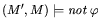 iff
iff
 .
Now let
.
Now let
 ,
let
,
let  denote the propositional formula
obtained from
by replacing each strict occurrence in
of a
formula of the form
denote the propositional formula
obtained from
by replacing each strict occurrence in
of a
formula of the form
 with
if
with
if
 and
with
otherwise, and let
and
with
otherwise, and let
 .
Now suppose there exists an interpretation J
such that
.
Now suppose there exists an interpretation J
such that
 and .
Then, from the definition of
satisfiability in
structures it follows that
and .
Then, from the definition of
satisfiability in
structures it follows that
 ,
thus contradicting the hypothesis that
(I,M) is an MBNF model for .
Hence,
,
thus contradicting the hypothesis that
(I,M) is an MBNF model for .
Hence,
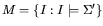 .
Now consider a pair (J,M): again, from the
definition of satisfiability in
structures it follows immediately
that
.
Now consider a pair (J,M): again, from the
definition of satisfiability in
structures it follows immediately
that
 iff
.
And since M contains
all the interpretations satisfying
iff
.
And since M contains
all the interpretations satisfying  ,
it follows that, for each
interpretation ,
,
therefore by
Proposition 3.4 it follows that M is an
model for
.
,
it follows that, for each
interpretation ,
,
therefore by
Proposition 3.4 it follows that M is an
model for
.
Only-if part. Suppose M is an
model for .
Then, by
Proposition 3.4, for each interpretation ,
and, for each interpretation ,
.
For each
 ,
let
,
let  denote
the propositional formula obtained from
by replacing each strict
occurrence of a formula of the form
with
if
denote
the propositional formula obtained from
by replacing each strict
occurrence of a formula of the form
with
if
 and with
otherwise, and let
and with
otherwise, and let
 .
Then, suppose there exists an interpretation J such
that
.
Then, suppose there exists an interpretation J such
that
 and .
Then, from the definition of
satisfiability in
structures it follows that
,
thus contradicting the hypothesis that M is an AEL model for .
Hence,
and .
Then, from the definition of
satisfiability in
structures it follows that
,
thus contradicting the hypothesis that M is an AEL model for .
Hence,
 .
Now suppose that, for some
interpretation I, (I,M) is not an MBNF model for .
Then, there exists
such that
.
Now suppose that, for some
interpretation I, (I,M) is not an MBNF model for .
Then, there exists
such that
 .
From the definition of ,
it follows that each interpretation
in M' satisfies
.
From the definition of ,
it follows that each interpretation
in M' satisfies  ,
and, since ,
there exists
such that
.
Contradiction. Therefore,
(I,M) is an MBNF model for .
,
and, since ,
there exists
such that
.
Contradiction. Therefore,
(I,M) is an MBNF model for .

We remark that the above theorem could alternatively be proved from the
fact that the K-free fragment of the logic  [21] is
equivalent to ,
which is stated (although without proof) by
[37, page 123], and from the correspondence between
and
[22].
[21] is
equivalent to ,
which is stated (although without proof) by
[37, page 123], and from the correspondence between
and
[22].
The previous theorem implies that the interpretation of the modality
in
and of the modal operator in autoepistemic logic are the same.
This property extends previous results relating
with
[24,36,3], and has interesting consequences both in the
logic programming framework and in nonmonotonic reasoning. In particular,
since
generalizes the stable model semantics for logic programs
[9], the above result strengthens the idea that
is
the true logic of negation as failure (as interpreted according to the
stable model semantics). Moreover, positive theories have the same
interpretation both in
and in the logic of minimal knowledge
[14]: consequently, the logic
generalizes both
Halpern and Moses'
and Moore's .
In this section we present algorithms for reasoning in propositional
:
in particular, we study the entailment problem in .
From
now on, we assume to deal with finite
theories ,
therefore we refer to a single formula
(which corresponds to the
conjunction of all the formulas contained in the finite theory ).
We now present a finite characterization of the
models of a formula
 .
As in several methods for reasoning in nonmonotonic modal
logics [12,25,6,28,5],
the technique we employ is based on the definition of a correspondence
between the preferred models of a theory and the partitions of the set of
modal subformulas of the theory. In fact, such partitions can be used in
order to provide a finite characterization of a universal Kripke structure:
specifically, a partition satisfying certain properties identifies a
particular universal Kripke structure M, by uniquely determining a
propositional theory
such that M is the set of all interpretations satisfying such a theory.
.
As in several methods for reasoning in nonmonotonic modal
logics [12,25,6,28,5],
the technique we employ is based on the definition of a correspondence
between the preferred models of a theory and the partitions of the set of
modal subformulas of the theory. In fact, such partitions can be used in
order to provide a finite characterization of a universal Kripke structure:
specifically, a partition satisfying certain properties identifies a
particular universal Kripke structure M, by uniquely determining a
propositional theory
such that M is the set of all interpretations satisfying such a theory.
We extend such known techniques in order to deal with the preference
semantics of .
In particular, we characterize the properties that a
partition of modal subformulas of a formula
must satisfy in
order to identify an
model for .
In this way, we provide a
method that does not rely on a modal logic theorem prover, but reduces the
problem of reasoning in a bimodal logic to a number of reasoning problems
in propositional logic.
First, we introduce some preliminary definitions. We call a formula of the
form
or
,
with
,
a modal atom.
Definition 4.1
Let
.
We call the set of modal atoms occurring in
the
modal atoms of (and denote such a set as

).
Definition 4.2
Let
and let (
P,
N) be a partition of a set of modal
atoms. We denote as

the formula obtained
from
by substituting each strict occurrence in
of a
formula in
P with
,
and each strict occurrence in
of a
formula in
N with
.
Observe that only the occurrences in
of modal subformulas which
are not within the scope of another modality are replaced; notice also
that, if  contains ,
then
is a
propositional formula. In this case, the pair (P,N) identifies a guess on
the modal subformulas from ,
i.e. P contains the modal
subformulas of
assumed to hold, while N contains the modal
subformulas of
assumed not to hold.
contains ,
then
is a
propositional formula. In this case, the pair (P,N) identifies a guess on
the modal subformulas from ,
i.e. P contains the modal
subformulas of
assumed to hold, while N contains the modal
subformulas of
assumed not to hold.
Definition 4.3
Let
and let (
P,
N) be a partition of
.
We
denote as

the propositional formula
Roughly speaking, the propositional formula
represents the
``objective knowledge'' implied by the guess (P,N) on the formulas of the
form
belonging to P. From the semantic viewpoint, in each
structure (I,M,M') satisfying the guess on the modal atoms given by
(P,N), the propositional formula
constrains the interpretations of
M, since in each such structure the propositional formula
must be
satisfied by each interpretation  ,
i.e.
,
i.e.
 .
.
Example 4.4
Let
Then,

.
Now suppose that
Then,

(which is
equivalent to
d), and

.
Definition 4.5
We say that a pair of sets of interpretations (
M,
M')
induces the partition (
P,
N) of
if, for each modal
atom

,

iff

.
Lemma 4.6
Let
,
let
I be an interpretation, let
M,
M' be sets of
interpretations, and let (
P,
N) be the partition induced by (
M,
M') on a
set of modal atoms
S.
Then,

iff
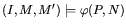
.
Proof.
Follows immediately from Definitions 4.2
and 4.5, and from the definition of satisfiability in
structures.
We now show that, if (I,M) is an
model for
which induces
the partition (P,N) of  ,
then the formula
completely
characterizes the set of interpretations M.
,
then the formula
completely
characterizes the set of interpretations M.
Theorem 4.7
Let
,
let (
I,
M) be an
model for
,
and let
(
P,
N) be the partition of
induced by (
M,
M). Then,

.
Proof.
Let
 .
Since (M,M) induces the partition (P,N), by
Definition 4.5 it follows that each interpretation in
M must satisfy ,
hence
.
Since (M,M) induces the partition (P,N), by
Definition 4.5 it follows that each interpretation in
M must satisfy ,
hence  .
Now suppose
.
Now suppose  ,
and consider the structure (I,M',M). We prove that each modal atom
belongs to P iff
,
and consider the structure (I,M',M). We prove that each modal atom
belongs to P iff
 .
The proof is
by induction on the depth of formulas in .
.
The proof is
by induction on the depth of formulas in .
First, consider a modal atom
such that
:
from
the definition of satisfiability of a formula in an
structure, it
follows immediately that
 iff
iff
 .
Then, consider a modal atom
such that
:
if
.
Then, consider a modal atom
such that
:
if  ,
then, by definition of ,
the propositional formula
,
then, by definition of ,
the propositional formula
 is valid, therefore
 .
If
.
If
 ,
then there exists an interpretation J in M such that
,
then there exists an interpretation J in M such that
 ,
and since ,
it follows that
,
and since ,
it follows that
 .
Hence, each modal atom
of depth 1 belongs to P iff
.
.
Hence, each modal atom
of depth 1 belongs to P iff
.
Suppose now that
iff
for each modal atom
 in
of depth less or equal to i. Consider a modal atom
of
of depth i+1: by the induction hypothesis, and
by Lemma 4.6,
iff
in
of depth less or equal to i. Consider a modal atom
of
of depth i+1: by the induction hypothesis, and
by Lemma 4.6,
iff
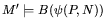 .
Now, if ,
then, by definition of ,
the propositional formula
.
Now, if ,
then, by definition of ,
the propositional formula
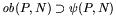 is valid, and since
,
it follows that
,
which
in turn implies
;
on the other hand, if
,
then there exists an interpretation J in M such that
is valid, and since
,
it follows that
,
which
in turn implies
;
on the other hand, if
,
then there exists an interpretation J in M such that
 ,
hence, by the induction hypothesis and
Lemma 4.6,
,
hence, by the induction hypothesis and
Lemma 4.6,
 .
Now, since ,
it follows that
.
Now, since ,
it follows that
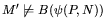 ,
hence
.
In the same way it is possible to show that a modal atom of the
form
of depth i+1 belongs to P iff
.
,
hence
.
In the same way it is possible to show that a modal atom of the
form
of depth i+1 belongs to P iff
.
We have thus proved that each modal atom
belongs to P
iff
:
this in turn implies that
 iff
iff
 ,
and since by hypothesis
(I,M,M) satisfies
and (P,N) is the partition of
induced by (M,M), by Lemma 4.6 it follows that
.
Therefore,
,
which
contradicts the hypothesis that (I,M) is an
model for
.
Consequently, M'=M, which proves the thesis.
,
and since by hypothesis
(I,M,M) satisfies
and (P,N) is the partition of
induced by (M,M), by Lemma 4.6 it follows that
.
Therefore,
,
which
contradicts the hypothesis that (I,M) is an
model for
.
Consequently, M'=M, which proves the thesis.
Informally, the above theorem states that each
model for
can be associated with a partition (P,N) of the modal atoms of ;
moreover, the propositional formula
exactly characterizes the set of
interpretations M of an
model (I,M), in the sense that M is
the set of all interpretations satisfying .
This provides a
finite way to describe all
models for .
We now define the notion of a partition of a set of modal atoms induced by a
pair of propositional formulas.
Definition 4.8
Let
,

.
We denote as

the partition of
induced by
(
M1,
M2), where
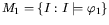
,
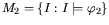
.
In order to simplify notation, we denote as
 the
partition
the
partition
 .
The following theorem provides a
constructive way to build the partition
.
The following theorem provides a
constructive way to build the partition
 .
.
Proof.
The proof is by induction on the structure of the formulas in .
First, from the fact that
is the partition
induced by (M,M'), with
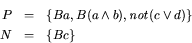
 ,
,
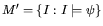 ,
and from the definition of satisfiability in
structures, it follows that, if
,
and from the definition of satisfiability in
structures, it follows that, if
 ,
then
,
then
 if
and only if
if
and only if
 is a valid propositional formula, and
 if and only if
 is not a valid
propositional formula. Therefore, (P,N) agrees with
on all modal atoms of modal depth 1. Suppose
now that (P,N) and
agree on all modal atoms of
modal depth less or equal to i. Consider a modal atom
is not a valid
propositional formula. Therefore, (P,N) agrees with
on all modal atoms of modal depth 1. Suppose
now that (P,N) and
agree on all modal atoms of
modal depth less or equal to i. Consider a modal atom  of
of modal depth i+1. From Lemma 4.6 and from the
definition of satisfiability in
structures, it follows that
if and only if
of
of modal depth i+1. From Lemma 4.6 and from the
definition of satisfiability in
structures, it follows that
if and only if
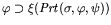 is a valid propositional
formula, and since by Definition 4.2 the value
of the formula
is a valid propositional
formula, and since by Definition 4.2 the value
of the formula
 only depends on the guess of
the modal atoms of modal depth less or equal to i in
,
by the induction hypothesis it follows that
only depends on the guess of
the modal atoms of modal depth less or equal to i in
,
by the induction hypothesis it follows that
 ,
hence
belongs to P if
and only if
.
Analogously, it can be proven that any
modal atom of depth i+1 of the form
,
hence
belongs to P if
and only if
.
Analogously, it can be proven that any
modal atom of depth i+1 of the form
 belongs to P if and only
if
.
Therefore, (P,N) and
agree on all modal atoms of modal depth i+1.
belongs to P if and only
if
.
Therefore, (P,N) and
agree on all modal atoms of modal depth i+1.
The algorithms we present in the following for reasoning in
use the
above shown properties of partitions of modal subformulas of a formula
,
together with additional conditions on such partitions (that vary
according to the different classes of theories accepted as inputs), in
order to identify all the
models for .
As for the entailment problem
 ,
we point
out that the occurrences of
in
are equivalent to occurrences
of ,
since in each
model for
both modalities in
are evaluated on the same set of interpretations. Therefore, as
in the original formulation of
[22], we restrict query
answering in
to positive formulas.
,
we point
out that the occurrences of
in
are equivalent to occurrences
of ,
since in each
model for
both modalities in
are evaluated on the same set of interpretations. Therefore, as
in the original formulation of
[22], we restrict query
answering in
to positive formulas.
Let
,
,
and
 .
We denote as
.
We denote as
 the propositional formula obtained from
by substituting
each strict occurrence of a modal atom
of
with
if
the propositional formula obtained from
by substituting
each strict occurrence of a modal atom
of
with
if
 ,
and with
otherwise. It can be immediately
verified that
,
and with
otherwise. It can be immediately
verified that
 .
.
Theorem 4.10
Let

.
Let (
I,
M) be an
model for
and
let (
P,
N) be the partition of
induced by (
M,
M). Then,
is satisfied by (
I,
M,
M) iff

.
Proof.
The proof follows immediately from the fact that, by
Theorem 4.9,
 ,
and from Lemma 4.6.
,
and from Lemma 4.6.
We now show that the entailment problem in
is related to the
membership problem for stable sets [13], which in turn is related
to the notion of (objective) kernel that has been used to characterize
stable expansions of autoepistemic theories [25].
Definition 4.11
Let
.
We denote as

the (unique) stable set

such that
Theorem 4.12
Let
,
.
Then,

iff there exists an
model (
I,
M) for
such that

,
where (
P,
N) is the partition of
induced by (
M,
M).
Proof.
Let
 :
from the above definition and
Definition 3.2, it follows immediately that
:
from the above definition and
Definition 3.2, it follows immediately that
 .
Therefore, if
then
.
Therefore, if
then
 iff
iff
 .
.
We now define a deductive method for reasoning in general propositional
theories. Specifically, we present the algorithm MBNF-Not-Entails,
reported in Figure 1, for computing entailment in .
Figure 1:
Algorithm -Not-Entails.
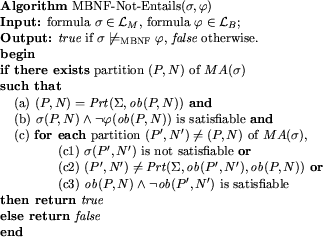 |
The algorithm exploits the finite characterization of
models given
by Theorem 4.7 and an analogous finite characterization,
in terms of partitions of ,
of all the models relevant for
establishing whether a partition (P,N) of
identifies an
model.
The algorithm checks whether there exists a partition (P,N) of
satisfying the three conditions (a), (b), (c). Intuitively,
the partition cannot be self-contradictory (condition (a)): in particular,
the condition
 establishes that the objective knowledge
implied by the partition (P,N) (that is, the formula )
identifies a
set of interpretations
such that (M,M) induces the
same partition (P,N) on .
Moreover, the partition must be
consistent with
and
(condition (b)): such a condition
implies that there exists an interpretation I such that both
is
satisfied in (I,M,M) and
is not satisfied in the structure
(I,M,M). Finally, condition (c) corresponds to check whether such a
structure (I,M,M) identifies an
model for
according to
Definition 2.1, i.e. whether there is no pair (J,M')
such that
and (J,M',M) satisfies .
Again, the
search of such a structure is performed by examining whether there exists a
partition of ,
different from (P,N), which does not satisfy
any of the conditions (c1), (c2), (c3).
establishes that the objective knowledge
implied by the partition (P,N) (that is, the formula )
identifies a
set of interpretations
such that (M,M) induces the
same partition (P,N) on .
Moreover, the partition must be
consistent with
and
(condition (b)): such a condition
implies that there exists an interpretation I such that both
is
satisfied in (I,M,M) and
is not satisfied in the structure
(I,M,M). Finally, condition (c) corresponds to check whether such a
structure (I,M,M) identifies an
model for
according to
Definition 2.1, i.e. whether there is no pair (J,M')
such that
and (J,M',M) satisfies .
Again, the
search of such a structure is performed by examining whether there exists a
partition of ,
different from (P,N), which does not satisfy
any of the conditions (c1), (c2), (c3).
We illustrate the algorithm through the following simple example.
Example 4.13
Suppose
Then,

.
Now suppose that
(
P,
N)=(
P1,
N1), where
Then,

(which is
equivalent to
c), and
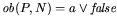
(which is equivalent to
a).
Now, let

:
it is easy to see that (
M,
M) satisfies the
modal atoms in
P, while it does not satisfy the modal atoms in
N, hence
,
thus satisfying condition (a) of the algorithm. Then,
since

is not a valid propositional formula,

,
hence

,
which is equivalent to
.
Therefore,

is not satisfiable, thus condition (b) does not
hold.
Suppose now that
(P,N)=(P2,N2), where
Then,

(which is
equivalent to
c), and

,
which
is equivalent to
b. Again, it is easy to see that
,
thus satisfying condition (a) of the algorithm. Then, since

is not a valid propositional formula,

,
which is equivalent to
.
Hence,
is equivalent to
c,
which implies that condition (b) holds. Finally, it is easy to verify that
either condition (c1) or condition (c2) holds for each partition of
different from (
P2,
N2), with the exception of (
P1,
N1).
So let
(
P',
N')=(
P1,
N1): as shown before,

is equivalent to
a,
hence

is equivalent to

,
therefore
condition (c3) holds for
(
P',
N')=(
P1,
N1), which implies that condition
(c) holds for
(
P,
N)=(
P2,
N2). Consequently,
-Not-Entails(

)
returns
.
In fact, the partition (
P2,
N2) identifies the set of
models for
(
I,
M) such that
I is an interpretation satisfying
c and

.
Each such model does not satisfy the query
:
indeed, it can immediately be verified that, for each interpretation
I,

,
since
and

.
To prove correctness of the algorithm -Not-Entails
we need the following preliminary lemma.
Lemma 4.14
Let
,
and let (
P,
N) be the partition
of
induced by (
M',
M). Let

.
Then,
(
P,
N) is the partition induced by (
M'',
M).
Proof.
The proof is by induction on the depth of the modal atoms of .
Let
 such that
:
then,
such that
:
then,
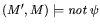 iff there exists an interpretation
such that
iff there exists an interpretation
such that
 ,
therefore
iff
,
therefore
iff
 .
Now let
.
Now let
 such that
:
by Definition 4.3,
such that
:
by Definition 4.3,
 iff the propositional formula
is
valid, and since
,
it follows that
iff
iff the propositional formula
is
valid, and since
,
it follows that
iff
 .
.
Now suppose that, for each modal atom
of depth i,
 iff
iff
 ,
and let (P',N') denote the partition of
the modal atoms in
of depth less or equal to i induced by
(M',M).
First, consider a modal atom
of depth i+1. Then, by
Lemma 4.6,
iff
,
and let (P',N') denote the partition of
the modal atoms in
of depth less or equal to i induced by
(M',M).
First, consider a modal atom
of depth i+1. Then, by
Lemma 4.6,
iff
 and, by the inductive hypothesis and
Lemma 4.6,
iff
and, by the inductive hypothesis and
Lemma 4.6,
iff
 .
Then, since
has depth i,
.
Then, since
has depth i,  is a propositional formula, hence
iff there exists an interpretation
such that
is a propositional formula, hence
iff there exists an interpretation
such that
 ,
which immediately implies that
iff
.
Now consider a modal atom
of depth i+1. Then, by
Lemma 4.6,
iff
,
which immediately implies that
iff
.
Now consider a modal atom
of depth i+1. Then, by
Lemma 4.6,
iff
 and, by the inductive hypothesis and
Lemma 4.6,
iff
and, by the inductive hypothesis and
Lemma 4.6,
iff
 .
By Definition 4.3,
iff
the propositional formula
.
By Definition 4.3,
iff
the propositional formula
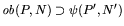 is valid, and since
,
it follows that
iff
,
which proves the thesis.
is valid, and since
,
it follows that
iff
,
which proves the thesis.
We are now ready to prove correctness of the algorithm MBNF-Not-Entails.
Proof.
If part. Suppose
.
Then, there exists a
pair (I,M) such that (I,M) is an
model for
and
 .
Let (P,N) be the partition of
induced
by (M,M). By Theorem 4.7,
.
Therefore, by Definition 4.8,
.
Then, since
,
by Theorem 4.10 it follows that
.
Let (P,N) be the partition of
induced
by (M,M). By Theorem 4.7,
.
Therefore, by Definition 4.8,
.
Then, since
,
by Theorem 4.10 it follows that
 ,
and since
,
and since
 ,
by
Lemma 4.6
,
therefore
,
by
Lemma 4.6
,
therefore
 .
Now suppose there exists a
partition (P',N') of
such that
.
Now suppose there exists a
partition (P',N') of
such that
 and none of
conditions (c1), (c2), and (c3) holds. Then, since
and none of
conditions (c1), (c2), and (c3) holds. Then, since  is
satisfiable, there exists an interpretation J such that
is
satisfiable, there exists an interpretation J such that
 ,
and since
,
and since
 ,
from Lemma 4.6
it follows that there exists an interpretation J such that
,
from Lemma 4.6
it follows that there exists an interpretation J such that
 ,
where
,
where
 .
Then, since
condition (c3) does not hold, the propositional formula
.
Then, since
condition (c3) does not hold, the propositional formula
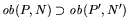 is
valid, which implies that
is
valid, which implies that  .
Now, if M'=M, then (P',N')
would be the partition induced by (M,M), thus contradicting the
hypothesis
.
Hence, ,
and since
,
it follows that (I,M) is not an
model
for .
Contradiction. Consequently, condition (c) in the algorithm
holds, therefore MBNF-Not-Entails(
)
returns true.
.
Now, if M'=M, then (P',N')
would be the partition induced by (M,M), thus contradicting the
hypothesis
.
Hence, ,
and since
,
it follows that (I,M) is not an
model
for .
Contradiction. Consequently, condition (c) in the algorithm
holds, therefore MBNF-Not-Entails(
)
returns true.
Only-if part. Suppose MBNF-Not-Entails(
)
returns true.
Then, there exists a partition (P,N) of
such that conditions (a),
(b), and (c) hold. Let
.
Since
,
by
Definition 4.8 (P,N) is the partition induced by (M,M).
And since
is satisfiable, it follows that
there exists an interpretation I such that
and
,
hence, by Lemma 4.6,
and
.
Now suppose (I,M)
is not an
model for .
Then, there exists a set M' and an
interpretation J such that
and
.
Let
(P',N') be the partition of
induced by (M',M). Since
,
it follows that M' contains at least one
interpretation J which does not satisfy ,
and since
 ,
J does not satisfy at least one
formula of the form
,
J does not satisfy at least one
formula of the form  such that .
Therefore,
such that .
Therefore,  ,
which implies that
.
Then, since
,
by Lemma 4.6
,
hence
is satisfiable. Now let
,
which implies that
.
Then, since
,
by Lemma 4.6
,
hence
is satisfiable. Now let
 .
By Lemma 4.14, it follows that (P',N') is the
partition induced by (M'',M), therefore, by Definition 4.8,
.
Moreover, since ,
it follows that the
propositional formula
is valid, hence the formula
is unsatisfiable. Consequently, (P',N') does not
satisfy condition (c) in the algorithm, thus contradicting the hypothesis.
Therefore, (I,M) is an
model for ,
and since
,
it follows that
,
thus proving the thesis.
.
By Lemma 4.14, it follows that (P',N') is the
partition induced by (M'',M), therefore, by Definition 4.8,
.
Moreover, since ,
it follows that the
propositional formula
is valid, hence the formula
is unsatisfiable. Consequently, (P',N') does not
satisfy condition (c) in the algorithm, thus contradicting the hypothesis.
Therefore, (I,M) is an
model for ,
and since
,
it follows that
,
thus proving the thesis.
We point out the fact that the algorithm -Not-Entails does not rely
on a theorem prover for a modal logic: thus, ``modal reasoning'' is not
actually needed for reasoning in .
This is an interesting
peculiarity that
shares with other nonmonotonic modal formalisms,
like autoepistemic logic [27] or the autoepistemic logic of
knowledge [33].
We now study reasoning in flat
theories. The main reason for
taking into account the flat fragment of
is the fact that reasoning
in many of the best known nonmonotonic formalisms like default logic,
circumscription, and logic programming, can be reduced to reasoning in flat
theories [22].
It is known that, if
 and
,
then it is possible
to reduce the entailment
to reasoning in logic
and
,
then it is possible
to reduce the entailment
to reasoning in logic
 ,
by translating
formulas into unimodal formulas of
[37]. Thus, the procedure for deciding entailment
in the logic
presented by [25] can be
employed for computing the entailment
.
In the following we study a more general problem, that is entailment
in the case
and
,
and present a specialized algorithm for this problem,
which is simpler than the more general reasoning method for
.
,
by translating
formulas into unimodal formulas of
[37]. Thus, the procedure for deciding entailment
in the logic
presented by [25] can be
employed for computing the entailment
.
In the following we study a more general problem, that is entailment
in the case
and
,
and present a specialized algorithm for this problem,
which is simpler than the more general reasoning method for
.
In Figure 2 we report the algorithm Flat-Not-Entails for
computing such an entailment. In the algorithm, Pn denotes the subset of
modal atoms from P prefixed by the modality ,
i.e.
 .
.
Figure 2:
Algorithm Flat-Not-Entails.
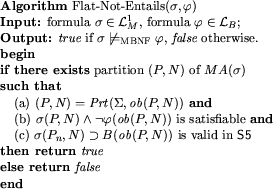 |
Informally, correctness of the algorithm Flat-Not-Entails is established by
the fact that, if
,
then (a), (b), and (c) are necessary and
sufficient conditions on a partition (P,N) in order to establish whether
it is induced by a pair (M,M) such that there exists an
model for
of the form (I,M). In particular, condition (c) states that
 must be a consequence of
  in modal logic
,1since it can be shown that if
in modal logic
,1since it can be shown that if
 is not valid
in ,
then the guess on the modal atoms of the form
in P is not minimal. We illustrate this fact through the following
example.
is not valid
in ,
then the guess on the modal atoms of the form
in P is not minimal. We illustrate this fact through the following
example.
Example 4.16
Let
and suppose
Then,
which is propositionally equivalent to

,
and

,
which is equivalent to

.
Now,

is not valid in
,
which
is proved by the fact that the set of interpretations
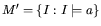
is such that

.
Indeed, the set of interpretations
M' can be immediately used in
order to prove that (
P,
N) does not identify any
model for
.
In fact, let
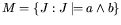
:
it is immediate to see
that, for each interpretation
I,
,
and since
,
(
I,
M) is not an
model for
.
Finally, condition (b) corresponds to check whether there exists an
interpretation I satisfying
 :
in fact, if such an
interpretation exists, then (I,M) is an
model for
which
does not satisfy .
:
in fact, if such an
interpretation exists, then (I,M) is an
model for
which
does not satisfy .
Therefore, the algorithms -Not-Entails and Flat-Not-Entails only
differ in the way in which it is verified whether the
structure
associated with a partition (P,N) satisfies the preference semantics
provided by Definition 2.1, which is implemented through
condition (c) in both algorithms. In the algorithm -Not-Entails,
a partition is checked against all other partitions of ,
while
in the algorithm Flat-Not-Entails it is sufficient to verify that the
partition (P,N) satisfies a ``local'' property. As shown in the next
section, such a difference reflects the different computational properties
of the entailment problem in the two cases.
In order to establish correctness of the algorithm, we need a preliminary
lemma.
Lemma 4.17
Let
and let (
P,
N) be the partition induced by a structure
(
M,
M). Then, (
I,
M) is an
model for
iff for each
the positive formula
is not satisfied by
M'.
Proof.
Suppose (I,M) is an
model for ,
and let (P,N) be the
partition induced by (M,M). Let M' be any set of interpretations such
that .
Then,
 .
Since
and ,
this implies that for each modal atom
in N,
.
Since
and ,
this implies that for each modal atom
in N,
 .
Moreover, for each modal atom
,
.
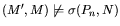
Therefore, by
Lemma 4.6,
.
Moreover, for each modal atom
,
.
Therefore, by
Lemma 4.6,
 .
Now, since
,
is a flat positive formula, hence its
satisfiability only depends on the structure M', therefore
.
Now, since
,
is a flat positive formula, hence its
satisfiability only depends on the structure M', therefore
 .
.
Conversely, suppose (I,M) is not an
model for ,
and let
(P,N) be the partition induced by (M,M). Then, there exists a set of
interpretations M' such that
and
 .
As shown before, this implies that the positive formula
is satisfied by M'.
.
As shown before, this implies that the positive formula
is satisfied by M'.
As observed in Section 2, the class of universal Kripke
structures characterizes modal logic .
This immediately implies the
following property.
Lemma 4.18
A formula
is valid in
iff, for each set of
interpretations
M, the formula
is not satisfied by
M.
Based on the above property, we are now able to prove correctness of the
algorithm Flat-Not-Entails.
Theorem 4.19
Let
and
.
Then,
Flat-Not-Entails(
)
returns
true iff
.
Proof.
If-part. If
,
then there exists an
model (I,M) for
such that
.
Let
(P,N) be the partition of
induced by (M,M). From
Theorem 4.7 it follows that
.
Therefore, by Definition 4.8,
,
hence
condition (a) in the algorithm holds.
Now let
 ,
and suppose the formula
,
and suppose the formula
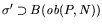 is not valid in .
Then, since the formula
belongs to ,
by Lemma 4.18
it follows that there exists a set of interpretations M' satisfying
is not valid in .
Then, since the formula
belongs to ,
by Lemma 4.18
it follows that there exists a set of interpretations M' satisfying
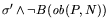 .
Let (P',N') be the partition of
.
Let (P',N') be the partition of
 induced by (M',M'), and let
.
Since
induced by (M',M'), and let
.
Since
 ,
by
Definition 4.3 it follows that
is a valid
propositional formula,
hence
,
by
Definition 4.3 it follows that
is a valid
propositional formula,
hence
 .
Now, since by hypothesis
.
Now, since by hypothesis
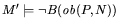 ,
it follows that
,
it follows that  .
Moreover, since
.
Moreover, since
 ,
by Lemma 4.14 it follows that
(P',N') is the partition induced by (M'',M''), and since
,
by Lemma 4.14 it follows that
(P',N') is the partition induced by (M'',M''), and since
 and
and  is flat,
 is equivalent to
,
therefore
is equivalent to
,
therefore
 and, by
Lemma 4.6,
and, by
Lemma 4.6,
 .
On the other hand, since
,
by Lemma 4.17 it follows that
.
On the other hand, since
,
by Lemma 4.17 it follows that
 .
Contradiction. Hence,
is
valid in ,
consequently condition (c) of the algorithm holds.
.
Contradiction. Hence,
is
valid in ,
consequently condition (c) of the algorithm holds.
Finally, since
and
,
by
Theorem 4.10 it follows that
.
Moreover, since
,
from Lemma 4.6 it
follows that
,
consequently
,
hence the propositional formula
is satisfiable. Therefore, conditions (a),
(b), and (c) in the algorithm hold, which implies that
Flat-Not-Entails(
)
returns true.
Only-if-part. If Flat-Not-Entails(
)
returns true,
then there exists a partition (P,N) of
for which conditions
(a), (b), and (c) of the algorithm hold. Let
.
By
Definition 4.8, (P,N) is the partition of
induced by (M,M). Now, since
is
satisfiable, there exists an interpretation I such that
and
 ,
hence by
Lemma 4.6
,
and by
Theorem 4.10
,
therefore we only have
to show that (I,M) is an
model for .
So, let us suppose
(I,M) is not an
model for .
Then,
by Lemma 4.17 there exists
such that
is satisfied in M'. Now, condition (c) in the algorithm
implies that
is a consequence of
in ,
therefore
is satisfied by each interpretation in M', that is,
,
hence by
Lemma 4.6
,
and by
Theorem 4.10
,
therefore we only have
to show that (I,M) is an
model for .
So, let us suppose
(I,M) is not an
model for .
Then,
by Lemma 4.17 there exists
such that
is satisfied in M'. Now, condition (c) in the algorithm
implies that
is a consequence of
in ,
therefore
is satisfied by each interpretation in M', that is,
 ,
which contradicts the hypothesis
,
which contradicts the hypothesis
 .
Consequently,
(I,M) is an
model for .
.
Consequently,
(I,M) is an
model for .
We remark the fact that the algorithm Flat-Not-Entails can be seen as a
generalization of known methods for query answering in Reiter's default
logic, Moore's autoepistemic logic, and (disjunctive) logic programming
under the stable model (and answer set) semantics. In particular, condition
(c) in the algorithm can be seen as a generalization of the minimality
check used in (disjunctive) logic programming for verifying stability of a
model of a logic program [10,11].
Complexity Results
In this section we provide a computational characterization of reasoning in
.
We first briefly recall the complexity classes in the polynomial
hierarchy, and refer to [18,29] for further details about
the complexity classes mentioned in the paper. PA (NPA) is the class
of problems that are solved in polynomial time by deterministic
(nondeterministic) Turing machines using an oracle for A (i.e. that
solves in constant time any problem in A). The classes  ,
,
 and
and  of the polynomial hierarchy are defined by
 P, and for
  ,
,
 ,
,
 and
and
 .
In
particular, the complexity class
.
In
particular, the complexity class  is the class of problems that
are solved in polynomial time by a nondeterministic Turing machine that
uses an NP-oracle, and
is the class of problems that are
complement of a problem in ,
while
is the class of problems that
are solved in polynomial time by a nondeterministic Turing machine that
uses an NP-oracle, and
is the class of problems that are
complement of a problem in ,
while  is the class of
problems that are solved in polynomial time by a nondeterministic Turing
machine that uses an -oracle, and
is the class of
problems that are complement of a problem in .
It is generally
assumed that the polynomial hierarchy does not collapse: hence, a problem
in the class
or
is considered computationally easier
than a -hard or -hard problem.
is the class of
problems that are solved in polynomial time by a nondeterministic Turing
machine that uses an -oracle, and
is the class of
problems that are complement of a problem in .
It is generally
assumed that the polynomial hierarchy does not collapse: hence, a problem
in the class
or
is considered computationally easier
than a -hard or -hard problem.
As for the complexity of entailment in ,
we start by establishing a
lower bound for reasoning in propositional
theories. To this end,
we exploit the correspondence between
and the logic
of minimal knowledge
[14]. Indeed, as stated by
Proposition 2.5, there is a one-to-one correspondence between
models and
models of positive subjective theories.
Lemma 5.1
Let

and let
.
Then, the problem of deciding
whether
is
-hard.
Proof.
As shown by [5], entailment in
is
-complete. Therefore, by Proposition 2.5, for
subjective (and hence for general)
theories, entailment is
-hard.
Then, we show that the entailment problem in propositional
is
complete with respect to the class .
Theorem 5.2
Let
and let
.
Then, the problem of deciding
whether
is
-complete.
Proof.
Hardness with respect to
follows from
Lemma 5.1. As for membership in ,
we analyze the
complexity of the algorithm -Not-Entails reported in Figure 1. In
particular, observe that:
- given (P,N), the formula
can be computed in polynomial time
with respect to the size of P. Moreover, by Lemma 4.9 it
follows that, since
has size linear with respect to the size
of ,
construction of the partition
 can be performed
through a linear number (with respect to the size of )
of calls
to an NP-oracle for propositional satisfiability. Therefore, condition
(a) can be checked through a linear number (in the size of the input) of
calls to an NP-oracle;
can be performed
through a linear number (with respect to the size of )
of calls
to an NP-oracle for propositional satisfiability. Therefore, condition
(a) can be checked through a linear number (in the size of the input) of
calls to an NP-oracle;
- since
,
the formula
can be computed in time linear with respect to the size of
 using an NP-oracle. And since, given
and
(P,N),
can be computed in polynomial time with respect to
the size of the input, it follows that condition (b)
can be computed through a linear number (in the size of the input) of
calls to an NP-oracle;
using an NP-oracle. And since, given
and
(P,N),
can be computed in polynomial time with respect to
the size of the input, it follows that condition (b)
can be computed through a linear number (in the size of the input) of
calls to an NP-oracle;
- given a partition (P',N'), each of the conditions (c1), (c2) and
(c3) (analogous to conditions (a) and (b)) can be checked in polynomial
time, with respect to the size of ,
using an NP-oracle.
Therefore, since the guess of the partition (P',N') of
requires a nondeterministic choice, falsity of condition (c) can be
decided in ,
which implies that verifying whether condition
(c) holds can be decided in .
Since the guess of the partition (P,N) of
requires a
nondeterministic choice, it follows that the algorithm -Not-Entails,
if considered as a nondeterministic procedure, decides
in nondeterministic polynomial time (with
respect to the size of
 ), using a -oracle.
Thus, we obtain an upper bound of
for the non-entailment
problem, which implies that entailment in
is in .
), using a -oracle.
Thus, we obtain an upper bound of
for the non-entailment
problem, which implies that entailment in
is in .
The previous analysis also allows for a computational characterization of
the logic
[21], which is a slight modification of .
Indeed, it is known [22] that, for each theory
,
M is an
model of
iff, for each
interpretation I, (I,M) is an
model of the subjective theory
 .
Therefore, from
Proposition 2.5 and from -hardness of entailment in
[5], it follows that entailment in
is
-hard. Then, since
.
Therefore, from
Proposition 2.5 and from -hardness of entailment in
[5], it follows that entailment in
is
-hard. Then, since
 iff
iff
 [22], it follows that entailment in
can be polynomially reduced to entailment in ,
hence such a
problem belongs to .
Therefore, the following property holds.
[22], it follows that entailment in
can be polynomially reduced to entailment in ,
hence such a
problem belongs to .
Therefore, the following property holds.
Theorem 5.3
Entailment in propositional
is
-complete.
Finally, the previous theorem provides a computational characterization of
the logic of grounded knowledge and justified assumptions GK
[24]. In fact, the logic GK can be considered as a syntactic
variant of the propositional fragment of .
Therefore, skeptical
entailment in GK is -complete.
Remark. The computational properties of
and its
variants relate such formalisms to ground nonmonotonic modal logics
[6,5,32]. Notably, ground nonmonotonic modal
logics share with
the interpretation in terms of minimal knowledge
(or minimal belief) of the modality B; specifically, as already
mentioned, the propositional fragment of
can be considered as built
upon
by adding a second modality .
Therefore, it turns out
that, in the propositional case, adding a ``negation by default'' modality
to the
logic of minimal knowledge does not increase the
computational complexity of reasoning, while adding a minimal knowledge
modality to
does increase the complexity of deduction. We can thus
summarize as follows: minimal knowledge is computationally harder than
negation as failure.
We now study the complexity of entailment for flat
theories.
First, it is known that, in the case of flat
theories and
subjective queries, entailment is -complete: membership in
the class
is a consequence of the fact that flat
theories
can be polynomially embedded into McDermott and Doyle's nonmonotonic modal
logic  [37, Proposition 3.2], whose entailment
problem is -complete [25],
while -hardness follows from the existence of a
polynomial-time embedding of propositional default theories into flat
theories [22]. Therefore, the following
property holds.
[37, Proposition 3.2], whose entailment
problem is -complete [25],
while -hardness follows from the existence of a
polynomial-time embedding of propositional default theories into flat
theories [22]. Therefore, the following
property holds.
Proposition 5.4
Let
and let
.
Then, the problem of deciding
whether
is

-complete.
As for complexity of entailment of generic queries with respect to flat
theories, we analyze the complexity of the algorithm
Flat-Not-Entails reported in Figure 2. As shown before, both condition (a)
and condition (b) can be checked through a linear number (with respect to
the size of the input) of calls to an NP-oracle. Moreover, validity in
modal logic
is a coNP-complete problem [15].
Hence, each of the conditions in the algorithm can be computed through a
number of calls to an oracle for the propositional validity problem which
is polynomial in the size of the input, and since the guess of the
partition (P,N) of
requires a nondeterministic choice, it
follows that the algorithm runs in .
Therefore, the following
property holds.
Theorem 5.5
Let
and let
.
Then, the problem of deciding
whether
is
-complete.
Proof.
Membership of the problem to the class
is implied by the algorithm
Flat-not-entails, whereas -hardness is implied by Proposition
5.4.
Hence, the algorithm Flat-Not-Entails is ``optimal'' in the sense that it
matches the lower bound for the entailment problem.
Finally, we remark that the subset of flat
theories in conjunctive
normal form can be seen as a further extension of the framework of generalized logic programming introduced by [16], which in turn
is an extension of the disjunctive logic programming framework under the
stable model semantics [11]. Roughly speaking, flat
theories in conjunctive normal form correspond to rules of generalized
logic programs in which propositional formulas (instead of literals) are
allowed as goals. The above computational characterization implies that
such an extension of the framework of logic programming under the stable
model semantics does not affect the worst-case complexity of the entailment
problem, which is -complete just like entailment in logic programs
with disjunction under the stable model semantics [8]. Such a
result extends analogous properties [26] to the case of
disjunctive logic programs.
In this paper we have investigated the problem of reasoning in the
propositional fragment of .
The main results presented can be
summarized as follows:
- the negation as failure modality
of
exactly corresponds
to negative introspection in .
This implies that the logic
can be viewed as the conservative extension of two different nonmonotonic
modal logics: Halpern and Moses' logic of minimal knowledge
and Moore's ;
- reasoning in the propositional fragment of
lies at the third
level of the polynomial hierarchy, hence (unless the polynomial hierarchy
does not collapse) reasoning in
is harder than reasoning in the
best known propositional nonmonotonic logics, like default logic,
autoepistemic logic, and circumscription;
- we have defined methods for reasoning in ,
which subsume and
generalize well-known nonmonotonic reasoning algorithms used in logic
programming [11], default logic [12], and
autoepistemic logic [25];
- we have studied the flat fragment of
and its relationship
with the logic programming paradigm.
As for the computational aspects of reasoning in ,
the results
presented in Section 5 prove that one source of
complexity is due to the presence of nested occurrences of modalities in
the theory, since reasoning in flat
is computationally easier than
in the general case.
It can be proven that another source of complexity lies in the underlying
objective language. In fact, if we consider  to be a tractable
fragment of propositional logic, then the complexity of reasoning in the
modal language
to be a tractable
fragment of propositional logic, then the complexity of reasoning in the
modal language  built upon
is lower than in the general case.
In particular, it is easy to see that, under the assumption that entailment
in
can be computed in polynomial time, the algorithm
-Not-Entails provides an upper bound of
for
-entailment in the fragment .
built upon
is lower than in the general case.
In particular, it is easy to see that, under the assumption that entailment
in
can be computed in polynomial time, the algorithm
-Not-Entails provides an upper bound of
for
-entailment in the fragment .
One possible development of the present work is towards the analysis of
reasoning about minimal belief and negation as failure in a first-order
setting: in particular, it should be interesting to see whether it is
possible to extend the techniques developed for the propositional case to a
more expressive language. A first attempt in this direction is reported in
[4].
This research has been partially supported by Consiglio Nazionale delle
Ricerche, grant 203.15.10.
-
- 1
-
A. Beringer and T. Schaub.
Minimal belief and negation as failure: a feasible approach.
In Proc. of the 11th Nat. Conf. on Artificial Intelligence
(AAAI'93), pages 400-405, 1993.
- 2
-
A. Bochman.
On bimodal nonmonotonic modal logics and their unimodal and nonmodal
equivalents.
In Proc. of the 14th Int. Joint Conf. on Artificial
Intelligence (IJCAI'95), pages 1518-1524, 1995.
- 3
-
J. Chen.
The logic of only knowing as a unified framework for non-monotonic
reasoning.
Fundamenta Informaticae, 21:205-220, 1994.
- 4
-
F. M. Donini, D. Nardi, and R. Rosati.
Autoepistemic description logics.
In Proc. of the 15th Int. Joint Conf. on Artificial
Intelligence (IJCAI'97), pages 136-141, 1997.
- 5
-
F. M. Donini, D. Nardi, and R. Rosati.
Ground nonmonotonic modal logics.
J. of Logic and Computation, 7(4):523-548, Aug. 1997.
- 6
-
T. Eiter and G. Gottlob.
Reasoning with parsimonious and moderately grounded expansions.
Fundamenta Informaticae, 17(1,2):31-54, 1992.
- 7
-
T. Eiter and G. Gottlob.
Propositional circumscription and extended closed world reasoning are
-complete.
Theoretical Computer Science, 114:231-245, 1993.
- 8
-
T. Eiter and G. Gottlob.
On the computational cost of disjunctive logic programming:
propositional case.
Annals of Mathematics and Artificial Intelligence, 15(3,4),
1995.
- 9
-
M. Gelfond and V. Lifschitz.
The stable model semantics for logic programming.
In Proceedings of the Fifth Logic Programming Symposium, pages
1070-1080. The MIT Press, 1988.
- 10
-
M. Gelfond and V. Lifschitz.
Logic programs with classical negation.
In Proceedings of the Seventh International Conference on Logic
Programming, pages 579-597. The MIT Press, 1990.
- 11
-
M. Gelfond and V. Lifschitz.
Classical negation in logic programs and disjunctive databases.
New Generation Computing, 9:365-385, 1991.
- 12
-
G. Gottlob.
Complexity results for nonmonotonic logics.
J. of Logic and Computation, 2:397-425, 1992.
- 13
-
G. Gottlob.
NP trees and Carnap's modal logic.
J. of the ACM, 42(2):421-457, 1995.
- 14
-
J. Y. Halpern and Y. Moses.
Towards a theory of knowledge and ignorance: Preliminary report.
In K. Apt, editor, Logic and models of concurrent systems.
Springer-Verlag, 1985.
- 15
-
J. Y. Halpern and Y. Moses.
A guide to completeness and complexity for modal logics of knowledge
and belief.
Artificial Intelligence, 54:319-379, 1992.
- 16
-
K. Inoue and C. Sakama.
On positive occurrences of negation as failure.
In Proc. of the 4th Int. Conf. on the Principles of Knowledge
Representation and Reasoning (KR'94), pages 293-304. Morgan Kaufmann, Los
Altos, 1994.
- 17
-
T. Janhunen.
On the intertranslatability of autoepistemic, default and priority
logics.
In Proc. of the 6th European Workshop on Logics in Artificial
Intelligence (JELIA'98), pages 216-232, 1998.
- 18
-
D. S. Johnson.
A catalog of complexity classes.
In J. van Leuven, editor, Handbook of Theoretical Computer
Science, volume A, chapter 2. Elsevier Science Publishers (North-Holland),
Amsterdam, 1990.
- 19
-
M. Kaminski.
Embedding a default system into nonmonotonic logics.
Fundamenta Informaticae, 14:345-354, 1991.
- 20
-
H. J. Levesque.
All I know: a study in autoepistemic logic.
Artificial Intelligence, 42:263-310, 1990.
- 21
-
V. Lifschitz.
Nonmonotonic databases and epistemic queries.
In Proc. of the 12th Int. Joint Conf. on Artificial
Intelligence (IJCAI'91), pages 381-386, 1991.
- 22
-
V. Lifschitz.
Minimal belief and negation as failure.
Artificial Intelligence, 70:53-72, 1994.
- 23
-
V. Lifschitz and T. Woo.
Answer sets in general nonmonotonic reasoning (preliminary report).
In Proc. of the 3rd Int. Conf. on the Principles of Knowledge
Representation and Reasoning (KR'92), pages 603-614. Morgan Kaufmann, Los
Altos, 1992.
- 24
-
F. Lin and Y. Shoham.
Epistemic semantics for fixed-point non-monotonic logics.
Artificial Intelligence, 57:271-289, 1992.
- 25
-
W. Marek and M. Truszczynski.
Nonmonotonic Logics - Context-Dependent Reasoning.
Springer-Verlag, 1993.
- 26
-
W. Marek, M. Truszczynski, and A. Rajasekar.
Complexity of computing with extended propositional logic programs.
Annals of Mathematics and Artificial intelligence, 15(3,4),
1995.
- 27
-
R. C. Moore.
Semantical considerations on nonmonotonic logic.
Artificial Intelligence, 25:75-94, 1985.
- 28
-
I. Niemelä.
On the decidability and complexity of autoepistemic reasoning.
Fundamenta Informaticae, 17(1,2):117-156, 1992.
- 29
-
C. H. Papadimitriou.
Computational Complexity.
Addison Wesley Publ. Co., Reading, Massachussetts, 1994.
- 30
-
R. Reiter.
What should a database know?
J. of Logic Programming, 14:127-153, 1990.
- 31
-
R. Rosati.
Reasoning with minimal belief and negation as failure: Algorithms
and complexity.
In Proc. of the 14th Nat. Conf. on Artificial Intelligence
(AAAI'97), pages 430-435. AAAI Press/The MIT Press, 1997.
- 32
-
R. Rosati.
Reasoning about minimal knowledge in nonmonotonic modal logics.
J. of Logic, Language and Information, 8(2):187-203, 1999.
- 33
-
G. Schwarz.
Autoepistemic logic of knowledge.
In Proc. of the 1st Int. Workshop on Logic Programming and
Non-monotonic Reasoning (LPNMR'91), pages 260-274. The MIT Press, 1991.
- 34
-
G. Schwarz.
Minimal model semantics for nonmonotonic modal logics.
In Proc. of the 7th IEEE Sym. on Logic in Computer Science
(LICS'92), pages 34-43. IEEE Computer Society Press, 1992.
- 35
-
G. Schwarz.
On embedding default logic into Moore's autoepistemic logic.
Artificial Intelligence, 80:388-392, 1996.
- 36
-
G. Schwarz and V. Lifschitz.
Extended logic programs as autoepistemic theories.
In Proc. of the 2nd Int. Workshop on Logic Programming and
Non-monotonic Reasoning (LPNMR'93), pages 101-114. The MIT Press, 1993.
- 37
-
G. Schwarz and M. Truszczynski.
Minimal knowledge problem: a new approach.
Artificial Intelligence, 67:113-141, 1994.
- 38
-
Y. Shoham.
Nonmonotonic logics: Meaning and utility.
In Proc. of the 10th Int. Joint Conf. on Artificial
Intelligence (IJCAI'87), pages 388-392, 1987.
- 39
-
R. Stalnaker.
A note on non-monotonic modal logic.
Artificial Intelligence, 64(2):183-196, 1993.
Footnotes
- ...,1
- We denote as B the modal operator used in .
1999-10-09
 then
then
 ;
;
 then
then
 .
.
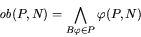


 .
Let (P,N) be the partition of
.
Let (P,N) be the partition of
 ;
;
 ,
if the propositional formula
,
if the propositional formula
 is valid, then add
 is
not valid, then add
is
not valid, then add
 .
.
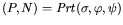 .
.