
Here is a rapid sketch of our Activity, courtesy of Chris Bates.
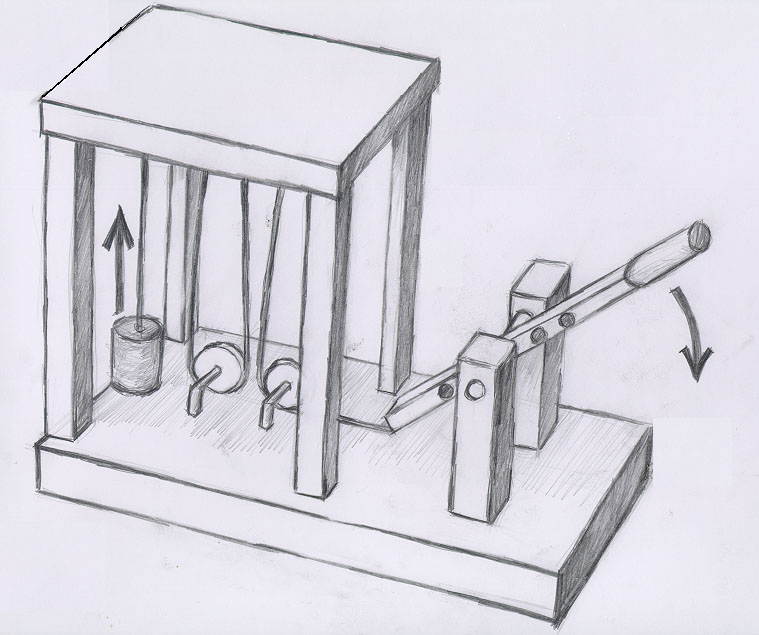
By using different numbers of pulleys and different fulcrum points for the lever, the children are able to see how drastically the mechanical advantage changes. Basically, the mechanism is designed to allow the user to apply force on the lever, which is attached to the pulleys and the weight, in order to lift a certain amount of weight. If the pulleys are not used, and the fulcrum for the lever is not in an ideal location, the child will not be able to lift the weight.
The child is allowed to test out different fulcrum positions and different number of pulleys to see which makes lifting the weight the easiest. The contraption consists of a long plank, with four vertical beams on one half lined up in the shape of a cube. The beams have a board on top, acting as a ceiling. The ceiling and the bottom of the cube are lined with hooks, which are used to attach the pulleys. On the other half of the plank, there is the lever with the end of a string attached to it. The other end of the string is run through the pulleys and is attached to the weight which is placed inside the cubical structure. The fulcrum point of the lever is allowed to shift to allow the mechanical advantage to change. The free end of the lever has a handle on it, so that the child may push on it. For further information, refer to the diagram.
This mechanism is directed toward children in 2nd to 5th grades, because of its simplicity. It teaches easy concepts without the use of complicated jargon. Plus, using the knowledge obtained from this contraption, the child may be able to solve more complicated problems. The mechanism is generally safe, because none of the parts are sharp. The mechanism also does not incorporate combustion or explosion, which makes it even more safe. The only danger involved in this contraption may be the weight, which may be pretty heavy.