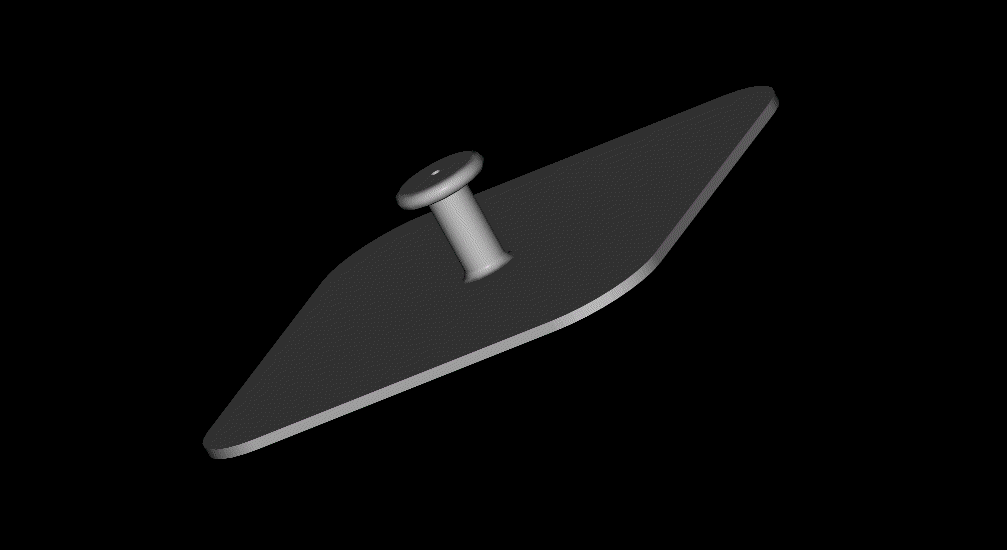
Hovercrafts:
A Demonstration of Air Flow and Pressure
Submitted to:
Professor Susan Finger
Carnegie Mellon University
Submitted By:
Suman Grandhi
Sophomore, Electrical & Computer Engineering
Amy Ng
Junior, Mechanical Engineering
Armando Morreale
Senior, Mechanical Engineering
April 7th, 1998
Introduction
Bringing innovative activities into a classroom usually elevates student interest and increases their attention span. The activity kit, titled ‘Build your own Hovercraft,’ teaches students about the principles of frictionless surfaces, airflow patterns, and air pressure. By engaging students in this activity, it will help them correlate the properties learned in class to real-world examples. This process of learning elevates the student’s creative thought processes while keeping them interested and attentive. After a demonstration of these principles, the students will then build their own hovercrafts and compete in a game of ‘Shufflecraft.’
Problem & Objectives
A major problem with the way that science and engineering is taught to young students is that instructors merely describe scientific phenomena, and do not provide concrete examples to which students can relate.
An activity box is the ideal setup for an instructor to coordinate an outreach project with students in Elementary and Junior High Schools. The portability and flexibility of the activity box allows instructors to easily adapt this kit anywhere in their curriculum. The activity box contains all necessary items for a single class lesson. The materials in the box are safe, durable, and suitable for an indoor classroom.
Furthermore, the activity engages up to 30 students in the 5th to 6th grades, and introduces the concepts of pressure, airflow patterns, and frictionless surfaces. First, the instructor demonstrates these concepts by using the manufactured prototype of the hovercraft. As the air flows out of the hovercraft, colored powder on the surface below will move in the direction of airflow. This will help students visualize the streamlines depicting turbulence, eddies, and stagnation points. As the instructor demonstrates the working concepts of the hovercraft, he or she will also ask the students to consider several questions to explain the things they see. With this question and answer session, students will develop an understanding of the engineering principles of air flow.
Solution
The game that the young children will play will be straightforward and will also be fun. The game itself is similar to curling, bocce, and shuffleboard. First, the child will be supplied with the materials to manufacture his/her own hovercraft. After the hovercraft has been assembled from the given parts, the child will proceed to blow up a balloon and place it on the hovercraft. Now the child is ready to play the game.
The game itself consists of a playing surface similar to the one in the sport of curling. That is, there exists a bulls-eye at the end of the playing surface. This bulls-eye will have a variety of different colored rings, each corresponding to a certain point value. Naturally, the center of the bulls-eye will be worth the most.
The playing surface will be made of a roll of transparent vinyl, similar to the transparency rolls used by professors while lecturing with an overhead projector. The transparency roll would suffice, but it is only 11" wide. The vinyl rolls are approximately 3’ wide. This provides for a spacious, flat playing surface. Also, the surface of the vinyl roll is very smooth, creating an almost frictionless interface between it and the hovercraft. The roll of vinyl will be unraveled on top of a table or on the floor in order to play the game. The bulls-eye will be drawn on a large piece of paper and will be placed underneath the end of the playing surface.
The picture above shows a rough image of what the game surface might look like. The rules of the game are to slide the hovercraft down the game board onto the bulls-eye. As stated before, the center of the bulls-eye will be worth the most points, while each larger ring represents a smaller point value. Each child will be able to slide his/her own hovercraft down the playing surface two times. The total score will be the sum of the two different point scores for each of the individual turns taken. The child with the highest score at the end of the game will win.
Since pressure is equal to force per area, students will see that the larger the volume of the balloon, the larger the air pressure, and the further the hovercraft travels. The instructor will remind the students that this is what is happening. Supporting examples include the flattening of a ball of clay. Using a ball of clay, the instructor can place a small block on top, to
Plan
The design and activity concepts have been developed and agreed upon. The remaining tasks to be accomplished include (by order of importance):
PARTS LIST:
Rapid Manufactured Items
Purchased Items
Hovercraft Items:
Bulls-eye Items:
COST:
Glue: $ 0.80 * 15 = $ 12.00
15-pack 12" Balloons: $ 1.29 * 2 = $ 2.58
18-pack Wooden Spools: $ 2.00 * 2 = $ 4.00
Cardboard: $ 2.00 * 1 = $ 2.00
Colored Powder: $ 3.00 * 1 = $ 3.00
Glass Rods: $ 0.50 * 15 = $ 7.50
Colored Markers: $ 5.00 * 1 = $ 5.00
Cookie Cutters: $ 3.00 * 2 = $ 6.00
Poster Board: $ 1.00 * 1 = $ 1.00
Small Scissors: $ 1.00 * 15 = $ 15.00
-------------------------------------------
TOTAL: $ 58.08 + tax