Homemade Electical Generators
Ryan Yates, Heeyong Kang, Tina Daup

ABSTRACT
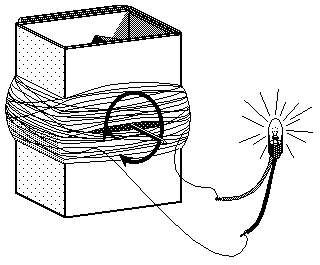
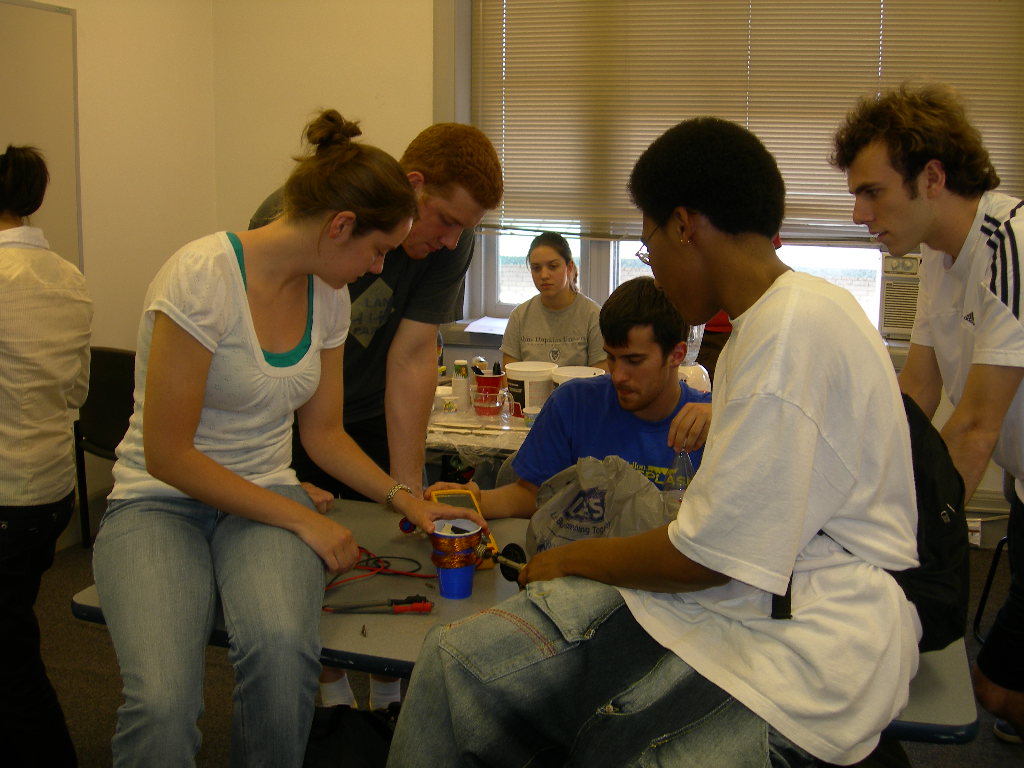
This activity is designed to demonstrate a method of converting mechanical energy to electrical energy to middle school girls. Each team will assemble a basic electric generator with loops of copper wire, magnets, and a hand crank. Students will use the crank to manually spin the magnets in the center of several loops of wire. This changes the magnetic flux through the loops and current will flow through the wires. Students will learn that mechanical energy can be converted to electrical energy by using the induced current to operate electronics such as light bulbs. Students will also construct their own generators and measure the current produced; through the activity, students will also learn the factors that affect the amount of current generated.
HOW WE MADE IT
Most materials can be found within a common household or are easily available at local hardware stores; however, for our display generator, we manufactured a housing for the device, which would hold the magnets and allow them to spin freely within the structure. We used fused composition modeling (FDM), a type of rapid prototyping technology. FDM works on an "additive" principle by laying material down in multiple layers, similar to a 3D printer.
DRAWING