Closed-loop driving demonstrations across diverse long-tailed scenarios from the
nuPlan benchmark. Our planner is interruptible and generates coherent textual reasoning alongside motion plans in
real-time.
Overview
Abstract
We present LAD, a real-time language-action planner with an interruptible architecture
that produces a motion plan in a single forward pass (~20 Hz) or generates textual reasoning alongside
a motion plan (~10 Hz). LAD is fast enough for real-time closed-loop deployment, achieving ~3× lower
latency than prior driving language models while setting a new learning-based state of the art on
nuPlan Test14-Hard and InterPlan. We also introduce RAD, a rule-based planner designed
to address structural limitations of PDM-Closed. RAD achieves state-of-the-art performance among
rule-based planners on nuPlan Test14-Hard and InterPlan. Finally, we show that combining RAD and LAD
enables hybrid planning that captures the strengths of both approaches. This hybrid system demonstrates
that rules and learning provide complementary capabilities: rules support reliable maneuvering, while
language enables adaptive and explainable decision-making.
Key Insights
01
Two Complementary Challenges
Planning requires both geometric feasibility and semantic reasoning and no single approach covers both.
02
RAD Addresses Geometry
Expands the search space via dynamic topology and data-driven maneuver priors.
03
LAD Addresses Semantics
Enables language-grounded reasoning over ambiguous traffic interactions in real-time.
04
RAD-LAD: Best Together
The hybrid system integrates structured planning with foundation models for complementary strengths.
Method
Classical Planning
Rule-Based Autonomous Driving (RAD)
A flexible rule-based planner that extends PDM-Closed with:
Dynamic Topological Replanning — full graph search at every timestep, ensuring
proposals always extend from the current ego pose
Lane-Change Capability — augments the road topology with adjacent-lane centerlines,
enabling lane changes and even opposite-lane maneuvers
Trajectory Vocabulary — data-driven maneuver priors (swerves, bypasses) from clustered
training trajectories
Context-Aware Rule Relaxation — softly downweights penalties in deadlock situations
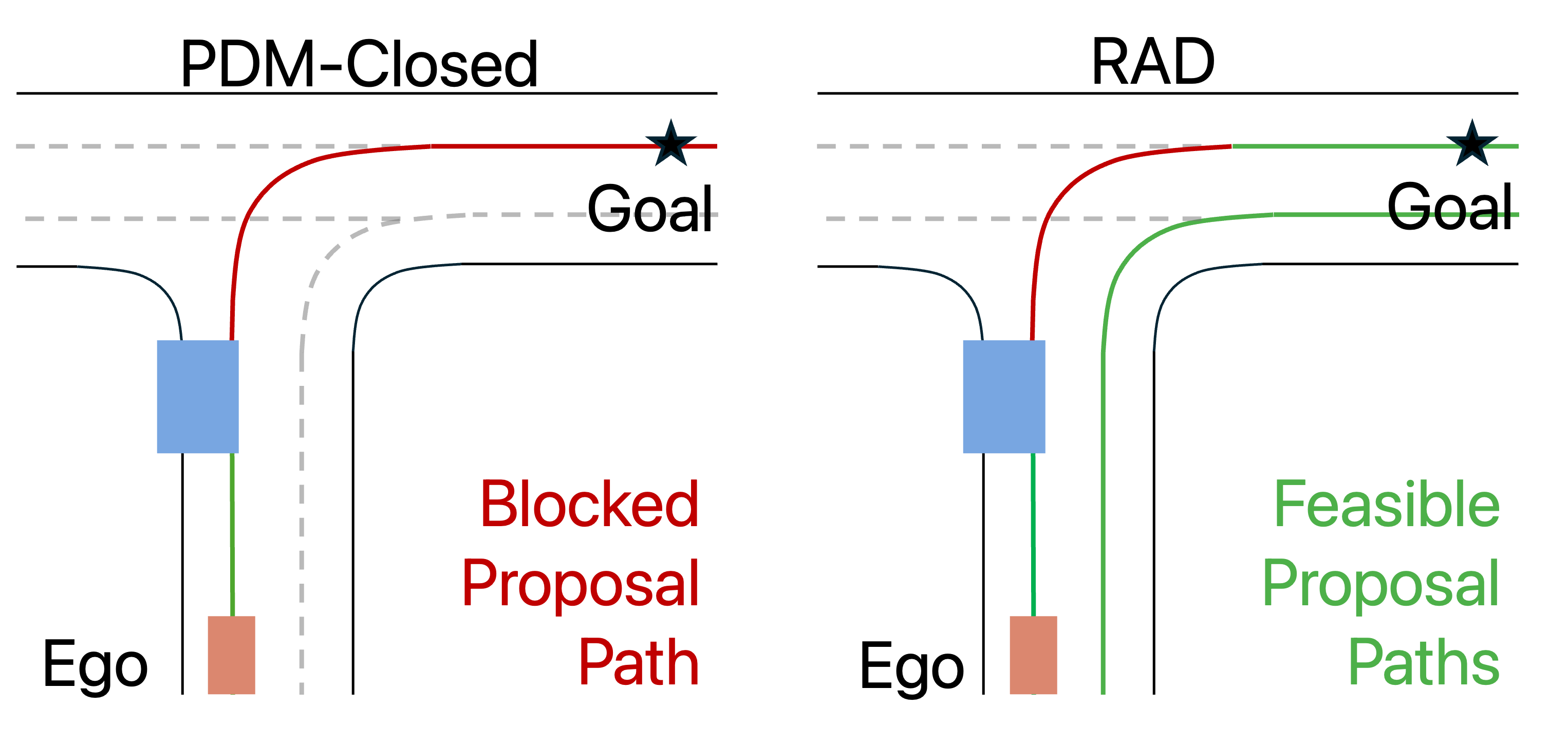
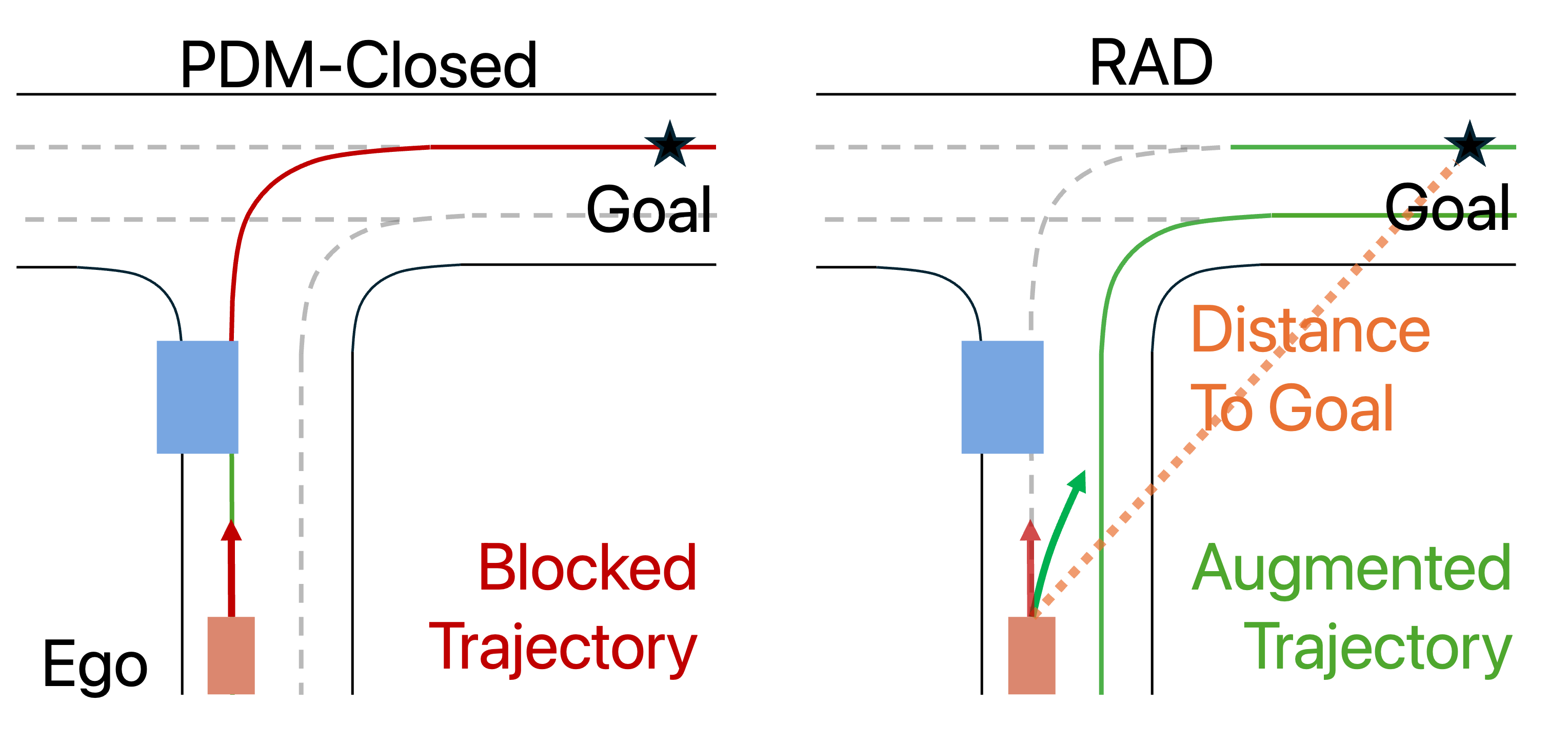
PDM-Closed's static proposal paths can get blocked. RAD
topologically replans at every timestep and augments paths with adjacent-lane centerlines.RAD combines goal-directed optimization with trajectory proposal
augmentation to enable lane changes and other maneuvers.
Learned Planning
Language-Based Autonomous Driving (LAD)
An anytime multimodal language model planner that produces a valid motion plan in a single forward pass:
Scene Encoding — PlanTF encodes map elements and agents; MLP adapters project into the
LLM's token space
Planning Decoder — classification over a discrete trajectory vocabulary, not
autoregressive waypoint generation
Language Supervision — DrivingQA + PlanningQA provide complementary inductive bias for
trajectory prediction
Interruptible Inference — valid plan always available from the plan token; reasoning
tokens generated opportunistically
Multimodal Training — two-stage curriculum (alignment → LoRA finetuning) preserving
language abilities
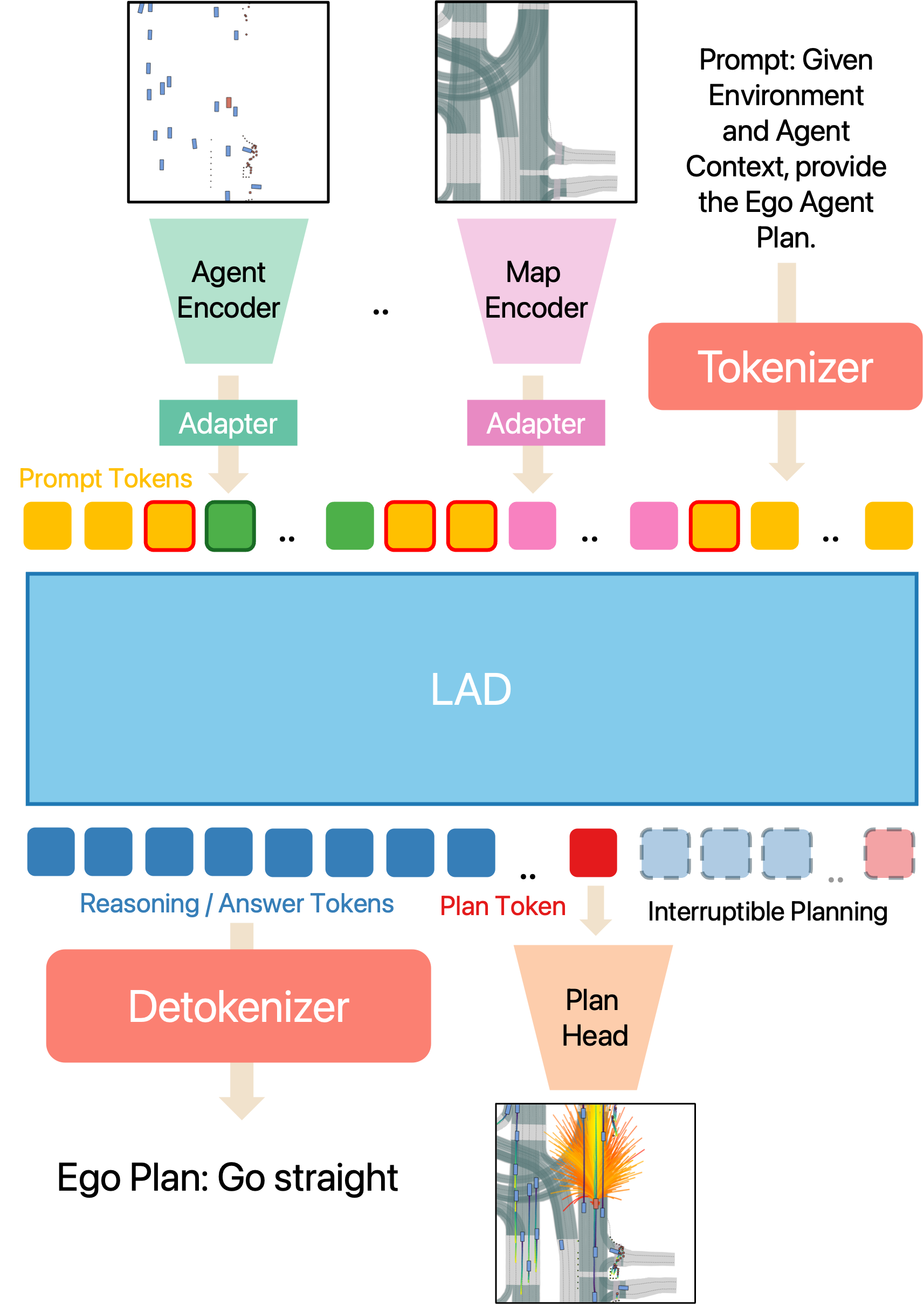
LAD architecture: We encode map and agent features, which
MLP adapters project into the LLM's token space as pseudo-tokens. A designated plan token produces
trajectory logits via classification over a discrete vocabulary, while reasoning tokens are generated
autoregressively dependent on budget — enabling interruptible, anytime inference.
Hybrid Planning
RAD-LAD: Best of Both Worlds
The hybrid planner combines strict rule-following with language-based reasoning. LAD's trajectory refinement
head
produces per-waypoint offsets for better rules alignment. The refined trajectory is added as a proposal to
RAD's
cost-based scorer, which selects the final plan from an expanded set of candidates. This enables
interpretable planning via LAD and safe planning via RAD.
Results
Performance on Long-Tailed SituationsRules and learning provide complementary capabilities: RAD alone
rivals hybrid methods, LAD sets a new learned SOTA, and their combination
improves upon both while being competitive on long-tail scenarios.
Type
Planner
Test14-Hard
InterPlan
Expert
Log Replay
85.96
—
Rule
IDM
62.26
31
Rule
PDM-Closed
75.19
42
Rule
RAD (Ours)
80.53
72
Learned
PlanTF
61.61
32
Learned
PLUTO
59.74
—
Learned
DiffusionPlanner
69.22
25
Learned
FlowPlanner
70.42
—
Learned
LAD (Ours)
70.77
40
Hybrid
PLUTO
76.88
49
Hybrid
STR2-CKS-800m
78.58
45
Hybrid
DiffusionPlanner
82.00
—
Hybrid
FlowPlanner
80.25
—
Hybrid
RAD-LAD (Ours)
81.36
74
Language supervision improves planning performanceLanguage supervision acts as an inductive
bias that improves planning. Autoregressive textual reasoning provides a complementary signal to
planning.
Component
Test14-Hard (R)
PlanTF
61.61
+ 128 Objects
59.73
+ Static Objects
68.49
+ Plan Token
68.90
+ LLM / DrivingQA
69.75
+ PlanningQA (LAD)
70.77
LAD is real-time with textual reasoningPrior work widely assumed language-based planners are too slow for
closed-loop deployment, we dispel that notion.
Model
Reasoning
Latency (ms)
Hardware
DriveVLM
Yes
410
Orin X-2
DriveGPT4-V2-8B
No
2500
—
DriveGPT4-V2-1.5B
No
345
—
DriveGPT4-V2-0.5B
No
124
—
PlanTF
No
12
A6000
DiffusionPlanner
No
50
A6000
FlowPlanner
No
83
A6000
LAD
No
43
A6000
LAD (10 tokens max)
Yes
102
A6000
LAD (40 tokens max)
Yes
222
A6000
BibTeX
@article{ghosh2025radlad,
  title     = {RAD-LAD: Rule and Language Grounded Autonomous Driving in Real-Time},
  author    = {Ghosh, Anurag and Narasimhan, Srinivasa and Chandraker, Manmohan and Pittaluga, Francesco},
  journal   = {arXiv preprint arXiv:2603.28522},
  year      = {2025}
}