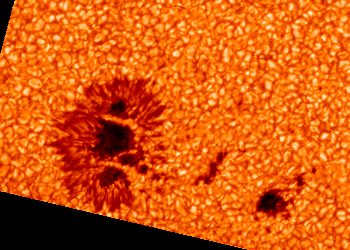
First frame of sunspot image data.
|
First frame of sunspot image data. |
The appearance of structures on the surface of the sun, such as sunspots and granulation, has been studied for many years. In this project, we attempt to gain some understanding of the nature of the flow in such coherent structures by determining a set of empirical eigenfunctions which describe the flow such that the eigenfunction representation is most compact. This involves applying the Karhunen-Loeve (KL) transform to the observed data. These eigenfunctions determine the primary modes of the evolution of the structure. |
The KL transform has been proven to be the optimal transform in terms of the information entropy in the eigenspace representation. This has several implications:
In image processing, it means that an image may be broken up such that the information content in the first N basis functions is higher, for any N, than in any other transform. This implies that for reconstruction of data compressed with a lossy transform and truncation operation, the KL transform can offer the best reconstruction of original data with the same number of retained eigenfunctions and transform coefficients than any other lossy compression algorithm, including the popular JPEG format.
For the study of coherent structures in turbulent flows, it means that the structure may be decomposed into modes such that the energy contained in the highest N modes is larger, for any N, than under any other linear transformation, including of course the Fourier Transform. This means that rather than using an arbitrary basis for studying coherent structures, the primary empirical modes may be decoupled and studied as they exist.
|
|
|

|
The sunspot image data comes from the Swedish Solar Observatory on the island of La Palma, Spain. The observatory made a set of observations in the visible range of a sunspot on the solar surface. One image was taken every 20 seconds for a total of 11 hours. Our analysis was done with 200 frames covering about 1 hour.
The images were masked to eliminate the area surrounding the sunspot and the mask was oriented in each frame to remove translations in the sunspot. The KL procedure resulted in eigenfunctions which show that most of the energy lies within large structures in the outer regions of the sunspot with less energetic, higher frequency modes present.
A presentation of the problem, the Karhunen-Loeve method, and the results was made on August 6th, 1996. A short paper was also written.
Eigenfunction Analysis of Coherent Structures on the Solar Surface
Authoring NASA Official:Dr. Milton Halem, Chief, Earth
and Space Data Computing Division
Contact:Marilyn Mack/Code 930
marilyn.j.mack.1@gsfc.nasa.gov