Evaluation of Queue Management Algorithms
¾ Course
Project Report for 15-744 Computer Networks
Ningning Hu (hnn@cs.cmu.edu)
Liu Ren (liuren@cs.cmu.edu)
Jichuan Chang (cjc@cs.cmu.edu)
Abstract
In this report, we evaluate
several queue management algorithms with respect to their abilities of
maintaining high resource utilization, identifying and restricting
disproportionate bandwidth usage, and their deployment complexity. We compare
the performance of FRED, BLUE, SFB, and CHOKe based on simulation results,
using RED and Drop Tail as the evaluation baseline. The characteristics of
different algorithms are also discussed and compared.
1. Introduction
The robustness of today’s Internet depends heavily on the TCP
congestion control mechanism. However, as more and more UDP applications (e.g.
packet audio/video applications) are deployed on the Internet, people cannot
rely on end users to incorporate proper congestion control. Router mechanisms
must be provided to protect responsive flows from non-responsive ones, and
prevent “Internet meltdown”. Several methods have been proposed for the
management of shared resources on the Internet, active queue management is one
of the major approaches.
Traffic on the Internet tends to fluctuate
and to be greedy. Ideally, a router queue management algorithm should allow
temporary bursty traffic, and penalize flows that persistently overuse
bandwidth. Also, the algorithm should prevent high delay by restricting the
queue length, avoid underutilization by allowing temporary queueing, and
allocate resource fairly among different types of traffic [1]. In practice,
most of the routers being deployed use simplistic Drop Tail algorithm, which is
simple to implement with minimal computation overhead, but provides
unsatisfactory performance.
To
attack this problem, many queue management algorithms are proposed, such as
Random Early Drop (RED) [3], Flow Random Early Drop (FRED) [4], BLUE [5],
Stochastic Fair BLUE (SFB) [5], and CHOKe (CHOose and Keep for responsive
flows, CHOose and Kill for unresponsive flows) [7]. Most of the algorithms
claim that they can provide fair sharing among different flows without imposing
too much deployment complexity. Most of the proposals focus on only one aspect
of the problem (whether it is fairness, deployment complexity, or computational
overhead), or fix the imperfections of previous algorithms, and their
simulations setting are different from each other. These all make it difficult
to evaluate, and to choose one to use under certain traffic load.
This project aims at a thorough evaluation
among these algorithms and illustrations of their characteristics by
simulation. We compare the performance of FRED, BLUE, SFB, and CHOKe, using RED
and Drop Tail as the evaluation baseline. For each of these algorithms, three
aspects are discussed: (1) resource utilization (whether the link bandwidth is
fully utilized), (2) fairness among different traffic flows (whether different
flows get their fair share), and (3) implementation and deployment complexity
(whether the algorithm requires too much space and computation resources).
This report is organized as follows. In
section 2, we introduce the queue management algorithms to be evaluated and how
to configure their key parameters. Section 3 presents our simulation design,
parameter settings, simulation result, and comparison. Section 4 discusses the
key features of different algorithms, and their impact on performance. Section
5 summaries our conclusion.
2. Queue Management Algorithms
2.1 RED (Random Early Drop)
RED [3] was designed with the objectives to (1) minimize packet loss and queuing delay, (2) avoid global synchronization of sources, (3) maintain high link utilization, and (4) remove biases against bursty sources. The basic idea behind RED queue management is to detect incipient congestion early and to convey congestion notification to the end-hosts, allowing them to reduce their transmission rates before queues in the network overflow and packets are dropped.
To do this, RED maintain an exponentially-weighted
moving average (EWMA) of the queue length which it uses to detect congestion.
When the average queue length exceeds a minimum threshold (minth),
packets are randomly dropped or marked with an explicit congestion notification
(ECN) bit [2]. When the average queue
length exceeds a maximum threshold (maxth), all packets are
dropped or marked.
While RED is
certainly an improvement over traditional droptail queues, it has several shortcomings.
One of the fundamental problems with RED is that they rely on queue length as an
estimator of congestion. While the presence of a persistent queue indicates
congestion, its length gives very little information as to the severity of
congestion. That is, the number of competing connections sharing the link. In a
busy period, a single source transmitting at a rate greater than the bottleneck
link capacity can cause a queue to build up just as easily as a large number of
sources can. Since the RED algorithm relies on queue lengths, it has an
inherent problem in determining the severity of congestion. As a result, RED requires
a wide range of parameters to operate correctly under different congestion
scenarios. While RED can achieve an ideal operating point, it can
only do so when it has a sufficient amount of buffer space and is correctly
parameterized.
RED represents a class of
queue management mechanisms that does not keep the state of each flow. That is,
they put the data from the all the flows into one queue, and focus on their
overall performance. It is that which originate the problems caused by
non-responsive flows. To deal with that, a few congestion control algorithms
have tried to separate different kind of data flows, for example Fair Queue
[6], Weighted Fair Queue [6], etc. But their per-flow-scheduling philosophy is
different with that of RED, which we will not discuss here.
2.2 FRED (Flow Random Early Drop)
Flow Random Early Drop (FRED) [4] is a modified version of RED, which
uses per-active-flow accounting to make different dropping decisions for
connections with different bandwidth usages. FRED only keeps track of flows
that have packets in the buffer, thus the cost of FRED is proportional to the
buffer size and independent of the total flow numbers (including the
short-lived and idle flows). FRED can achieve the benefits of per-flow queuing
and round-robin scheduling with substantially less complexity.
Some other interesting features of FRED include: (1) penalizing non-adaptive flows by imposing a maximum number of buffered packets, and surpassing their share to average per-flow buffer usage; (2) protecting fragile flows by deterministically accepting flows from low bandwidth connections; (3) providing fair sharing for large numbers of flows by using “two-packet-buffer” when buffer is used up; (4) fixing several imperfections of RED by calculate average queue length at both packet arrival and departure (which also causes more overhead).
Two parameters are introduced into FRED: minq
and maxq, which are minimum and maximum numbers of
packets that each flow is allow to buffer. In order to track the average
per-active-flow buffer usage, FRED uses a global variable avgcq to
estimate it. It maintains the number of active flows, and for each of them,
FRED maintains a count of buffer packets, qlen, and a count of times
when the flow is not responsive (qlen > maxq). FRED
will penalize flows with high strike values. FRED processes arriving packets using the following algorithm:

Figure 1. FRED processing arriving packet
2.3 BLUE
BLUE
is an active queue management algorithm to manage congestion control by packet
loss and link utilization history instead of queue occupancy. BLUE maintains a single
probability, Pm, to mark (or drop) packets.
If the queue is continually dropping packets due to buffer overflow, BLUE increases Pm,
thus increasing the rate at which it sends back congestion notification or
dropping packets. Conversely, if the queue becomes empty or if the link is
idle, BLUE decreases its marking
probability. This effectively allows BLUE to “learn” the correct rate it needs to send back congestion
notification or dropping packets.
The typical parameters of BLUE are d1, d2,
and freeze_time. d1determines the amount by which Pm is
increased when the queue overflows, while d2 determines the amount by
which Pm is decreased when the link is idle. freeze_time is an
important parameter that determines the minimum time interval between two
successive updates of Pm. This allows the changes in the marking
probability to take effect before the value is updated again. Based on those
parameters. The basic blue algorithms can be summarized as following:
|
Upon
link idle event: if
((now-last_update)>freeze_time) Pm = Pm-d2; Last_update
= now; |
Upon
packet loss event: if
((now–last_updatte)>freeze_time) Pm = Pm+d1; last_update
= now; |
2.4 SFB
Based on BLUE, Stochastic Fair Blue (SFB) is a novel technique for protecting TCP flows against non-responsive flows. SFB is a FIFO queuing algorithm that
identifies and rate-limits non-responsive flows based on accounting mechanisms
similar to those used with BLUE. SFB maintains accounting bins. The bins are organized in L
levels with N bins in each level. In addition, SFB maintains L independent hash functions, each
associated with one level of the accounting bins. Each hash function maps a
flow into one of the accounting bins in that level. The accounting bins are
used to keep track of queue occupancy statistics of packets belonging to a particular
bin. As a packet arrives at the queue, it is hashed into one of the N bins in each of the L levels. If the
number of packets mapped to a bin goes above a certain threshold (i.e., the
size of the bin), the packet dropping probability Pm
for that bin is increased. If the number of packets in that bin drops to zero, Pm
is decreased. The observation is that a non-responsive flow quickly drives Pm to 1 in all of the L bins it is
hashed into. Responsive flows may share one or two bins with non-responsive flows,
however, unless the number of non-responsive flows is extremely large compared
to the number of bins, a responsive flow is likely to be hashed into at least
one bin that is not polluted with non-responsive flows and thus has a normal
value. The decision to mark a packet is based on Pmin the
minimum Pm value of all bins to which the flow is mapped into. If
Pmin is 1, the packet is identified as belonging to a
non-responsive flow and is then rate-limited.
|
B[l][n]: L ´ N
array of bins(L levels, N bins per level) Enque() Calculate hash function values
h0,h1,…,hL-1; Update bins at each level For i =0 to L-1
If(B[i][hi].QLen> bin_size) B[i][hi].Pm
+= delta; Drop packet; Else if (B[i][hi].Qlen ==0) B[i][hi].Pm - = delta; Pmin = min(B[0][h0].Pm…B[L][hL].Pm); If(Pmin==1) Ratelimit(); Else Mark/drop
with probability Pmin; |
The typical parameters of SFB algorithm are QLen,
Bin_Size, d1, d2, freeze_time, N, L, Boxtime,
Hinterval. Bin_Size is the buffer space of each bin. Qlen is
the actual queue length of each bin. For each bin, d1, d2 and freeze_time
have the same meaning as that in BLUE. Besides, N and L are
related to the size of the accounting bins, for the bins are organized in L levels
with N bins in each level. Boxtime is used by penalty box of SFB
as a time interval used to control how much bandwidth those non-responsive
flows could take from bottleneck links. Hinterval is the time interval
used to change hashing functions in our implementation for the double buffered
moving hashing. Based on those parameters, the basic SFB queue management
algorithm is shown in the above table.
2.5 CHOKe
As
a queue management algorithm, CHOKe [7] differentially penalizes non-responsive
and unfriendly flows using queue buffer occupancy information of each flow.
CHOKe calculates the average occupancy of the FIFO buffer using an exponential
moving average, just as RED does. It also marks two thresholds on the buffer, a
minimum threshold minth and a maximum threshold maxth. If the
average queue size is less than minth, every arriving packet
is queued into the FIFO buffer. If the aggregated arrival rate is smaller than
the output link capacity, the average queue size should not build up to minth
very often and packets are not dropped frequently. If the average queue size is
greater than maxth, every arriving packet is
dropped. This moves the queue occupancy back to below maxth.
When the average queue size is bigger than minth, each
arriving packet is compared with a randomly selected packet, called drop
candidate packet, from the FIFO buffer. If they have the same flow ID, they
are both dropped. Otherwise, the randomly chosen packet is kept in the buffer
(in the same position as before) and the arriving packet is dropped with a
probability that depends on the average queue size. The drop probability is
computed exactly as in RED. In particular, this means that packets are dropped
with probability 1 if they arrive when the average queue size exceeds maxth. A flow chart of the algorithm is given in
Figure 2. In order to bring the queue occupancy back to below maxth
as fast as possible, we still compare and drop packets from the queue
when the queue size is above the maxth. CHOKe has three
variants:
A.
Basice CHOKe (CHOKe): It behaves exactly as described in the above, that
is, choose one packet each time to compare with the incoming packet.
B.
Multi-drop CHOKe (M-CHOKe): In M-CHOKe, m packets are chosen from the buffer to compare with
the incoming packet, and drop the packets that have the same flow ID as the
incoming packet. Easy to understand that choosing more than one candidate
packet improves CHOKe’s performance. This is especially true when there are
multiple non-responsive flows; indeed, as the number of non-responsive flows increases, it
is necessary to choose more drop candidate packets. Basic CHOKe is a special
case of M-CHOKe with m=1.
C.
Adaptive CHOKe (A-CHOKe): A more sophisticated way to do M-CHOKe is to let
algorithm automatically choose the proper number of packets chosen from buffer.
In A-CHOKe, it is to partition the interval between minth and
maxth into k regions, R1, R2,
…, Rk. When the average buffer occupancy is in Ri,
m is automatically set as 2i (i = 1, 2, …, k).

3. Simulation and Comparison
In this section, we will compare the
performances of FRED, BLUE, SFB and CHOKe. We use RED and Drop Tail as the
evaluation baseline. Our simulation is based on ns-2 [8]. Both RED and FRED
have implementation for ns-2. BLUE and SFB are originally implemented in a
previous version of ns, ns-1.1, and are re-implemented in ns-2. Based on the
CHOKe paper [7], we implemented CHOKe in ns-2. In our simulation, ECN support
is disabled, and “marking a packet” means “dropping a packet”.
3.1 Simulation Settings
As
different algorithms have different preferences or assumptions for the network
configuration and traffic pattern, one of the challenges in designing our
simulation is to select a typical set of network topology and parameters (link
bandwidth, RTT, and gateway buffer size), as well as load parameters (numbers
of TCP and UDP flow, packet size, TCP window size, traffic patterns) as the
basis for evaluation. Currently we haven’t found systematic way or guidance
information to design the simulation. So we make the decision by reading all
related papers and extracting and combining the key characteristics from their
simulations.

Figure 3. Simulation topology
The network topology we used is a classic dumb-bell
configuration as shown in Figure 3. This is a typical scenario that different
types of traffic share a bottleneck router. TCP (FTP application in particular)
and UDP flows (CBR application in particular) are chosen as typical traffic
patterns.
In our simulation, we use 10 TCP flows
and 1 UDP flow. The bottleneck link in this scenario is the link between two
gateways. We set TCP window size as 50 packets, and the router queue buffer
size in the simulation as 150 packets (the packets size for both TCP and UDP
are 1000 bytes). For RED, we also need to choose values for minth and
maxth, which are typically set as 20% and 80% queue buffer
size. In the following, we set them as 50 and 100 packets.
3.2 Metrics
Throughput and queue size are the two major
metrics in our simulations. The throughput of each flow is used to illustrate
the fairness among different flows, and the total throughput can be compared
with the bottleneck bandwidth as an indicator of resource utilization. Queue
size is a direct indicator of router resource utilization. The average queue
size of each flow illustrates the fairness of router resource allocation, which
also shows the different characteristics of different algorithms. We calculate
the average queue size using exponentially weighted average (EWMA), and the
aging weight is set to 0.002.
3.3 Algorithm Parameters
How
to configure different algorithms for the simulation is also an issue. First,
we want to show the best performance of each algorithm under the same network
topology and traffic load. For the best performance, we need to fine-tune these
algorithms for the fixed setting (as described above) to achieve the fairest
sharing with a high utilization value. The result will be presented in Section
3.4 to show their “best-effort” performance.
On the other hand, an ideal algorithm should always
achieve the best performance under all possible settings without human
intervention. The different parameters set of these algorithms will impact
their performance in different ways. We will discuss the impact of
algorithm-specific parameters and the easiness of algorithm configuration in
Section 4.
3.3.1 FRED
It’s easy to set the parameters of FRED compared with RED. For the
parameters coming from RED, FRED uses a simple formula to calculate minth
and maxth, and assigns fixed values to wq (0.002)
and maxq (0.02). The only parameter new to FRED is minq,
whose value depends on the router buffer size. It’s usually set to 2 or 4
because a TCP source sends no more than 3 packets back-to-back: two because of
deployed ACK, and one more due to congestion window increase. We chose to set
it to 2 (which is also the built-in setting of the FRED implementation in ns-2)
after some experimentation. For most cases it turned out a FRED is not
sensitive to minq.
3.3.2 BLUE
In
our simulation, the default values of BLUE static parameters are: d1 = 0.02, d2 = 0.002, freeze_time = 0.01s.
d1 is set significantly larger than d2. This is because link
underutilization can occur when congestion management is either too conservative
or too aggressive, but packet loss occurs only when congestion management is
too conservative. By weighting heavily against packet loss, BLUE can quickly
react to a substantial increase in traffic load. A rule of thrum is: d2
= d1/10.
3.3.3 SFB
The
default parameter values for SFB are: d1 = 0.005, d2 = 0.001, freeze_time =
0.001s, N=23, L=2, Boxtime = 0.05s, Hinterval = 5. Bin_Size is set
as (1.5/N) of the total buffer
size of the bottleneck link. N and L are related to number of
flows in the router. If the number of non-responsive flows is large while N and
L are small, the TCP flows are easily misclassified as non-responsive
flows [5]. Further more, since Boxtime indirectly determines the total
bandwidth that those non-responsive flows could take in the bottleneck link, it
is fine-tuned according to different policies to treat those non-responsive
flows. So in SFB, ideal parameters for one case might not necessarily good for
other cases.
3.3.4 CHOKe
Except the parameters from RED (minth, maxth,
etc), our implementation maintains three parameters specific for CHOKe:
- adaptive_: control whether or not
A-CHOKe should be applied, set adaptive_ = 1 will enable A-CHOKe;
- cand_num_: effective when adaptive_ is not set, when cand_num_ = 1, it is basic CHOKe, otherwise, it is M-CHOKe,
and cand_num_ is the number of
packets to be selected from the queue;
- interval_num_: effective when adaptive_ is set, and this
parameters determines the number of intervals to be derided.
With our experience on running CHOKe, A-CHOKe has
the best performance. So in the following simulation, we choose adaptive_ = 1 and interval_num_ = 5.
3.4 Comparison
Figure 4 and Figure 5 show the major result of the simulation. The total throughput values of all TCP and UDP flows are not shown here. For all the simulations, the total throughputs are reasonably high (about 90-96% of available bandwidth), indicating that all these algorithms provide high link utilization.
Figure 4-1 shows the UDP throughput and queue length under simulations using 10 TCP flows, 1 UDP flow, when UDP sending rate changes from 0.1Mbps to 8Mbps[1]. According to this diagram, Drop Tail is the worst in terms of unfairness, which provides no protection for adaptive flows and yields the highest UDP throughput. RED and BLUE do not work well under high UDP sending rate. When UDP sending rate is above the bottle link bandwidth, UDP flow quickly dominates the transmission on the bottleneck link, and TCP flows could only share the remaining bandwidth. On the other hand, FRED, SFB and CHOKe properly penalize UDP flow, and TCP could achieve their fair share.
One interesting point in Figure 4-1 is the behavior of CHOKe. UDP throughput decreases with the increase of UDP rate from 2Mbps to 8Mbps. This is because, with the increase of UDP rate, the total number of packets selected to compare increases, which will increase the dropping probability for UDP packets, and decrease UDP flow throughput as a result.
Figure 4-2 illustrates the size of queue buffer occupied by UDP flow. It seems that buffer usage is a good indicator of link bandwidth utilization. Similar to Figure 4-1, Drop Tail is the worst in fairness. Although RED and BLUE are similar in permissive to non-responsive flows, BLUE uses much less buffer. FRED and SFB are also the fairest.

Figure 4-1. UDP flow throughput
|
|
|
Figure 4-2. UDP flow queue
size |
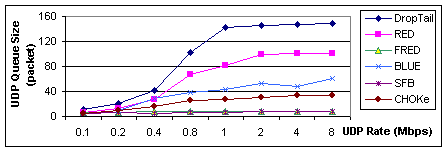
Figure 5 illustrates the average queue size for UDP and TCP flows as well as the average total buffer usage. The difference of algorithms is clearly captured in the buffer usage plots. We can see, for Drop Tail, RED and BLUE, most of the packets in the queue are UDP flow packets, while only a small percentage belongs to TCP flows. FRED, SFB and CHOKe effectively penalize UDP flow and allow TCP flows to achieve a higher throughput.
It is also interesting to notice the difference among the total queue sizes. Since Drop Tail only drops packets when the queue buffer is full, at most time, its total queue size is the maximum queue buffer size. For RED, although it begins to provide congestion notification when the queue size reaches minth, it only affects TCP flows, while UDP flow will keep the same sending rate, which drives the total queue size to maxth quickly, after which all the incoming packets will be dropped and the total queue size will be kept at maxth. In CHOKe, however, the random packet selection mechanism effectively penalizes UDP flow after the average queue size reaches minth. What’s more, UDP dropping rate is proportional to its incoming rate, which will effectively keep the total queue size around minth, as illustrated in Figure 5f. FRED, BLUE and SFB are not directly affected by minth and maxth settings, so their total queue sizes have no obviously relation with these two parameters in Figure 5.
In some of the figures in Figure 5 where TCP flow queue size is very small, UDP flow queue size is the same as that of the total queue size, but the corresponding queue size for TCP flows are not zero, which seems to be a contradiction. The reason is that we draw these figures using the EWMA value of the queue size. Although we calculate the queue size every time we get a new packet, only EWMA value (weight = 0.002) is plotted[2]. It is EWMA that eliminates the difference between UDP flow queue size and total queue size when TCP flow queue size is very small.
|
|
|
|
|
(a) Drop Tail |
(b) RED |
(c) FRED |
|
|
|
|
|
(d) BLUE |
(e) SFB
|
(f) CHOKe. |
|
Figure 5. Queue size in different algorithms
(Notice that the total queue sizes of different algorithms are different) |
||


4. Algorithm Characteristics
4.1 FRED
FRED algorithm focuses on the management of per-flow
queue length. The parameter qlen is compared with minq and
maxq, and used as a traffic classifier. Fragile flows are
those whose qlen <= minq, robust flows are
those whose minq<qlen<maxq; and non-responsive flows
are those whose qlen was once larger than maxq. The minq
is set to 2 or 4, but can adapt to average queue length when there are only
few robust flows (for example, in a LAN environment with small RTT and large
buffer size).
FRED is very robust in identifying different kind of traffic, and protecting adaptive flows. Figure 5c shows the queue length of 1 UDP flow and the sum of 10 TCP flows. The UDP queue length was effectively limited within 10 packets, which is approximately the average queue length. The single UDP flow is isolated and panelized, without harming the adaptive TCP flows.
|
|
|
Figure 6. Impact of buffer
size to FRED fairness |

Figure 6 shows the impact of buffer size to
FRED algorithm (without “two-packet-mode”). It is clear that FRED works well
only when the buffer size is larger (larger than 45 packets in this case)
enough to hold minq packets for each active flow. When the
average queue length is larger than maxth, FRED degrades into
Drop Tail, and can’t preserve fairness. This problem is discussed in [4] and
can be partly solved by using “many flow support.”
The fairness of FRED is
also illustrated in Table 1. The shares of UDP flows and TCP flows do not
change very much as the bottleneck bandwidth increases from 0.5 Mbps to 8 Mbps.
After the bandwidth of backbone link is large enough, the UDP flow gets its
full share, and TCP flows begin to compete with each other.
|
Bottleneck
BW (Mpbs) |
0.5 |
1 |
2 |
4 |
8 |
10 |
20 |
|
TCP_Thpt
(Mbps) |
0.42 |
0.80 |
1.61 |
3.14 |
5.73 |
7.41 |
13.94 |
|
UDP_Thpt
(Mbps) |
0.06 |
0.15 |
0.29 |
0.66 |
1.82 |
1.85 |
1.86 |
|
TCP Share
(%) |
83% |
80% |
81% |
78% |
72% |
74% |
70% |
|
UDP Share
(%) |
12% |
15% |
14% |
17% |
23% |
19% |
9% |
|
TCP Share
: UDP Share |
6.92 |
5.33 |
5.79 |
4.59 |
3.13 |
3.89 |
7.78 |
Table 1. Impact of bottleneck bandwidth to FRED link
utilization
The FRED algorithm has an O(N) space
requirement (N = buffer size), which was one of the major advantages
compared with per-flow queueing mechanisms (e.g. Fair Queueing). But with today’s memory price, it turned out space requirement is
not an important factor. The computational resources required for each packet
is more significant. For each arriving packet, FRED need to classify the packet
into a flow, update flow information, and calculate average queue length (also
done when a packet is departing), and deciding whether to accept or drop the
packet. Although optimizations can be employed to simplify the per-flow
operation, it’s not clear whether it can be cost-effectively implemented in
backbone routers. The implementation issue is not unique to per-flow
algorithms, but also applies to algorithms like RED.
In
summary, FRED achieves the fairness and high link utilization by share the
buffer size among active flows. It is also easy to configure, and adapt itself
to preserve performance under different network environments (different
bandwidth, buffer size, flow number) and traffic patterns (non-adaptive flows,
robust adaptive flows, and fragile flows).
4.2 BLUE
The most important consequence of using BLUE is that
congestion control can be performed with a minimal amount of buffer size. Other
algorithms like RED need a large buffer size to attain the same goal [5].
Figure 7 shows the average and actual queue length of the bottleneck link in
our simulation based on the following settings: 49 TCP flows with TCP window
size 300(KB), a bottleneck link queue size 300(KB). As we can see from Figure
7, in this case the actual queue length in the bottleneck is always kept quite
small (about 100KB), while the actual capacity is as large as 300KB. So only
about 1/3 buffer space is used to achieve 0.93 Mbps bandwidth by TCP flows. The
other 2/3 buffer space allows room for a burst of packets, removing biases
against bursty sources.
|
|
|
|
Figure 7. BLUE queue
length for TCP flows |
Figure 8. BLUE queue
length for TCP and UDP flows |


However, things get worse
when non-responsive flows appear. Figure 8 show the actual and average queue
length of the bottleneck link in our simulation when a 40Mbps UDP flow joins
those 49 TCP flows. In this case, the total throughput (TCP and UDP) achieved
is 0.94 Mbps, among which 0.01Mbps bandwidth is taken by 49 TCP flows while the
UDP flow’s throughput is as high as 0.93Mbps. The slow fluctuation of the
bottleneck queue length shown in Figure 8
is reasonable. At t = 40 second, the buffer of the bottleneck
link is overflowed, so Pm increases to 1 quickly. Thus all the incoming
packets will be dropped and in the meanwhile packets in the queue are dequeued.
Since Pm does not change until the link is idle, the queue length
shrinks to zero gradually. The queue length at t=48s is 0. After that, the Pm
is decreased by BLUE. Then incoming packets could get a chance to enter queue,
and the actual queue length will gradually increase from zero accordingly.
4.3 SFB
(1) Basic SFB characteristics:
|
|
|
|
Figure 9. SFB queue length
for TCP flows |
Figure 10. SFB queue
length for TCP and UDP flows |


Although SFB is able to
accurately identify and rate-limit a single non-responsive flow without
impacting the performance of any of the individual TCP flows, as the number of non-responsive flows
increases, the number of bins which become “polluted” or have Pm values of 1 increases. Consequently, the probability
that a responsive flow becomes misclassified increases. To
overcame this problem, the moving hash functions was implemented, i.e. by
changing the hash function, responsive TCP flows that happen to map into
polluted bins will potentially be remapped into at least one unpolluted bin.
However, in this case, non-responsive flows can temporarily consume more
bandwidth than their fair share. To remedy this, two set of hash functions are
used to remedy this [5]. As one set of bins is being used for queue management,
a second set of bins using the next set of hash functions can be warmed up. In
this case, any time a flow is classified as non-responsive, it is hashed using
the second set of hash functions and the marking probabilities of the
corresponding bins in the warmup set are updated. When the hash functions are
switched, the bins which have been warmed up are then used. Consequently,
non-responsive flows are rate-limited right from the beginning. Figure 9 and 10
show the typical performance of SFB with TCP and UDP flows. The two simulation
settings are the same as that in BLUE except the buffer size of bottleneck link
is set as small as 150KB. Figure 9 shows the TCP flow queue length of the
bottleneck link when there is no UDP flow. In this case, the 49 TCP flows’ throughput
is 0.94Mbps. While Figure 10 shows the case when a 40Mbps UDP flow joins. In
this case, the UDP flow’s throughput is only 0.026 Mbps while the 49 TCP flows’
throughput is still quite large which consumes 0.925Mbps bandwidth of the
bottleneck link. The UDP queue length is kept very small (about 4-5KB) all the
time. So we could see that due to effect of SFB’s double buffered moving hash,
those non-responsive flows are effectively detected and rate-limited by SFB.
|
|
|
|
(a) Large Boxtime |
(b) Small Boxtime |
|
Figure 11. Impact of Boxtime on average queue sizes of TCP and UDP flows |
|
|
|
|
|
(a) Unfairness of UDP flows when rate-limited |
(b) Fairness of UDP flows when rate-limited |
|
Figure 12. Throughput of flows |
|


(2) Improving the fairness of UDP flows:
In SFB, all the non-responsive flows are treated as a whole. How much bandwidth those non-responsive flows could take depends mainly on the parameter Boxtime. The Boxtime is the time interval in which no packets from non-responsive flows can enter the queue. When a packet from a UDP flow comes, if it is detected as a packet from a non-responsive flow, SFB will compare the current time with the most recent time when a packet from any non-responsive flows enqueued. If the time interval of these two events is greater than the Boxtime, the packet will be enqeued. Otherwise, it will be dropped. If it is enqueued, the current time is recorded for the next compare. By this way, Boxtime indirectly controls how much bandwidth those non-responsive flows could take. Figure 11 (a) and Figure 11 (b) illustrate the impact of Boxtime on the average queue size of TCP and UDP flows. In these simulations, the parameter setting is the same as the simulations illustrated by Figure 9 and Figure 10 except the value for Boxtime. The average queue sizes of TCP and UDP flows with a large Boxtime (0.5s) are illustrated in Figure 11 (a). Since large Boxtime means that non-responsive flows can only achieve a low throughput, the average queue length of those UDP flows is very small in Figure 11(a). In this case, the UDP flow’s throughput is 0.013 Mbps, while the throughput of TCP flows is as large as 0.926Mbps. On the contrary, if the value of Boxtime is set small, the average queue length of those UDP flows is quite large as illustrated in Figure 11(b) when Boxtime is equal to 0.02 seconds. It is reasonable for the small value of Boxtime leads to a high throughput for those Non-responsive flows. In this case, the throughput of UDP flow is 0.27Mbps while the throughput of those TCP flows is 0.66Mbps.Since Boxtime is a static parameter which can only be set manually and is hard to configure automatically, the suitable value of Boxtime in one case might not apply to other cases. This is the main drawback of SFB.
Even worse, this rate-limited scheme can’t guarantee fairness among UDP flows all the time. Figure 12(a) illustrates this case, where 5 UDP flows with sending rate 4Mbps and 10 TCP flows compete the 1Mbps bottleneck link in our standard scenario. One UDP flow (flow id 0) consumes more bandwidth than other UDP flows (flow id 1-4), although the fairness among TCP flows (flow id 5-14) is obvious. To enhance the fairness among UDP flows, the method we proposed is to make Boxtime a bit randomized. Figure 12(b) shows the throughput of TCP flows and UDP flows after Boxtime is randomized. The fairness among the UDP flows is improved. However, this method only improves the fairness of none-responsive flows when they are rate-limited to a fixed amount of bandwidth across the bottleneck. Sometimes, it is reasonable to rate-limit non-responsive flows to a fair share of the link’s capacity. As suggested by [5], this could be acheived by estimating both the number of non-responsive flows and the total number of flows going through the bottleneck link.
4.4 CHOKe
(1) Basic CHOKe characteristics:
Here we want to manifest the effect of CHOKe specific parameters. Our simulation setting is the same as that in section 3. That is, we use 10 TCP flows, 1 UDP flow, queue buffer size = 150 packets, minth = 50, maxth = 100. Figure 13 and Figure 14 illustrate the performance of M-CHOKe and A-CHOKe with different parameters setting (cand_num_ and interval_num_). From these two figures we can see increased cand_num_/interval_num_ will effectively increase the penalization for UDP flows. This effect is most distinct when their values are small (for example, when cand_num_ changes from 1 to 2, interval_num_ changes from 1 to 5).
|
|
|
|
Figure 13. Effect of cand_num_ in M-CHOKe. |
Figure 14. Effect of interval_num_ in A-CHOKe |


(2) Fairness of CHOKe
This simulation is to illustrate the fairness of CHOKe in managing different types of flows, comparing with RED. Simulation setting is the same as section 3. Here, we use A-CHOKe with interval_num_ = 5. From Figure 15 we could see, when UDP rate is under the bottle link bandwidth, the performances of CHOKe and RED are very similar. When UDP rate superceeds the bottle link bandwidth, CHOKe could effectively penalize the UDP flow to keep the total queue size around minth, and enable TCP flows to get high throughput (data not shown). Although RED keeps the queue size below maxth most of the time, UDP rate is so high that most of queue buffer is occupied by UDP flow, which makes TCP flows throughput very low, which is the result of that RED does not distinguish different types of flows. Figure 15 tells that CHOKe could achieve much better fairness than RED.
|
|
|
Figure 15. TCP/UDP queue
size in RED and CHOKe |

(3) Effect of different number TCP and UDP flows
CHOKe can adapt to the change of the number of TCP and UDP flows. The simulation setting is the same as above, except that we change the number of TCP (m) and UDP (n) flows, with (m, n) = (1, 1), (10, 1) and (10, 5). From Figure 16a, we can see the more TCP flows, the more penalty UDP flow(s) get. It is because, with the increase of number of TCP flows, it will be less probable for the selected packet to match with the incoming TCP packet, that is, dropping of TCP packets by CHOKe decreases, correspondingly increase the throughput of TCP flows. This result could also be confirmed by the queue buffer occupation analysis (Figure 16b).
Increasing the number of UDP flows has similar effect as increasing the number of TCP flows. With more UDP flows, the percentage of UDP packets in the incoming packets will increase, which will decrease the probability to drop TCP packets. Another result is that UDP throughput decreases with increasing of UDP rate, which has been discussed in section 3.4.
On the other hand, RED will not differentiate UDP flow and TCP flow. Consequently, the throughputs have no distinct difference with the change of the number of TCP flows and UDP flows (Figure 16c, 16d).
|
|
|
|
(a) Throughput by CHOKe |
(b) Queue size by CHOKe |
|
|
|
|
(c) Throughput by RED |
(d) Queue size by RED |
|
Figure 16. Interaction of different number of TCP
flows and UDP flows |
|


(4) RED related parameters
We have done some simulations trying to illustrate
the effect of RED related parameters on the performance of CHOKe. We find the
results comply with the characteristics illustrated by the above data, which is
quite predictable. For example, the throughput and queue size occupied by CHOKe
changes proportionally with the setting of minth and
maxth. And the effect of other parameters could also be
explained by the analysis in [3].
5. Conclusion
This report compared several queue management algorithms (RED, FRED, BLUE, SFB, CHOKe) based on simulation results. We have presented our simulation setting, comparison result and algorithm characteristics. It’s still hard to conclude which algorithm is better in all aspects than another, especially considering the deployment complexity. But the major trends are: (1) all these algorithms provide high link utilization, (2) RED and BLUE don’t identify and penalize non-responsive flow, while the other three algorithms maintains fair sharing among different traffic flows, (3) the fairness is achieved using different methods, FRED record per-active-flow information, SFB statistically multiplex buffers to bins, but needs to be reconfigured with large number of non-responsive flows, CHOKe correlates dropping rate with corresponding flow’s incoming rate, and is able to penalize large number of non-responsive flows adaptively, (4) all of the algorithms has computation overhead per incoming packet, their space requirements are different.
The
following table summaries our evaluation results:
|
Algorithm |
Link Utilization |
Fairness |
Space Requirement |
Per-flow State Information |
Configuration Complexity |
|
RED |
Good |
Unfair |
Large |
No |
Hard |
|
FRED |
Good |
Fair |
Small |
Yes |
Easy (Adaptive) |
|
BLUE |
Good |
Unfair |
Small |
No |
Easy |
|
SFB |
Good |
Fair |
Large |
No |
Hard |
|
CHOKe |
Good |
Fair |
Small |
No |
Easy (Adaptive) |
Reference
1.
Jain,
R., and Ramakrishnan, K.K., Congestion Avoidance in Computer Networks with a
Congestionless Network Layer: Concepts, Goals, and Methodology, Proc. IEEE
Comp. Networking Symp., Washington, D.C., April 1988, pp.134-143.
2.
Floyd,
S., TCP and Explicit Congestion Notification. ACM Computer Communication
Review, V. 24 N. 5, October 1994, pp. 10-23.
3.
Floyd,
S., and Jacobson, V., Random Early Detection gateways for Congestion
Avoidance V.1 N.4, August 1993, pp. 397-413.
4.
D.
Lin and R. Morris. Dynamics of Random Early Detection. In Proceedings of
ACM SIGCOMM’ 97, pp. 127-137, Cannes, France, October 1997.
5.
W.
Feng, D. Kandlur, D. Saha, K. Shin, Blue: A New Class of Active Queue
Management Algorithms U. Michigan CSE-TR-387-99, April 1999.
6.
A.
Demers, S. Keshav, and S. Shenker. Analysis and Simulation of a Fair
Queueing Algorithm, In Journal of Internetworking: Research and Experience,
1, pp. 3-26, 1990.
7.
Rong
Pan, Balaji Prabhakar, Konstantinos Psounis. CHOKE, A Stateless Active Queue
Management Scheme for Approximating Fair Bandwidth Allocation. IEEE
INFOCOM 2000.
8.
The
ns Manual. The VINT Project. http://www.isi.edu/nsnam/ns/doc/index.html.