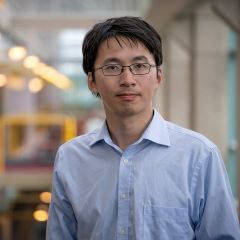
NOTE: due to load constraints, I can only start new research projects with students with IMO scores at least 30, or IOI rank top 9, or consistently reproducible performances on equivalents of the 2018-2025 versions of these tests. This is entirely due to limits of my bandwidth and resources, and is only specific to my group.
My research is broadly in the design and analysis of fast algorithms for solving fundamental computational problems, including graph algorithms, dynamic algorithms, and linear algebraic algorithms. My representative results include linear systems solvers, max-flow/min-cut algorithms, and time/space efficient data structures for matchings, resistances, and matrices. I teach courses on algorithms and data structures, supervise research projects at all levels, and am also extensively involved with organizations of programming competitions.
I was an assistant, then associate, professor at Georgia Tech from 2015 to 2021, and was an associate professor at the University of Waterloo from 2021 to 2023. Prior to that, I received my BMath from Waterloo, PhD from CMU, and was a postdoc at MIT. I have received the NSF Career Award, the 2011 Microsoft Research PhD Fellowship, the 2013 CMU SCS Distinguished Dissertation Award, the 2021 SODA Best Paper Award, and the 2022 FOCS Best Paper Award. When not thinking about problems, I enjoy biking, baseball, swimming, road trips, and flight simulators.