:: EXPERIENCE ::
Research Staff Member, IBM TJ Watson Research Center, Yorktown Heights, NY (September 2016 ~ present)
:: Education ::
Carnegie Mellon University, Pittsburgh, PA (August 2010 ~ May 2016)
Advisor: Prof. Brad A. Myers
Ph.D., Human-Computer Interaction (2016). Link to my PhD thesis
M.S., Human-Computer Interaction (2013)
National Taiwan University, Taipei, Taiwan (September 2005 ~ June 2009)
Advisor: Prof. Hao-Hua Chu
B.S., Computer Science and Information Engineering
:: Publications ::
conference papers
Kerry Shih-Ping Chang and Brad A. Myers. "Using and Exploring Hirarchical Data in Spreadsheets",
Proceedings ACM CHI'16. San Jose, CA, May 7-12, 2016. pp. 2497-2507.
[acm] [local]
Kerry Shih-Ping Chang and Brad A. Myers. "A Spreadsheet Model for Handling Streaming Data",
Proceedings ACM CHI'15. Seoul, South Korea, April 18-23, 2015. pp. 3399-3402.
[acm]
Kerry Shih-Ping Chang and Brad A. Myers. "Creating Interactive Web Data Applications with Spreadsheets",
Proceedings ACM UIST'2014. Honolulu, HI, October 5-8. pp. 87-96.
[acm]
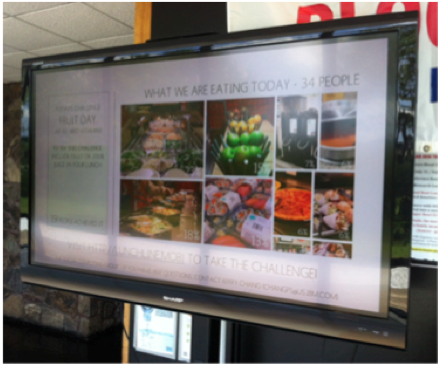
Kerry Shih-Ping Chang, Catalina M. Danis and Robert G. Farrell. "Lunch Line: Using Public Displays and Mobile Devices to Encourage Healthy Eating in an Organization",
Proceedings ACM UbiComp'2014. Seattle, WA, September 13-17, 2014. pp. 823-834.
[acm]
Kerry Shih-Ping Chang and Brad A. Myers. "A Spreadsheet Model for Using Web Service Data",
Proceedings IEEE VL/HCC'2014. Melbourne, Australia, July 28 - August 1, 2014. pp. 169-176.
[ieee] [local]
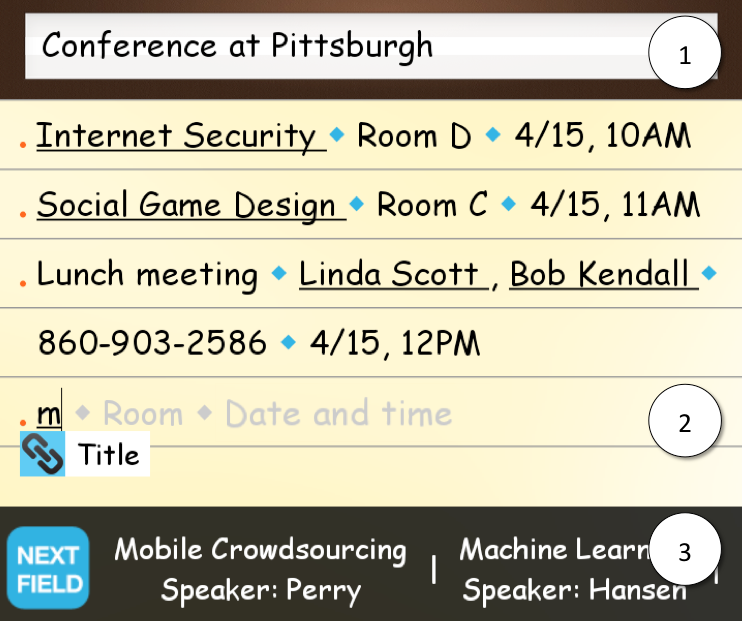
Kerry Shih-Ping Chang, Brad A. Myers, Gene M. Cahill, Soumya Simanta, Edwin Morris and Grace Lewis. "Improving Structured Data Entry on Mobile Devices",
Proceedings ACM UIST'2013. St Andrews, UK, Oct 8-11, 2013. pp. 75-84.
[acm] [local]
Kerry Shih-Ping Chang, Brad A. Myers, Gene M. Cahill, Soumya Simanta, Edwin Morris and Grace Lewis. "A Plug-in Architecture for Connecting to New Data Sources on Mobile Devices",
Proceedings IEEE VL/HCC'2013. San Jose, CA, Sep 15-19, 2013. pp 51-58.
[ieee] [local]
Kerry Shih-Ping Chang and Brad A. Myers. "WebCrystal: Understanding and Reusing Examples in Web Design",
Proceedings ACM CHI'2012. Austin, TX, May 5-10, 2012. pp.3205-3214.
[acm]
Meng-Chieh Chiu,
Shih-Ping Chang, Yu-Chen Chang, Hao-hua Chu, Cheryl Chia-Hui Chen, Fei-Hsiu Hsiao, Ju-Chun Ko, "Playful Bottle: a Mobile Social Persuasion System to Motivate Healthy Water Intake",
Proceedings ACM UBICOMP'2009. Orlando, FL, Sep.30 - Oct.3, 2009. pp. 185-194.
[acm]
journal papers
Kerry Shih-Ping Chang and Brad A, Myers, “Gneiss: spreadsheet programming using structured web service data”, Elsevier Journal of Visual Languages and Computing (JVLC), August 2016
[ScienceDirect]
Meng-Chieh Chiu, Cheryl Chia-Hui Chen,
Shih-Ping Chang, Hao-Hua Chu, Charlotte Wang, Fei-Hsiu Hsiao, Polly Huang, “Motivating the Motivators: Lessons Learned from the Design and Evaluation of a Social Persuasion System”, Elsevier Pervasive and Mobile Computing (PMC), Volume 10, Part B, February 2014, pp. 203–221.
[ScienceDirect] [acm]
workshop papers
Kerry Shih-Ping Chang and Brad A. Myers. "A Spreadsheet Tool for Creating Web Applications Using Online Data", CHI'2015
Workshop on End User Development in the Internet of Things Era, April 19, 2015, Seoul, Korea.
[local]
Kerry Shih-Ping Chang, Brad A. Myers, Gene M. Cahill, Soumya Simanta, Edwin Morris and Grace Lewis. "Listpad: Creating Customized Structured Data on Mobile Devices", CHI'2013
Workshop on Grand Challenges in Text Entry, April 28, 2013, Paris, France.
[local]