-
FIRE (Federation of Intelligent Robotic Explorers)
-
DIRA (Distributed Robot Architectures)
The primary objective of this project is to develop fundamental
capabilities that enable multiple, distributed, heterogeneous robots to
coordinate tasks that cannot be accomplished by the robots
individually. The basic concept is to enable individual robots to act
independently, while still allowing for tight, precise coordination when
necessary. Individual robots will be highly autonomous, yet will be able to
synchronize their behaviors, negotiate with one another to perform tasks,
and "advertise" their capabilities. The main technical challenge of the
project is to develop an architectural framework that permits a high degree
of autonomy for each individual robot, while providing a coordination
structure that enables the group to act as a unified team. Current
research is focusing on
distributed visual servoing using an overhead crane
and a mobile robot with stereo vision.
Co-investigators are Sanjiv Singh and David Kortenkamp at NASA Johnson.
This work is supported by NASA.
- Planetary Rovers:
We have developed several rovers
(Ratler,
Nomad, and
Bullwinkle)
that can navigate autonomously on Lunar- and Mars-relevant terrain.
Nomad travelled over 200 kilometers in the
Atacama desert of Chile, and was used in Antarctica
to find meteorites autonomously. Bullwinkle navigates Mars-like
terrain using stereo vision. It's software is currently being ported to a
prototype of the
next generation Mars Rover at JPL. Research focus includes
stereo perception, navigation planning, safeguarding, long-term
reliability, and position estimation.
Co-investigators are Red Whittaker, Dimi Apstoloupolos, Sanjiv Singh and
Tony Stentz. This work is supported by NASA.
-
Mercator (Multi-Robot Mapping and Exploration).
This project is concerned with the control and tasking of multiple
heterogeneous robots, each with fundamental sensing, navigation and
locomotion capabilities. It utilizes a diverse team of robots to accomplish
group-oriented tasks including map building, reconnaissance, surveillance,
and the establishment of an adaptive point-to-point communications network.
Co-investigators are Sebastian Thrun and Pradeep Khosla. This work is
supported by DARPA.
-
Formal Verification of Autonomous Systems.
We are developing tools and techniques to enable engineers to use formal
methods more easily in the process of designing and implementing autonomous
systems. The basic idea is to provide translators that can autonomously
convert specialized representation used in autonomous systems into
SMV, a
formal model-checking language, verify the resulting models, and then
translate any counter-examples back into the original representation
language. The research also involves developing classes of properties that
are useful to verify, automatic explanation and visualization of
counter-examples, and advanced model-checking techniques that are relevant
to verification of autonomous systems. To date, we have investigated these
issues using the
Livingstone
model-based fault diagnosis system (developed
at NASA Ames) and
TDL, a language for specifying task-level control
strategies for concurrent, distributed systems.
Co-investigator is Charles Pecheur at NASA Ames. This work is supported
by NASA.
We have a new, related project in formal verification tools for embedded
systems, supported by ARO. Click here for a description of the Specification and Verification
Center, its members, and the research we are persuing.
-
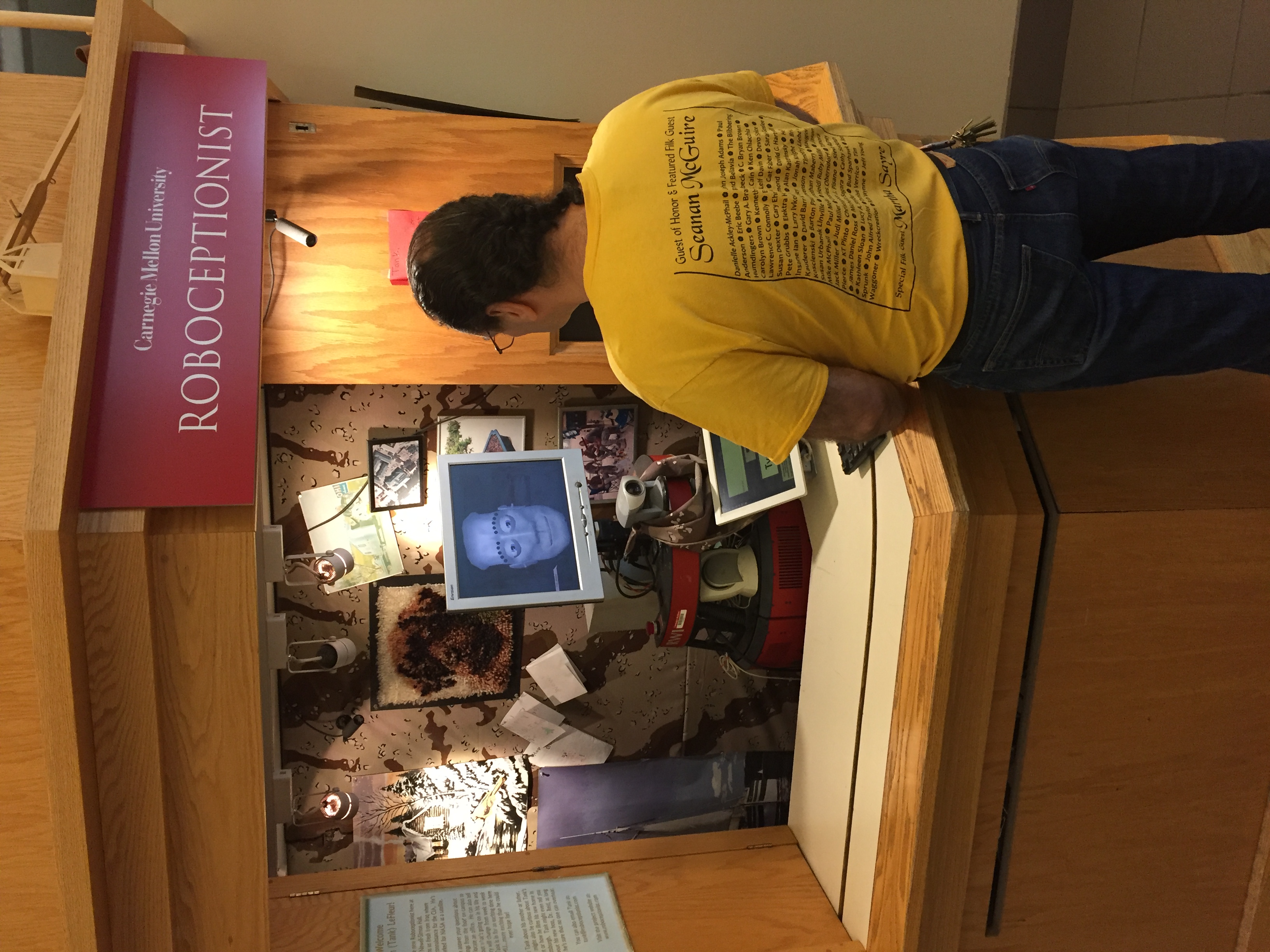
Social Robot Project.
The goal here is to make robots more useful and acceptable by enabling them
to interact with humans using social rules and conventions. This includes
such rules as how to pass people in hallways in a socially acceptable
manner, ride in elevators, and how to
enter and wait in line. In
conjunction with members of the Drama department, we are starting a project
to give a robot a personality, and have it converse with people. The goal
is to develop a robot that can escort visitors around
Newell-Simon Hall and
provide useful information naturally and pleasantly.
This work is currently supported internally by the
Robotics Institute.
- Architectures for Autonomy.
We have developed several architectures for aiding in design,
implementation, and execution of the robot systems described above. The
work is described in more detail on the Research
Interests page. In particular, we have developed:
- TCA (Task Control
Architecture)
- TDL (Task Description Language)
- IPC
(Inter-Process Communication Package)