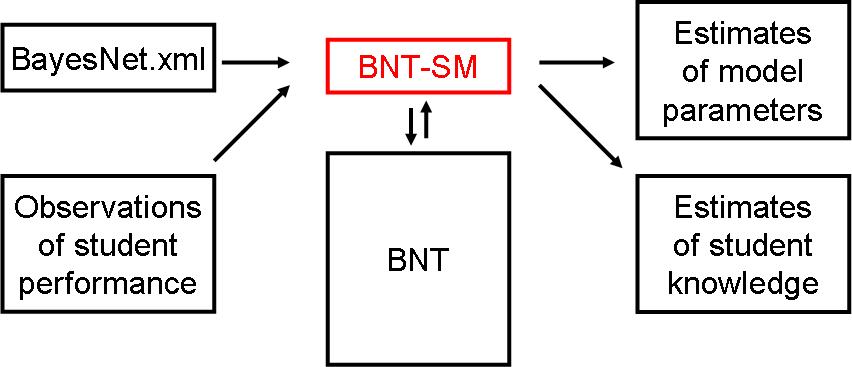
What is BNT-SM?

Bayes Net Toolbox for Student Modeling (BNT-SM) is an effort to facilitate the use of dynamic Bayes nets in the student modeling community. Dynamic Bayes Nets (DBNs) provide a powerful way to represent and reason about uncertainty in time series data, and are therefore well-suited to model a student's changing knowledge state during skill acquisition. Many general-purpose Bayes net packages have been implemented and distributed; however, constructing DBNs often involves complicated coding effort. To address this issue, we extend the popular Bayes Net Toolbox (Murphy, 1998) and tailor BNT-SM for the student modeling community.

BNT-SM as a black box

BNT-SM inputs a data set and a compact XML specification of a Bayes net model hypothesized by a researcher to describe causal relationships among student knowledge and observed behavior. BNT-SM generates and executes the code to train and test the model using the Bayes Net Toolbox. BNT-SM allows researchers to easily explore different hypothesis with respect to the knowledge representation in a student model. For example, by varying the graphical structure of a Bayesian network, we examined how tutoring intervention can affect students' knowledge state - whether the intervention is likely to scaffold or to help students to learn.

How to download and use BNT-SM?

BNT-SM is implemented in Matlab, so you need to have Matlab installed and running. Commercial and student license of Matlab can be purchased from Mathworks. By the way, for those of you who are not familiar with Matlab, Mark S. Gockenbach has an excellent, introductory tutorial to Matlab.

Before we download BNT-SM, we like to thank Kevin Murphy for his kindness in distributing Bayes Net Toolkit (BNT), which BNT-SM based and heavily depended on. For those of you who are proficient in coding and would like to go to the low level BNT code, BNT can be downloaded from Source Forge. Kevin Murphy also has a nice tutorial to BNT and Bayes nets in general.

BNT-SM can be downloaded from here.

Now, with BNT-SM downloaded and extracted, launch Matlab and do

>> cd src
>> setup
>> cd ../model/kt
>> [property evidence hash_bnet] = RunBnet('property.xml');

The RunBnet function first constructs the Bayes net specified in the property_xml file and trains the Bays nets using the training data set specified in the property_xml file. Then, it will extract model parameters and output to the param_table specified in property_xml. Finally, the RunBnet function will perform inference on hidden nodes and output to the inference_result specified in property_xml.

A Walk-through Example of modeling Knowledge Tracing with BNT-SM

Knowledge Tracing (KT) [2] is an established technique for student modeling and was first used in the ACT Programming Languages Tutor [2]. The goal of KT is to estimate the student’s knowledge from his or her observed actions. At each successive opportunity to apply a skill, KT updates its estimated probability that the student knows the skill, based on the skill-specific learning and performance parameters and the observed student performance (evidence). Reye [6] showed that KT is special case of a DBN which assumes parameters do not change across time slices. More specifically, the conditional independence graph of KT can be drawn as Figure 2. (We rename the original KT variables L0 and t as already know and learn for consistent naming with other sections.)
Knowledge Tracing

In the following sections, we will briefly go over the format of the input and output files. There are additional details in the file README.txt at the top level directory in the package.

property_xml

<?xml version="1.0"?>

<property>

        <input>
                <evidence_train>evidence.train.xls</evidence_train>
                <evidence_test>evidence.test.xls</evidence_test>
        </input>

        <inference>fast</inference>

        <output>
                <param_table>param_table.xls</param_table>
                <inference_result>inference_result.xls</inference_result>
                <inference_result_header>inference_result_header.xls</inference_result_header>
                <inference_is_prior>yes</inference_is_prior>
                <log>log.txt</log>
        </output>

        <structure>
                <var>F = 1; T = 2;</var>

                <nodes>
                        <node>
                                <id>1</id>
                                <name>knowledge</name>
                                <type>discrete</type>
                                <values>2</values>
                                <latent>yes</latent>
                                <field>knowledge</field>
                                <within>
                                        <transition>asr_accept</transition>
                                </within>
                                <between>
                                        <transition>knowledge</transition>
                                </between>
                        </node>

                        <node>
                                <id>2</id>
                                <name>asr_accept</name>
                                <type>discrete</type>
                                <values>2</values>
                                <latent>no</latent>
                                <field>asr_accept</field>
                                <within></within>
                                <between></between>
                        </node>
                </nodes>

                <eclasses>
                        <eclass>
                                <id>1</id>
                                <formula>P1(knowledge)</formula>
                                <type>discrete</type>
                                <clamp>no</clamp>
                                <cpd>
                                        <eq>P1(T)</eq><init>0.68</init><param>L0</param>
                                        <eq>P1(F)</eq><init>1-P1(T)</init><param>null</param>
                                </cpd>
                                <dirichlet>
                                        <eq>P1_dir(T)</eq><init>6</init>
                                        <eq>P1_dir(F)</eq><init>9</init>
                                </dirichlet>
                        </eclass>

                        <eclass>
                                <id>2</id>
                                <formula>P2(asr_accept|knowledge)</formula>
                                <type>discrete</type>
                                <clamp>no</clamp>
                                <cpd>
                                        <eq>P2(T|F)</eq><init>0.64</init><param>guess</param>
                                        <eq>P2(F|T)</eq><init>0.07</init><param>slip</param>
                                        <eq>P2(F|F)</eq><init>1-P2(T|F)</init><param>null</param>
                                        <eq>P2(T|T)</eq><init>1-P2(F|T)</init><param>null</param>
                                </cpd>
                                <dirichlet>
                                        <eq>P2_dir(T|F)</eq><init>19</init>
                                        <eq>P2_dir(F|T)</eq><init>1</init>
                                        <eq>P2_dir(F|F)</eq><init>9</init>
                                        <eq>P2_dir(T|T)</eq><init>15</init>
                                </dirichlet>
                        </eclass>

                        <eclass>
                                <id>3</id>
                                <formula>P3(knowledge|knowledge)</formula>
                                <type>discrete</type>
                                <clamp>no</clamp>
                                <cpd>
                                        <eq>P3(T|F)</eq><init>0.14</init><param>t</param>
                                        <eq>P3(F|T)</eq><init>0.00</init><param>forget</param>
                                        <eq>P3(F|F)</eq><init>1-P3(T|F)</init><param>null</param>
                                        <eq>P3(T|T)</eq><init>1-P3(F|T)</init><param>null</param>
                                </cpd>
                                <dirichlet>
                                        <eq>P3_dir(T|F)</eq><init>2</init>
                                        <eq>P3_dir(F|T)</eq><init>0</init>
                                        <eq>P3_dir(F|F)</eq><init>9</init>
                                        <eq>P3_dir(T|T)</eq><init>0</init>
                                </dirichlet>
                        </eclass>
                </eclasses>
        </structure>
</property>

evidence.xls

usermachine_nameutterance_start_timeutterance_smstarget_word_numberskillhelpknowledgecorrecttranscript_keytrn_correctasr_acceptconfidence_scoreasr_confidence
fBS7-7-1990-02-03LISTEN01-308-042000-05-12 17:52:276408WORLD1NULLNULLNULLNULL20.06687631
fDL7-5-1993-11-28LISTEN01-334-042004-10-13 13:56:4942113WORLD2NULLNULLNULLNULL20.04305811

param_table.xls

skillnum_usersnum_casesllL1guesssliptforget
skill_HELLO1423-3.6092970.7448550.7214320.0000050.9825170.000001
skill_WORLD46218-90.1775050.6953660.6341240.1136120.2560710.000001

inference_result.xls

usermachine_nameutterance_start_timeutterance_smstarget_word_numberskillhelpknowledgecorrecttranscript_keytrn_correctasr_acceptconfidence_scoreasr_confidence
fCA8-5-1994-06-27LISTEN01-302-042004-11-09 11:25:242181HELLO10.801846NULLNULLNULL20.1247511
fCA7-5-1994-06-27LISTEN01-315-042005-01-24 11:33:124681HELLO10.997498NULLNULLNULL20.07851521

Additional Output

For efficiency/debug purposes, we have also output the following files for you convenience:

Project Listen

Training a Student Model to be used in the Reading Tutor

  1. Specify the Bayes nets in the property_xml file.
  2. Provide the data.
  3. Execute RunBnet.m
  4. Retrieve the model parameters from the param_table.
  5. Derive the equation for student models.
  6. Inference pknow and pcorrect using the equations derived by hand.
  7. Verify the correctness of your derivation by comparing the pknow and pcorrect you derived to what BNT-SM estimated in inference_result.

Training the Out of Vocabulary (OOV) model