
Thursday, 21 January 1999
Senior Research Scientist
MIT Laboratory for Computer Science
Controlling the Internet (Is it out of Control?)
4:00 pm, Wean Hall 7500
3:45 pm - Refreshments Outside Wean Hall 7500
This talk will discuss how the Internet will change over the next decade as it evolves to support new sorts of applications (e.g Internet telephony) and service requirements (e.g delivering better service to users who pay more money).
The data delivery service provided by the Internet today is a very simple one, called best-effort (or "send it and pray"). This simple model has served the Internet very well, but there is a growing (though not universal) perception that this simple service may need to be augmented with more complex models that offer some sort of service guarantees. Research and standards-making over the last decade has focused on problems in this domain.
A number of approaches have been proposed to implement more advanced services in the Internet, differing in the degree of assurance to the user, the cost and complexity of implementation, and the potential to scale to the size of the Internet. While the specific services that have been proposed are interesting in their own right, the range of design approaches is equally interesting, because it illustrates different design philosoplies for the future of the Internet. The debates among the proponents of different approaches are sometimes of a religious nature, and make for interesting standards meetings.
This talk will describe the new services, the dueling design approaches, and comment on the increasing difficulty of evolving the Internet in today's reality.
SPEAKER BIO
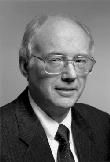
Dr. David Clark works at the MIT Laboratory for Computer Science, where he is
currently a Senior Research Scientist in charge of the Advanced Network
Architecture group. Since the mid-70s, Dr. Clark has been involved in the
development of the Internet; from 1981-1989 he acted as Chief Protocol
Architect in this development, and chaired the Internet Activities Board.
His current research area is protocols and architectures for very large and
very high speed networks. Recent activities include extensions to the
Internet to support real-time traffic, explicit allocation of service,
pricing and related economic issues, and new network technologies. He was a
major author of two studies by the Computer Science and Telecommunications
Board of the National Research Council on information infrastructure.
Dr. Clark graduated from Swarthmore College in 1966, and received his PhD from MIT in 1973. Dr. Clark is a fellow of the IEEE and a member of the ACM and the National Academy of Engineering. He is chairman of the Computer Science and Telecommunications Board of the National Research Council. He has received the ACM Sigcomm Award, the IEEE Award in International Communications and the IEEE Hamming Award for his work on the Internet.